New research has identified the oldest known rock art, dating back over **67,800 years**. This discovery, made in a cave on the Indonesian island of Sulawesi, provides significant insights into early human migrations, particularly the movements of **Homo sapiens** towards Australia. The findings were published in the journal **Nature**, marking a substantial advancement in our understanding of ancient artistic expression and human history.
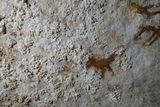
The rock art in question is a faint stencil of a human hand, found in the **Liang Metanduno cave**. This particular image is not just an artistic representation; it may also serve as a historical marker of a population that potentially embarked on one of the earliest migrations into Australia. The stencil predates previous rock art discoveries in the region by around **16,600 years**, reinforcing the importance of Sulawesi in the narrative of human evolution.
Significance of Sulawesi in Human History
According to study author **Maxime Aubert** from the **Griffith Centre for Social and Cultural Research**, this discovery highlights Sulawesi as a critical site for one of the world’s richest artistic cultures. Aubert stated, “It is now evident from our new phase of research that Sulawesi was home to one of the world’s richest and most longstanding artistic cultures,” which has roots dating back to the earliest human habitation on the island.
The research team also examined a number of other ancient rock art pieces in Sulawesi, revealing a series of stencils, including those resembling claw-like hands. Utilizing advanced dating techniques such as uranium-series dating, they established that the stencil was created approximately **67,800 years ago** by an artist likely linked to the ancestors of modern Aboriginal Australians.
**Adhi Agus Oktaviana**, a co-author from Indonesia’s **National Research and Innovation Agency**, remarked, “It is very likely that the people who made these paintings in Sulawesi were part of the broader population that would later spread through the region and ultimately reach Australia.” This assertion supports the theory that the ancestors of the First Australians arrived in **Sahul**—the paleocontinent that encompassed Australia, New Guinea, and Tasmania—by **65,000 years ago**.
Insights into Migration Patterns
Previous research had proposed two timelines for the arrival of **Homo sapiens** in Sahul: the “long chronology” around **65,000 years ago**, and the “short chronology” at approximately **50,000 years ago**. The migration routes were theorized to have been either northern or southern, with the northern route passing through Sulawesi.
The study authors noted that the Liang Metanduno cave also contains younger artworks, suggesting that the area was occupied for a significant period, potentially spanning over **35,000 years**. **Renaud Joannes-Boyau**, another study author from the **Geoarchaeology and Archaeometry Research Group** at **Southern Cross University**, stated, “With the dating of this extremely ancient rock art in Sulawesi, we now have the oldest direct evidence for the presence of modern humans along this northern migration corridor into Sahul.”
Looking ahead, the research team intends to expand their exploration of human art and migration patterns further along the northern route into Sahul. Aubert emphasized the archaeological importance of the many Indonesian islands between Sulawesi and New Guinea, identifying them as potential sites for future investigation.
The implications of these findings are profound, not only in understanding the migration of early humans but also in appreciating the rich cultural heritage that they left behind. As research continues, these ancient artworks serve as a reminder of the complex journey of our ancestors and their lasting impact on history.