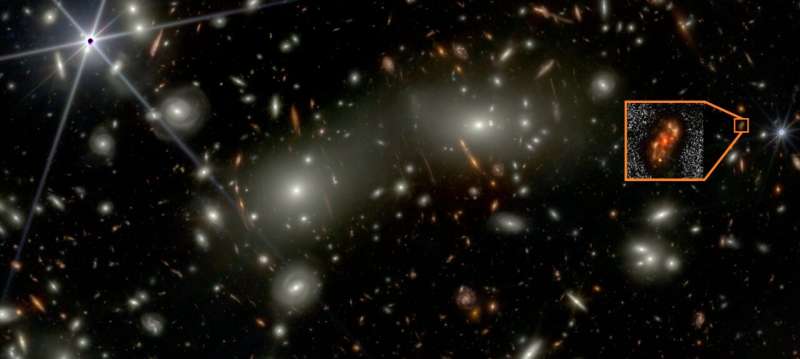
A team of astronomers from India has identified a remarkably well-structured spiral galaxy, named Alaknanda, that dates back to just 1.5 billion years after the Big Bang. This discovery, made using NASA’s James Webb Space Telescope (JWST), challenges existing theories about galaxy formation and evolution. The findings were published on December 2, 2025, in the journal Astronomy & Astrophysics.
Alaknanda, resembling our own Milky Way, is notable for its mature spiral structure, which was previously thought to require billions of years to develop. Traditionally, astronomers believed that early galaxies would appear irregular and chaotic, rather than the organized spirals observed in the contemporary universe. This new discovery has been led by researchers Rashi Jain and Yogesh Wadadekar at the National Center for Radio Astrophysics of the Tata Institute of Fundamental Research in Pune, India.
Revolutionizing Understanding of Galaxy Formation
The existence of Alaknanda suggests that the processes driving galaxy formation—such as gas accretion and the settling into a rotating disk—might occur more efficiently than current models predict. With two prominent spiral arms extending approximately 30,000 light-years across, Alaknanda is producing stars at a remarkable rate, with a mass equivalent to 60 times that of the Sun. This stellar formation rate is about 20 times greater than that of the present-day Milky Way.
“Alaknanda has the structural maturity we associate with galaxies that are billions of years older,” Jain stated. “Finding such a well-organized spiral disk at this epoch tells us that the physical processes driving galaxy formation can operate far more efficiently than our current theoretical framework suggests.”
A Cosmic Lens Reveals New Insights
Alaknanda is located in the direction of Abell 2744, also known as Pandora’s Cluster. The immense gravitational forces of this galaxy cluster enhance and magnify light from background objects, a phenomenon known as gravitational lensing. This effect allowed JWST to capture detailed images of Alaknanda’s spiral structure.
The researchers analyzed images taken through 21 different filters, each revealing unique aspects of the galaxy’s light. This comprehensive data set provided precise estimates of Alaknanda’s distance, dust content, stellar population, and the speed of star formation over time.
As more evidence accumulates from JWST, it is becoming increasingly clear that the early universe was capable of complex galaxy assembly much earlier than previously thought. Alaknanda stands out as one of the most significant examples of a “grand-design” spiral galaxy at such an ancient epoch.
Wadadekar remarked, “Alaknanda reveals that the early universe was capable of far more rapid galaxy assembly than we anticipated. The ability of this galaxy to organize ten billion solar masses of stars into a spiral disk in a few hundred million years is extraordinarily fast by cosmic standards.”
Future research will focus on understanding the origins of Alaknanda’s spiral arms. One possibility is that the galaxy accumulated cold gas streams, enabling the formation of density waves that shaped its spiral structure. Another theory suggests that gravitational interactions with smaller companion galaxies may have played a role.
The implications of this discovery extend beyond astronomy, as it prompts a reevaluation of the cosmic timeline and how celestial bodies like galaxies and planets develop. If galaxies can mature as rapidly as Alaknanda suggests, the conditions for forming planets like Earth could have arisen much earlier than previously presumed.
As JWST continues its exploration of the universe, astronomers anticipate uncovering more galaxies akin to Alaknanda, each providing new insights into the dynamic and complex history of the cosmos. Alaknanda not only stands as evidence of the early universe’s capabilities but also as a prompt for scientists to reconsider established theories about galaxy formation and evolution.