An international team of astronomers has identified the first known runaway supermassive black hole, which appears to be speeding away from its home galaxy at an astonishing rate of 2.2 million miles per hour. This significant discovery was made using NASA’s James Webb Space Telescope, marking a notable advancement in our understanding of these enigmatic cosmic entities.
Supermassive black holes typically reside at the centers of galaxies, exerting immense gravitational forces that can consume anything that ventures too close, including light. Observations have confirmed the existence of such black holes across numerous galaxies, including our own, where the black hole is known as Sagittarius A*. The latest finding, however, presents a unique case in which a black hole is not only moving rapidly but is also effectively ejected from its original location.
Breakthrough Discovery in Cosmic Research
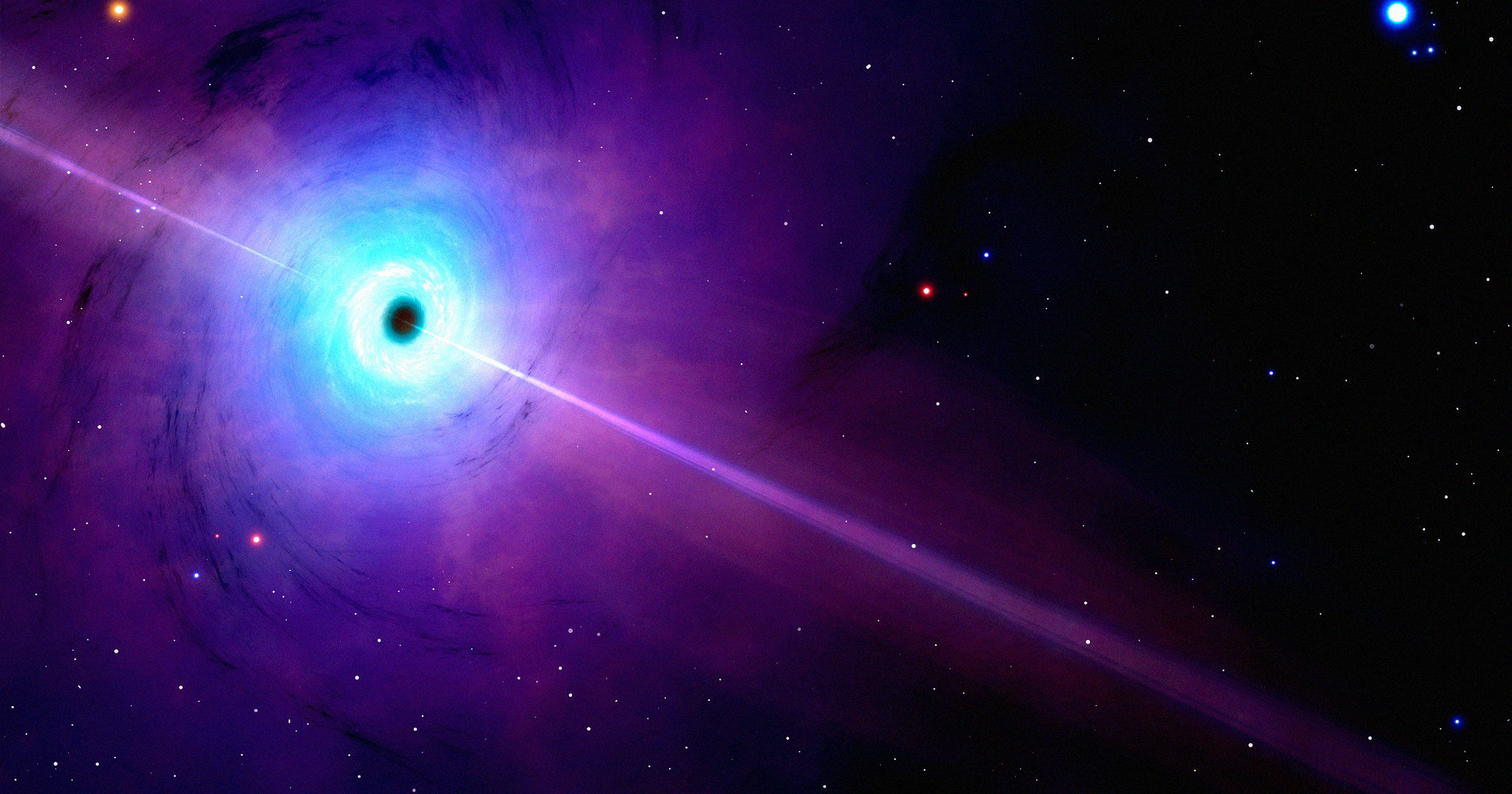
The runaway black hole, with a mass estimated at 10 million times that of the Sun, is currently traversing the region known as the “Cosmic Owl,” located around eight billion light-years from Earth. As it moves, the black hole displaces a massive “bow-shock” of material ahead of it and creates a striking tail of gas extending approximately 200,000 light-years behind.
According to Pieter van Dokkum, an astronomer at Yale University and lead author of a forthcoming paper detailing this discovery, the forces necessary to displace such a massive black hole are monumental. Van Dokkum described the phenomenon as “baffling,” emphasizing that while the existence of runaway black holes had been theorized, this is the first confirmed observation of one.
The researchers initially identified this intriguing object in 2023 using the Hubble Space Telescope. However, its event horizon, which absorbs light, made it challenging to detect while it traveled through the vastness of space. The James Webb Space Telescope’s advanced technology enabled astronomers to study the significant amount of gas being displaced by the black hole, facilitating a clearer understanding of its velocity and trajectory.
Understanding the Ejection Mechanism
The team posits several potential scenarios for how this supermassive black hole was ejected from its original galaxy. One possibility includes a collision with another black hole, which could have unleashed a massive wave of gravitational energy, propelling the black hole at high speeds. Another theory suggests that it may have interacted with a binary black hole system, leading to an unstable configuration described as a “three-body interaction.”
Van Dokkum believes that the most likely explanation involves a merger with a single black hole. He states, “Mergers happen often in the life of a galaxy; each galaxy with the size and mass of the Milky Way has experienced several during its lifetime.” This suggests that the formation of black hole binaries is a common occurrence.
The discovery of this runaway supermassive black hole presents an opportunity for astronomers to further investigate these cosmic phenomena. As Van Dokkum notes, “Now that we know how to look for them, we can find other examples.” By quantifying the number of black holes that escape their host galaxies, researchers aim to deepen their understanding of the dynamics at play within the universe.
This groundbreaking finding not only enhances our comprehension of supermassive black holes but also opens the door to new avenues of research in astrophysics, prompting further inquiry into the nature of these extraordinary celestial objects.