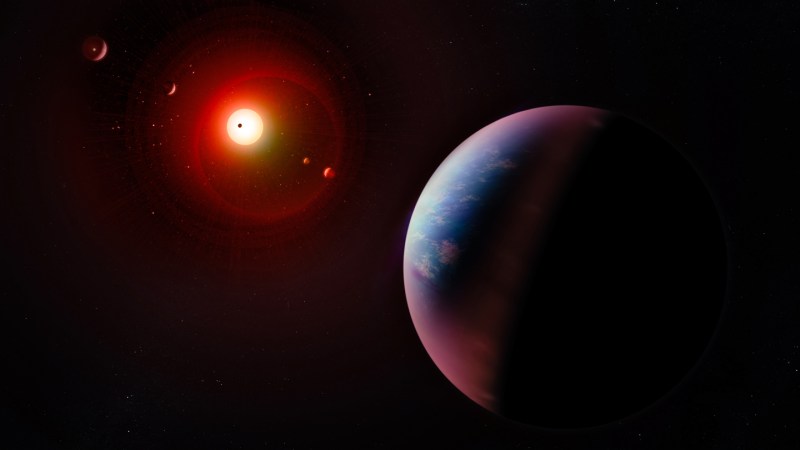
Astronomers have unveiled a significant discovery regarding the potential for life beyond Earth, identifying a “chemical Goldilocks zone” that may determine which planets can sustain life. This concept aligns with the traditional “Goldilocks zone,” where conditions allow for the presence of liquid water on a planet’s surface. The new findings, published on February 9, 2024, in Nature Astronomy, suggest that a narrow range of planetary conditions is essential for the availability of critical nutrients like phosphorus and nitrogen.
Researchers conducted simulations of tens of thousands of exoplanets to assess their nutrient profiles. The results indicate that fewer than 10% of these planets possess Earth-like levels of phosphorus and nitrogen, which are vital for life. According to planetary scientist Craig Walton from the University of Cambridge, while water is crucial for habitability, the presence of nutrients is equally important. He emphasized, “You need nutrients.” These elements are essential for various biological functions, including assembling cell walls, encoding genetic information, and constructing proteins.
The research highlights that even planets with adequate water and initial quantities of phosphorus and nitrogen may not be suitable for life. This limitation arises because these nutrients can sink into a planet’s core during formation. Unlike the mantle, which can exchange materials with the surface through volcanic activity, the core remains isolated. Astrophysicist Sebastiaan Krijt from the University of Exeter noted that any phosphorus or nitrogen that reaches the core is unavailable for life on the surface, stating, “It’s completely inaccessible to life.”
The ability of phosphorus and nitrogen to remain in the mantle depends on the level of reactable oxygen present. Laura Rogers, an astronomer at NOIRLab in Tucson, Arizona, explained that the abundance of oxygen influences how these nutrients interact with iron. When oxygen levels are high, phosphorus tends to stay in the mantle, while nitrogen binds to iron and sinks into the core. Conversely, lower oxygen levels lead to less phosphorus and more nitrogen remaining in the mantle. Walton described this scenario as a “push-pull situation,” where gaining one nutrient results in losing another.
The research team proposed a “chemical Goldilocks zone” where the right amount of oxygen would allow for both phosphorus and nitrogen to exist in sufficient quantities in a planet’s mantle. Their simulations, which factored in the observed chemistry of thousands of nearby stars, revealed that less than 10% of simulated planets had the optimal conditions for life-supporting nutrients.
The discovery raises important questions about the prevalence of habitable planets in the universe. Over 6,000 exoplanets have been confirmed to date, but the specific conditions necessary for life are complex. In addition to the requirement for liquid water, the availability of oxygen must also be precisely calibrated. Krijt remarked, “This forces us to reconsider how prevalent Earth-like planets are in the cosmos.”
The implications of these findings contribute to the ongoing discussion surrounding the Fermi Paradox, which questions why, despite the vastness of the universe, humanity has yet to find extraterrestrial life. With this new understanding of planetary conditions, scientists may gain further insights into the factors that influence the development of life beyond our planet.