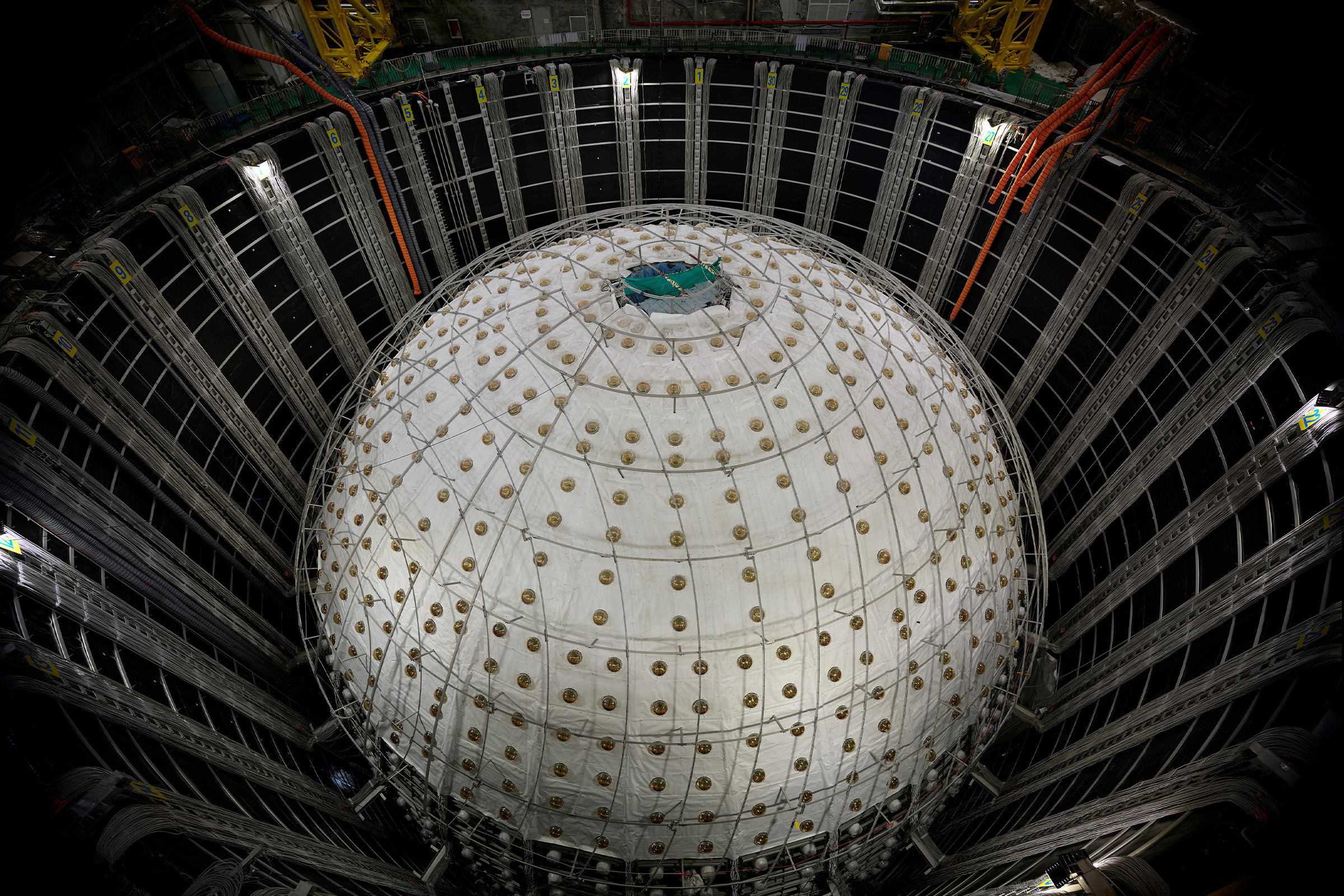
Scientists have made significant strides in the detection of elusive subatomic particles known as neutrinos through the newly operational Jiangmen Underground Neutrino Observatory (JUNO) in Kaiping, China. After ten years of construction, this massive, 20,000-tonne spherical detector aims to unlock the mysteries surrounding the mass ordering of neutrinos, which are theorized to be the most abundant particles in the universe.
Since beginning operations just 86 days ago, JUNO has already made noteworthy contributions to neutrino research, achieving a level of precision in measuring neutrino oscillation parameters that surpasses all previous experiments combined. This achievement has been highlighted in a recent press release from researchers at the University of Mainz in Germany, who are collaborating on the project.
Neutrinos, often referred to as “ghost particles,” have little mass and nearly no electrical charge, making them incredibly difficult to detect. For decades, scientists have grappled with various challenges, including a phenomenon known as “solar neutrino tension,” where early observations indicated a lower emission of neutrinos from the Sun than anticipated. The pioneering work at JUNO is expected to address these inconsistencies.
Breakthroughs in Precision Measurement
Early neutrino detectors were limited in their capability, only able to capture one type of neutrino. This led to the misconception that many neutrinos were vanishing during their transit. Subsequent research revealed that neutrinos can change forms, a process known as oscillation. JUNO’s advanced technology has now measured this oscillation with remarkable accuracy, confirming its operational readiness and potential to transform the field of particle physics.
“Achieving such precision within only two months of operation shows that JUNO is performing exactly as designed,” stated Yifang Wang, the project manager and spokesperson for JUNO. He emphasized that this level of accuracy positions JUNO to soon determine the neutrino mass ordering, test the three-flavor oscillation framework, and explore new physics beyond established theories.
The JUNO facility represents a significant international collaboration, involving over 700 researchers from 17 countries, including Italy, France, Russia, Germany, and the United States. The project has been funded with an investment exceeding $350 million, underscoring its importance to the global scientific community.
A New Era in Neutrino Research
JUNO’s early results suggest that it is on track to make groundbreaking discoveries in neutrino physics. By offering a more precise understanding of neutrino behavior, scientists hope to shed light on fundamental questions regarding the universe’s composition and the nature of matter itself.
As the observatory continues its work, the implications of its findings could extend beyond neutrino research, potentially influencing various fields within physics and enhancing our understanding of the universe. With ongoing advancements in technology and international collaboration, JUNO stands at the forefront of one of the most exciting frontiers in modern science.