Clemson University researchers are making significant strides in robotics, recently developing machines that can jump, swim, and crawl. Led by professor of mechanical engineering Phanindra Tallapragada, the team is now focusing on creating flying robots inspired by insect flight. This ambitious project aims to enhance the range and capabilities of robotic mobility.
In Tallapragada’s lab, robots are designed to mimic the movements of living creatures, showcasing advanced engineering principles. “A lot of robotics today is perceived as designing something with motors, microcontrollers, machine learning and AI,” Tallapragada explained. “I want to change that by coming up with these different kinds of mobility based on mathematics.”
The team has successfully harnessed the concept of centripetal force to enable their robots’ movements. This principle can be likened to a dryer spinning with wet clothes, which causes it to vibrate and leap. The same force allows the robots to perform various actions, from jumping and swimming to crawling. With this foundation, the researchers aim to develop robots that can fly.
Innovative Robotics in Action
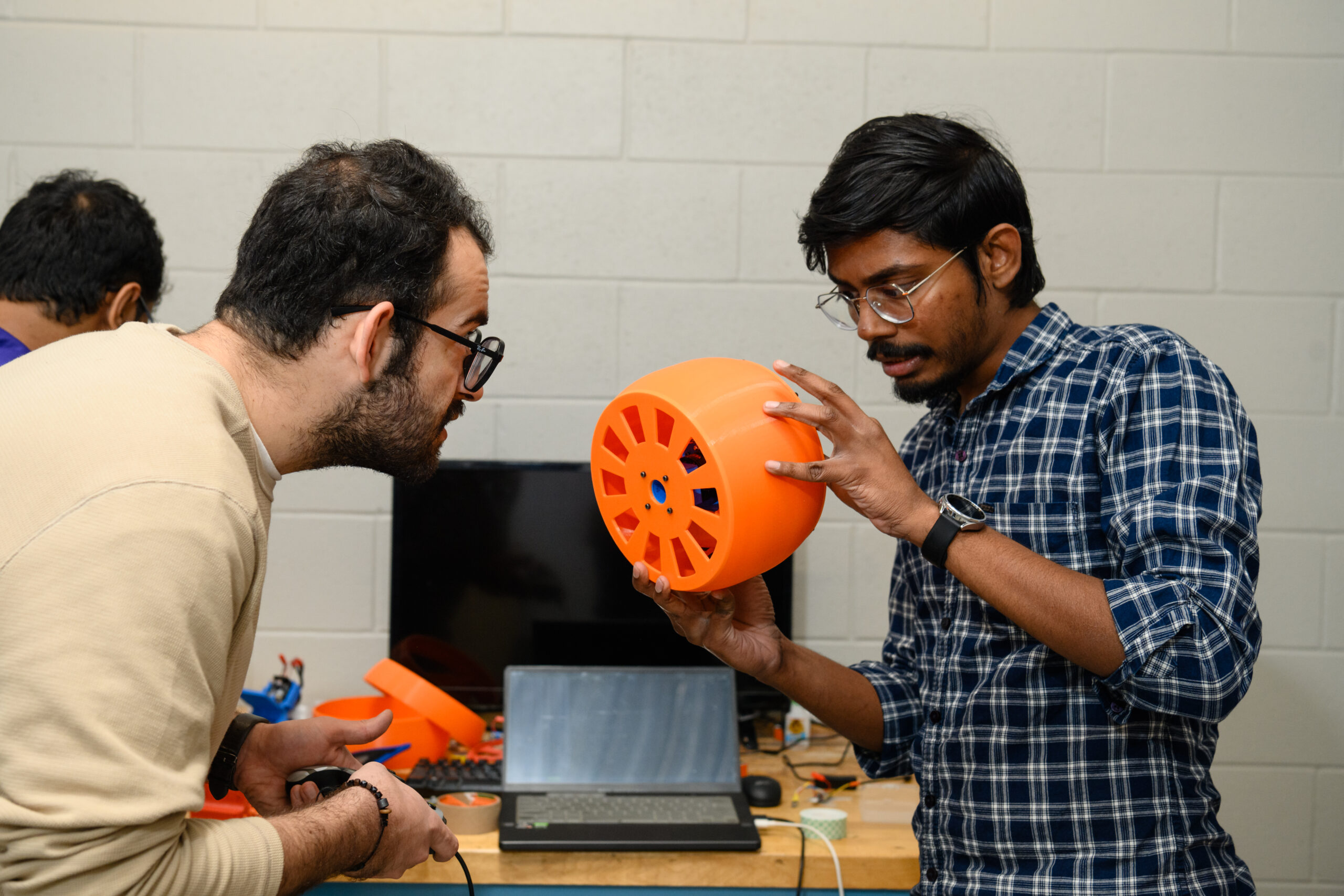
The robot collection includes notable examples of innovative design. The remote-controlled wheel, known as the Spin Gyro, utilizes an unbalanced mass that spins to create lift, enabling it to jump powerfully off the ground. This technology could potentially help robots traverse rocky or uneven terrains efficiently.
The fish-like robot operates on similar principles, using a spinning mass to propel its tail and navigate through water. This design allows for energy-efficient swimming, making it ideal for monitoring aquatic environments or collecting water samples without human intervention.
Another creation, the pipe robot, crawls through narrow spaces by employing a spinning mass that compresses and releases small bristles on its body. This method generates friction, propelling the robot forward. Capable of maneuvering through pipes as small as an inch, it could be instrumental in inspecting tight spaces and even pulling cables through complex networks.
Aiming for the Skies and Beyond
Tallapragada’s latest project aims to take robotic mobility to the next level by developing a small flying robot that mimics insect flight. The same centripetal force concepts are being adapted to create high-speed wing flapping, essential for achieving flight. This work is supported by a three-year grant from the National Science Foundation.
Looking ahead, Tallapragada envisions robots capable of exploring icy moons on other planets, where scientists suspect liquid water may exist beneath the surface. A versatile robot that can roll, jump, swim, and fly could navigate challenging environments, searching for signs of extraterrestrial life.
“I just like working on these new ideas that are very different from what others are doing,” Tallapragada noted. “Once they come into action, that motivates me to return to the whiteboard and develop more models.”
The advancements in Tallapragada’s lab provide students with unique opportunities to engage in cutting-edge research. Graduate student Prashanth Chivkula, who has continued work on the fish robot as a postdoctoral researcher, expressed his passion for robotics: “I want to be a roboticist, and that’s what motivates me every day—to make robots that do something useful in the world.”
Alexander Leonessa, chair of the Department of Mechanical Engineering, commended the team’s efforts, emphasizing Clemson’s commitment to enhancing student experiences and research profiles. “Projects like those in Dr. Tallapragada’s lab provide our students with an opportunity to innovate on the cutting-edge,” he said.
As the team continues to explore new possibilities in robotics, their innovative approach could redefine the future of this field, merging rigorous science with creativity and practical applications.