A recent study suggests that cosmic rays generated by nearby supernovae could provide crucial insights into the formation of Earth-like planets. The research, led by astrophysicist Ryo Sawada from the Institute for Cosmic Ray Research at the University of Tokyo, highlights the role of these high-energy particles in producing short-lived radioactive elements that may have influenced the early solar system.
For decades, scientists believed that the formation of rocky planets like Earth was significantly aided by short-lived radioactive elements, such as aluminum-26, delivered by a nearby supernova. This theory posited that a supernova had to explode at an ideal distance to enrich the solar system without destroying the fragile protoplanetary disk. Such a scenario implied that Earth’s formation relied on an improbable series of events.
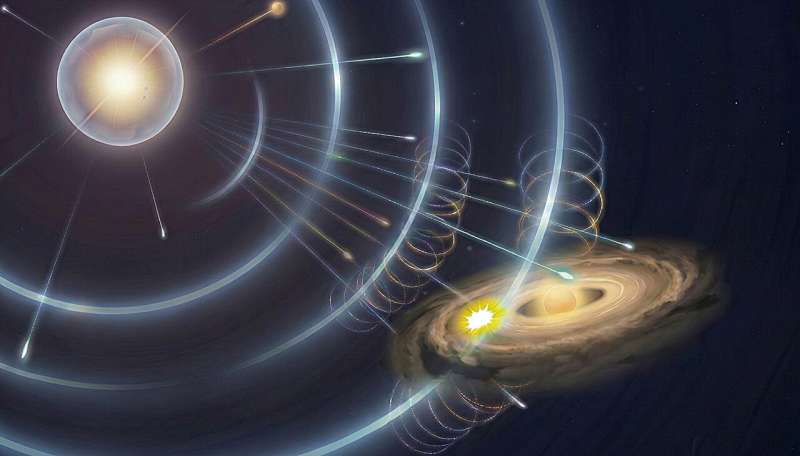
In addressing this, Sawada and his colleagues questioned whether the young solar system experienced more than just a singular event of supernova ejecta. They proposed that the solar system may have been immersed in what they termed a “cosmic-ray bath.” This idea shifts the focus from an extraordinary event requiring perfect timing to a more universal process.
Their findings, published on December 21, 2025, in the journal Science Advances, indicate that when cosmic rays interact with the protosolar disk, they can trigger nuclear reactions that naturally produce the necessary radioactive elements. The simulations revealed that such elements could be generated at distances of approximately one parsec from a supernova, a distance frequently observed in star clusters.
This new perspective suggests that rather than depending on a rare supernova event, the formation conditions for Earth-like planets could be common in environments where massive stars explode.
“If cosmic-ray baths are common in such environments, then the thermal histories that shaped Earth’s interior may be common as well,”
said Sawada, emphasizing the broader implications of their research.
The study points out that while the influence of supernovae is significant, many other factors also contribute to the potential habitability of planets, including the dynamics of star clusters and the lifespan of the protoplanetary disk. Thus, supernovae do not guarantee the emergence of habitable planets, but they open new avenues for understanding planetary formation.
Sawada’s work exemplifies the interconnectedness of astrophysical processes, demonstrating how phenomena typically studied in high-energy astrophysics are vital to questions in planetary science. This research encourages a re-evaluation of how astrophysical events interact with planetary formation, highlighting that sometimes, the key to understanding our origins lies in recognizing overlooked connections.
By integrating cosmic-ray physics with planetary science, this study not only sheds light on the formation of Earth-like planets but also enriches our understanding of the universe’s complexities and the conditions that foster planetary habitability.