Research from the University of Rochester reveals that Earth’s magnetic field has facilitated the transport of tiny particles from our atmosphere to the moon for billions of years. This process, which has been ongoing since the early formation of the solar system, suggests that the moon may serve as a historical archive of Earth’s atmospheric evolution and could potentially provide vital resources for future lunar expeditions.
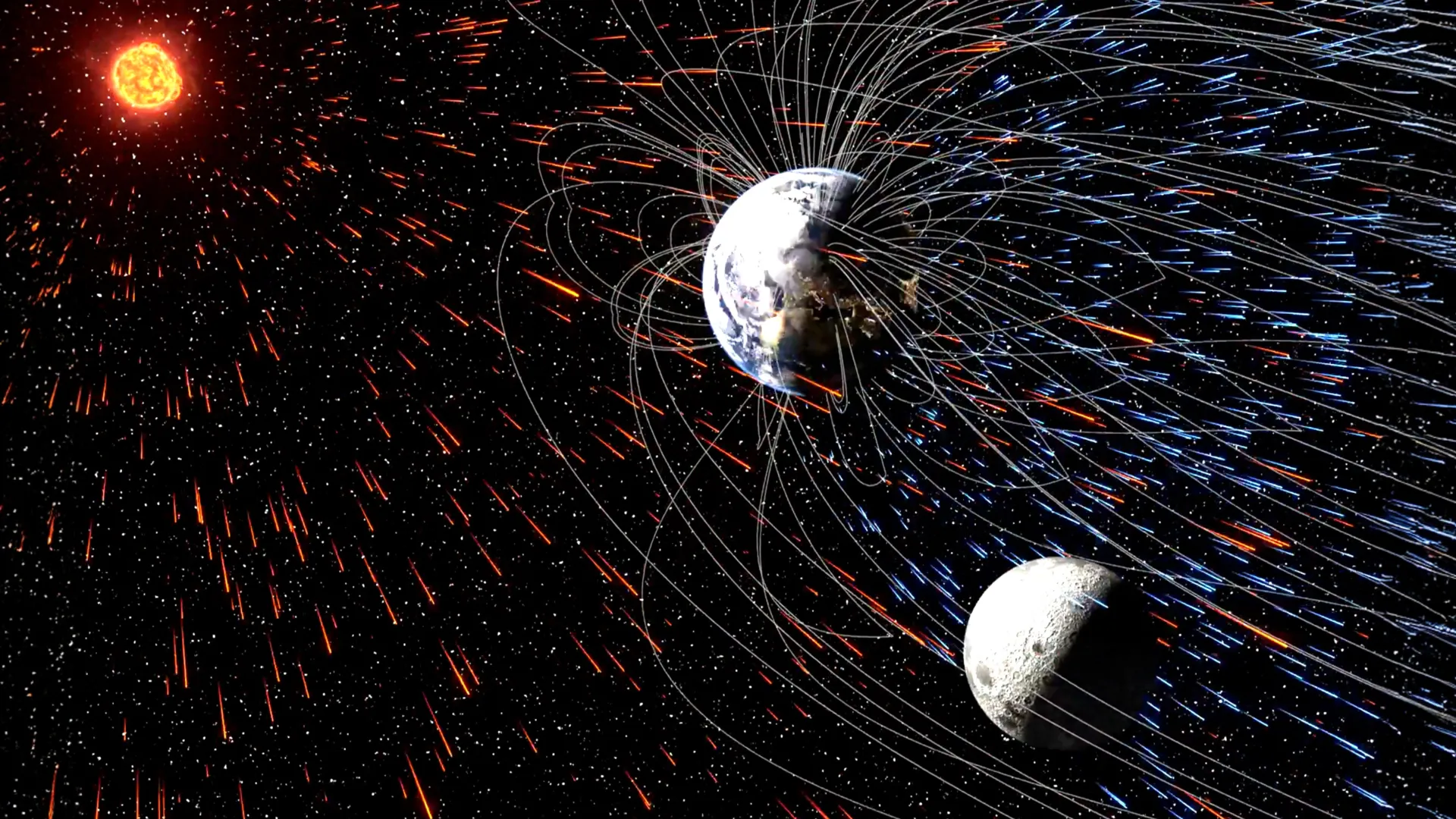
For a long time, scientists have puzzled over how atmospheric particles could travel such great distances to reach the moon. The study, published in Nature Communications Earth and Environment, indicates that rather than acting as a barrier, Earth’s magnetic field channels these particles along invisible lines towards the moon. This finding not only explains the presence of certain gases found in lunar soil samples collected during the Apollo missions but also opens up possibilities for lunar resource utilization in human exploration.
Understanding the Journey of Atmospheric Particles
According to the research led by Eric Blackman, a professor in the Department of Physics and Astronomy at the University of Rochester, the moon’s surface is not as barren as it seems. “By combining data from particles preserved in lunar soil with computational modeling of how solar wind interacts with Earth’s atmosphere, we can trace the history of Earth’s atmosphere and its magnetic field,” Blackman stated.
The study highlights that atmospheric particles, propelled by the solar wind, can be directed outward by the magnetic field. This magnetic shield has existed for billions of years, enabling a continuous movement of material from Earth to the moon. As particles escape from Earth’s upper atmosphere, they can follow magnetic field lines that extend into space, eventually intersecting the moon’s orbit.
The research team, including graduate student Shubhonkar Paramanick and professor John Tarduno, used advanced computer simulations to examine the transfer of particles under two conditions: one representing an early Earth with no magnetic field and a stronger solar wind, and another modeling present-day Earth with its robust magnetic field. The results showed that the modern scenario significantly enhances the transfer of particles to the moon.
Implications for Lunar Exploration
The findings suggest that lunar soil may preserve a long-term chemical record of Earth’s atmosphere. This archive could provide valuable insights into how Earth’s climate, oceans, and even life itself have evolved over billions of years. Furthermore, the steady influx of particles hints that the moon may contain more useful resources than previously believed.
Volatile elements such as water and nitrogen are essential for sustaining long-term human activity on the moon. By utilizing these materials, astronauts could reduce their reliance on Earth for supplies, making lunar exploration more feasible. Paramanick added, “Our study may also have broader implications for understanding early atmospheric escape on planets like Mars, which lacks a global magnetic field today but had one similar to Earth in the past.”
The research was funded in part by NASA and the National Science Foundation, underscoring the significance of this work in the context of future space exploration. As scientists continue to analyze lunar samples and study the interactions between solar wind and Earth’s atmosphere, the moon may reveal secrets that enhance our understanding of planetary evolution and habitability across the solar system.