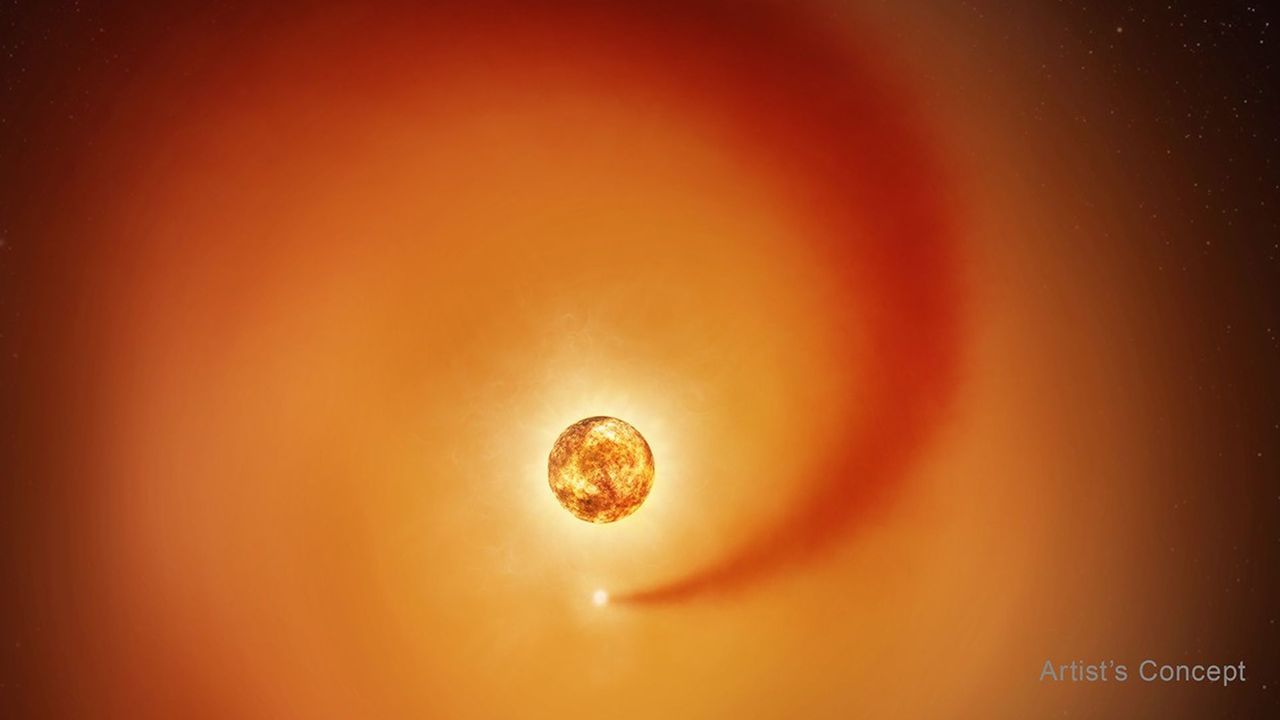
Astronomers have made significant strides in understanding the red supergiant star Betelgeuse, renowned for its brightness and peculiar dimming patterns. Recent observations from the Hubble Space Telescope and ground-based observatories have confirmed the existence of a companion star, named Siwarha, situated within Betelgeuse’s outer atmosphere. This discovery sheds light on the star’s unconventional behavior and evolution.
The findings were presented at the 247th meeting of the American Astronomical Society in Phoenix, Arizona, on January 5, 2024. Lead author Andrea Dupree, an astronomer at the Center for Astrophysics | Harvard & Smithsonian (CfA), emphasized the significance of this discovery. “With this new direct evidence, Betelgeuse gives us a front-row seat to watch how a giant star changes over time,” she stated. The research highlights how the presence of Siwarha affects Betelgeuse’s appearance, allowing scientists to gain insights into the processes involved in stellar evolution.
Researchers utilized data from both the Hubble Space Telescope and observatories such as the Fred Lawrence Whipple Observatory in Arizona and the Roque de Los Muchachos Observatory in the Canary Islands. They identified a distinct “wake” created by Siwarha, which manifests as a trail of denser material that interacts with the less dense gases surrounding Betelgeuse. This wake is particularly visible every six years when Siwarha passes between Betelgeuse and Earth, altering the spectrum of light emitted by the star’s atmosphere.
“It’s a bit like a boat moving through water. The companion star creates a ripple effect in Betelgeuse’s atmosphere that we can actually see in the data,” Dupree explained. The study marks the first time direct evidence of this wake has been observed, confirming the theory that Betelgeuse has a hidden companion star influencing its behavior.
The implications of this research extend beyond Betelgeuse. According to Dupree, understanding the wake and its effects will enhance knowledge of how massive stars evolve, shed material, and ultimately explode as supernovae. The next visibility of Siwarha is anticipated in 2027, prompting researchers to plan further observations to gather more data.
The new results will appear in The Astrophysical Journal, contributing to the growing body of knowledge surrounding Betelgeuse and its intriguing companion. As astronomers continue to explore the mysteries of the universe, discoveries like this offer invaluable insights into the life cycles of stars and the dynamics of our cosmos.