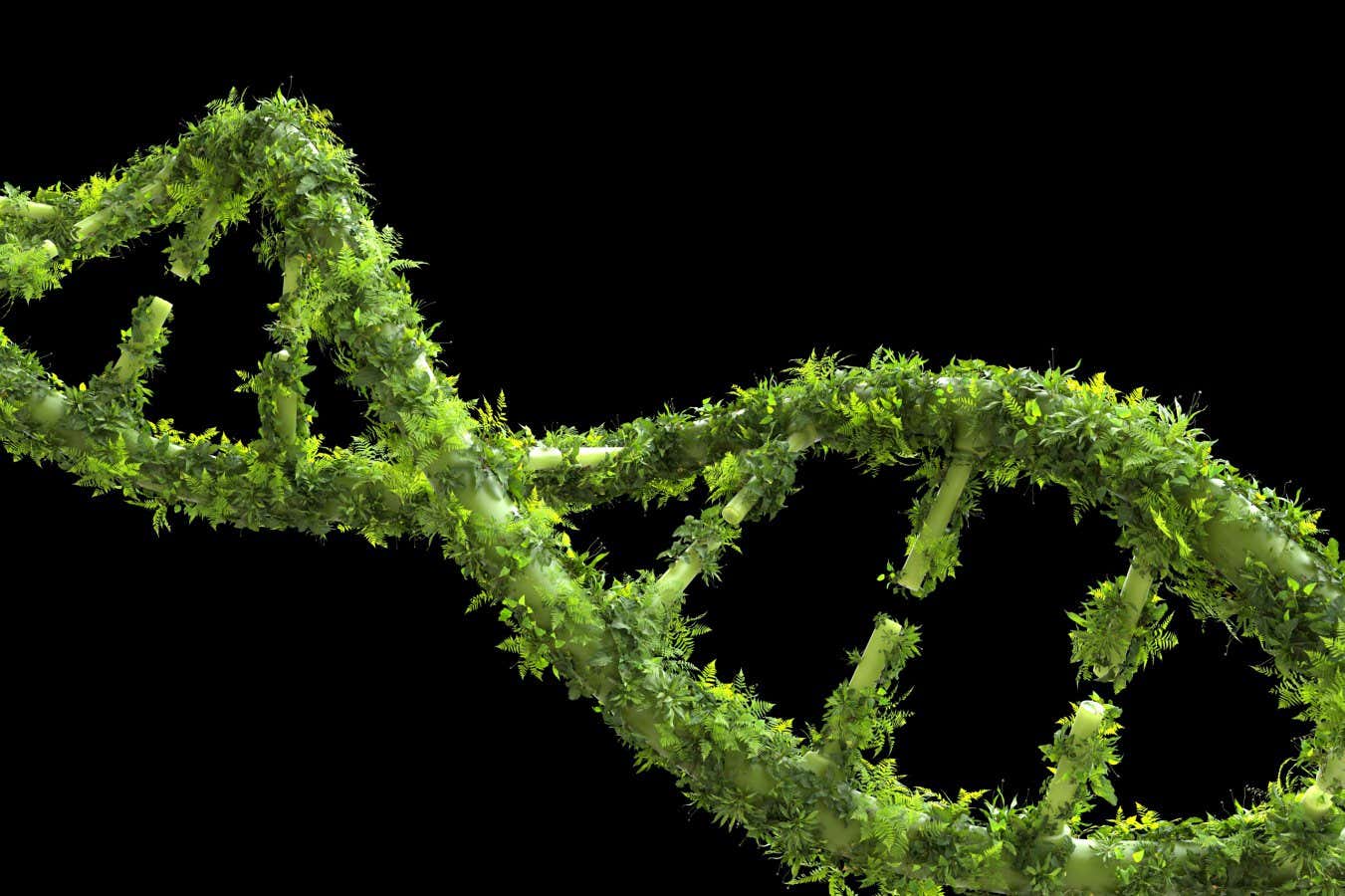
Researchers have made significant strides in understanding the role of non-coding DNA in the human genome by studying hybrid cells containing both human and plant DNA. This groundbreaking work, conducted at the University of Auckland, suggests that a substantial portion of our genome may be largely inactive or “junk,” a notion that has sparked considerable debate in the scientific community.
The study focuses on cells that incorporate DNA from the plant Arabidopsis thaliana, which contains approximately 35 million base pairs. The implications are profound, as the research indicates that much of the activity attributed to human DNA may not serve any functional purpose. According to Brett Adey, a lead researcher on the project, “a large amount can simply be explained by background noise,” aligning with the long-standing theory that much of the human genome is non-essential.
Understanding DNA’s role in protein synthesis is crucial. Originally, scientists believed that most DNA contained instructions for making proteins. However, it is now recognized that only about 1.2 percent of the human genome actually codes for proteins. This raises questions about the function of the remaining DNA and whether it plays any significant role in our biology.
Historically, the argument that non-coding DNA is mostly junk has been bolstered by various studies, including a 2011 analysis that found only about 5 percent of the genome was conserved across evolutionary time. This inconsistency in DNA size among species further supports the idea that much of the genome may lack essential function. For instance, the onion has five times more DNA than a human, and the lungfish possesses a staggering thirty times more.
Despite the evidence for junk DNA, a counterpoint emerged with the ENCODE project in 2012, which suggested that over 80 percent of the human genome is active in some form. This led to the concept of “dark DNA,” referring to non-coding regions that might have unknown but critical functions. In response to this, Sean Eddy from Harvard University proposed a radical experiment: introducing entirely random synthetic DNA into human cells to see if it would exhibit similar activity patterns.
The recent study by Adey and Austen Ganley took this idea further by using hybrid cells. After confirming that the plant DNA was effectively random, they measured the number of starting points for RNA production across the non-coding DNA. Surprisingly, they found that the plant DNA showed about 80 percent of the activity seen in human non-coding DNA. This suggests that much of the previously reported activity may be mere noise rather than indicative of actual function.
Chris Ponting from the University of Edinburgh commented on the findings, stating, “This is an excellent demonstration of how biology is, indeed, noisy.” He emphasized that the biochemical activities observed in the plant DNA do not confer any function on the human cells. Similarly, Dan Graur from the University of Houston remarked that the study reinforces the long-standing belief that most of the human genome is junk, dismissing the concept of dark DNA as unfounded.
The team has yet to explain the 25 percent increase in activity seen in human DNA compared to the plant DNA. While some of this activity might indicate functional roles, other explanations could also account for the discrepancy. As a next step, the researchers plan to employ machine learning techniques to differentiate between potentially meaningful activity and background noise.
Although this study has not yet been published, its implications for genetics and evolutionary biology could be substantial, reshaping our understanding of the human genome’s complexity. The ongoing debate over the nature of non-coding DNA continues, but this research provides compelling evidence that reaffirms the junk DNA hypothesis while simultaneously challenging existing assumptions about genomic function.