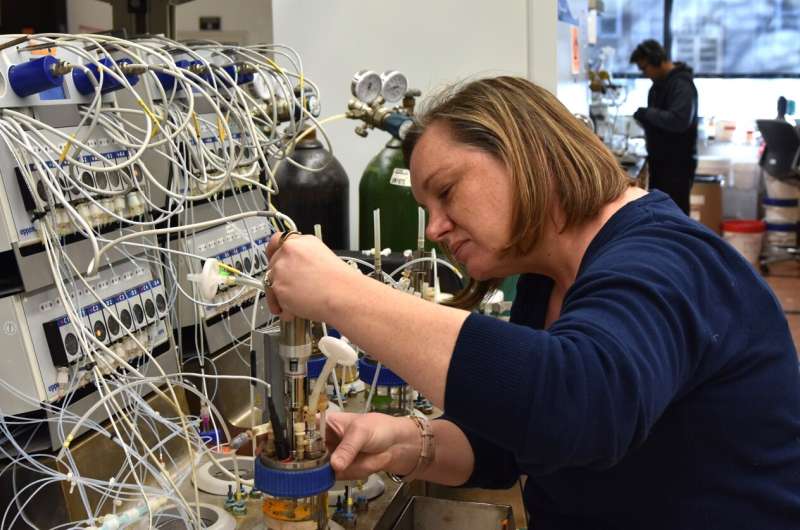
Using engineered yeast, researchers have discovered a cost-effective method to produce 3-hydroxypropanoic acid (3-HP), a crucial precursor for acrylic acid, from renewable plant materials. This innovation holds the potential to transform the production of everyday products such as disposable diapers, microplastics, and acrylic paints, making them more sustainable.
The study, conducted by scientists at the University of Illinois Urbana-Champaign and Penn State University, highlights the biomanufacturing process’s commercial viability. Traditionally, 3-HP is derived from petroleum through energy-intensive chemical synthesis. However, the newly developed method uses engineered microbes to ferment plant sugars into 3-HP, effectively offering a renewable alternative.
The research team, part of the Center for Advanced Bioenergy and Bioproducts Innovation (CABBI), published their findings in Nature Communications on January 9, 2026. They developed a high-yield strain of the yeast Issatchenkia orientalis specifically for 3-HP production. This approach not only enhances yield but also significantly reduces costs associated with traditional methods.
Huimin Zhao, a professor in the Department of Chemical and Biomolecular Engineering at Illinois and lead author of the study, stated, “The high-level production of this chemical from yeast can provide a pathway to acrylic acid production, significantly boosting the agricultural economy.” The commercial market for acrylic acid is substantial, valued at an estimated $20 billion with a global demand of around 6.6 million tons as of 2019.
While various companies, including industry giants like BASF and Cargill, have explored bio-based production of 3-HP, low yields and concentrations have hindered profitability. The CABBI team addressed these issues by selecting I. orientalis, a yeast that thrives in acidic conditions, simplifying the fermentation process compared to other organisms that require neutral pH environments.
The researchers implemented advanced metabolic engineering techniques to optimize 3-HP production. They identified the beta-alanine genetic pathway as an optimal target, ensuring higher theoretical yields with minimal oxygen requirements. Their efforts resulted in the integration of multiple copies of the enzyme PAND, which significantly increased production rates.
In laboratory-scale fermentations, the team achieved an impressive yield of 0.7 grams of 3-HP per gram of glucose consumed, equating to a conversion efficiency of 70%. Additionally, they recorded a titer of 92 grams of 3-HP per liter, surpassing previous benchmarks for engineered microbes.
Following these advancements, the team utilized BioSTEAM software to simulate a biomanufacturing facility capable of producing 3-HP and upgrading it to acrylic acid. Their techno-economic analysis confirmed the financial feasibility of this bio-based production method.
“This work establishes I. orientalis as a next-generation platform for cost-effective 3-HP production and paves the way toward industrial commercialization,” Zhao noted. The research team is now focused on scaling up the process and enhancing economic viability by integrating additional renewable feedstocks.
Simultaneously, other CABBI researchers are exploring additional applications for 3-HP. For instance, George Huber, a professor at the University of Wisconsin-Madison, is investigating the use of 3-HP broth to create malonic acid, an important chemical for producing vitamins, biodegradable plastics, and agrochemicals.
The findings from this study represent a significant step toward sustainable biomanufacturing, with the potential to reshape the production landscape for critical industrial chemicals.