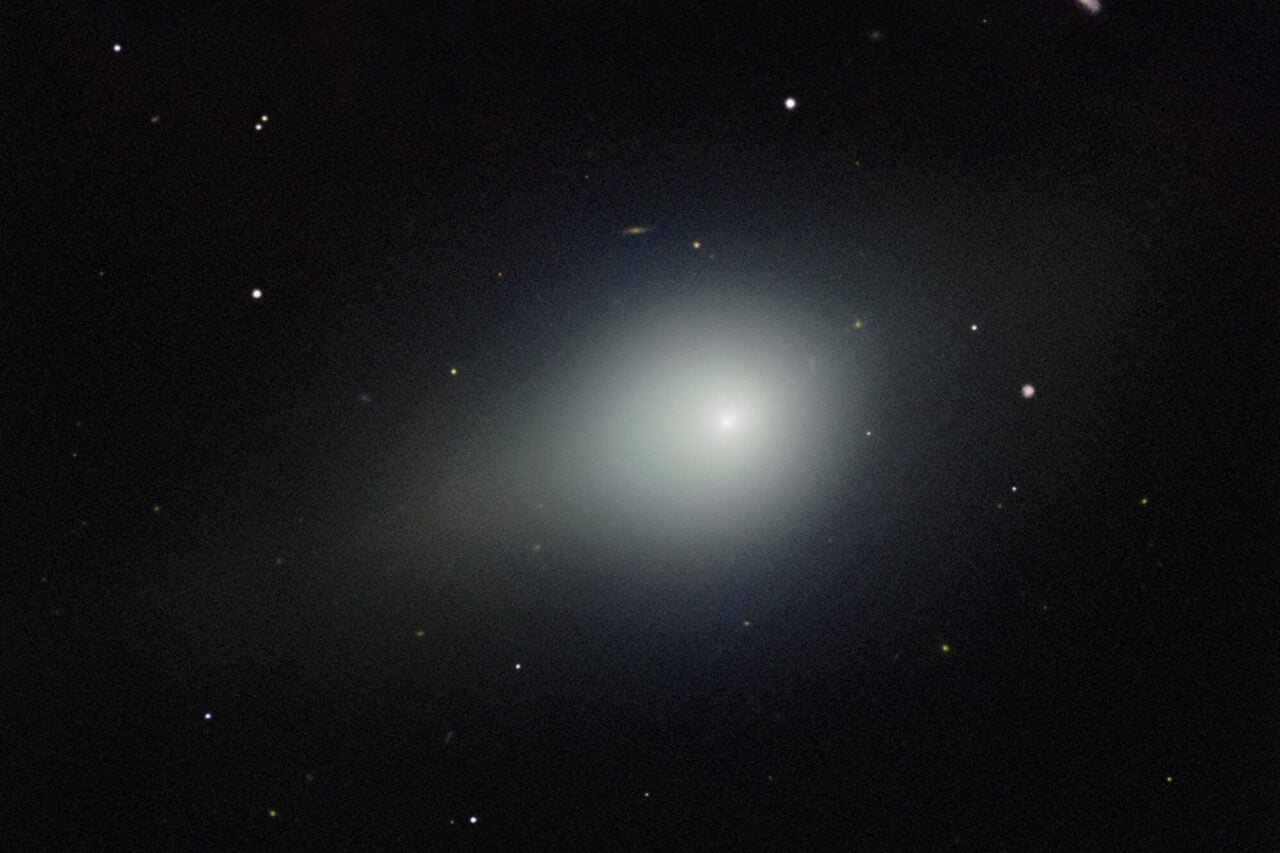
Astronomers are preparing for the closest approach of the interstellar comet 3I/ATLAS to Earth, scheduled for 1 a.m. ET on December 19, 2023. This unique celestial body, which originated from another star system, will pass by our planet at a distance of 1.8 astronomical units, equivalent to approximately 167 million miles or 270 million kilometers. While it will not be visible to the naked eye, those equipped with powerful binoculars or telescopes may catch a faint glimpse of this remarkable visitor.
For those unable to observe it directly, the Virtual Telescope Project 2.0 will provide a livestream of the flyby. This initiative, managed by the Bellatrix Astronomical Observatory in Italy, utilizes remotely controlled telescopes to deliver real-time observations of significant astronomical events. The livestream will begin at 11 p.m. ET on December 18, allowing enthusiasts to witness this extraordinary moment from home.
Significance of 3I/ATLAS
Discovered on July 1, 2023, by the NASA-funded ATLAS observatory, 3I/ATLAS is only the third interstellar object identified by astronomers, following ‘Oumuamua in 2017 and 2I/Borisov in 2019. Its approach presents a rare opportunity for scientists to analyze a sample from a distant corner of the galaxy, something current spacecraft cannot reach. The upcoming flyby will be particularly valuable for scientific research, as it offers an optimal chance to gather data on the comet’s characteristics before it exits our solar system.
Research has been ongoing since the discovery of 3I/ATLAS. Initial studies have led to various hypotheses regarding its origin. One theory proposed that it originated from an ancient star system located within a region of the Milky Way known as the thick disk, which consists of older stars. Subsequently, other studies suggested it may instead stem from the thin disk, where our solar system resides. Regardless of its exact origin, the analysis of 3I/ATLAS can provide insight into the conditions of its home system.
Further investigations revealed that this comet is abundant in carbon dioxide, indicating it formed in an environment with higher radiation levels than those found in our solar system. The comet is currently racing through space at remarkable speeds, having reached a maximum velocity of 153,000 miles per hour (or 246,000 kilometers per hour) during its closest approach to the Sun in late October.
How to Observe 3I/ATLAS
For those interested in observing 3I/ATLAS with personal telescopes or binoculars, the best viewing opportunity will occur during the pre-dawn hours, approximately 90 minutes before sunrise. To locate the comet, enthusiasts can find the constellation Leo and look slightly to the lower left of its brightest star, Regulus. From there, they can “star-hop” to the nearby magnitude 3.8 star Rho Leonis and look for a small, misty smudge about half the distance away.
Several astronomy apps, such as Stellarium or SkyView, can assist in pinpointing the comet’s location in the sky. However, for those who prefer a more straightforward option, tuning into the livestream provided by the Virtual Telescope Project will allow viewers to see 3I/ATLAS in greater detail.
Witnessing this rare celestial event promises to be an exciting experience for both seasoned astronomers and casual stargazers alike. The opportunity to observe an interstellar comet, along with the scientific insights it may yield, makes December 19 a date to mark on the calendar.