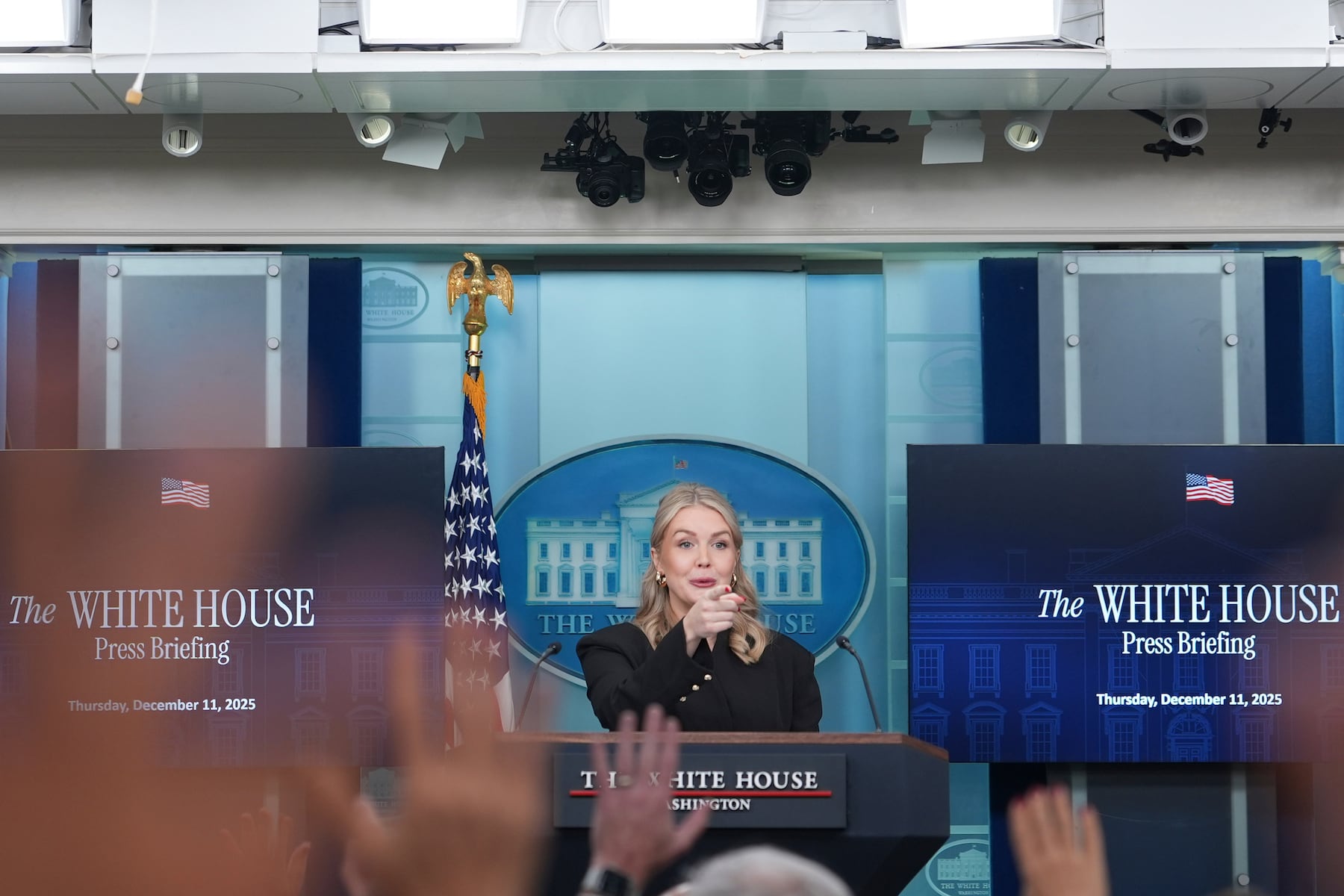
During a press conference on December 11, 2025, White House Press Secretary Karoline Leavitt reported positive news regarding the economy. She stated, “Inflation as measured by the overall CPI has slowed to an average 2.5% pace,” referring to the Consumer Price Index. Additionally, she claimed that “real wages are increasing roughly $1,200 for the average worker.” These assertions, however, have been met with skepticism as they contrast sharply with actual economic data and raise questions about the administration’s transparency.
When CNN political correspondent Kaitlan Collins attempted to seek clarification, Leavitt pivoted the discussion to critique her predecessor, Jen Psaki. Leavitt accused Psaki of spreading “utter lies” while asserting that her own statements were grounded in “real, factual data.” However, the inflation rate she cited was misleading; the actual rate for September stood at 3%, contradicting her claims. Furthermore, reports indicate that U.S. workers experienced the lowest annual paycheck growth since May 2021, challenging the optimism expressed by the White House.
Leavitt’s communications have drawn comparisons to themes from George Orwell‘s dystopian novel “1984.” In the novel, fictional government statistics are manipulated, leading citizens to accept fabricated realities. Orwell wrote, “The fabulous statistics continued to pour out of the telescreen,” suggesting a disconnect between official narratives and the lived experiences of the populace. In a similar vein, Leavitt’s remarks about economic progress seem disconnected from the challenges faced by many Americans.
Transparency and Accountability Under Scrutiny
Despite her claims of transparency, Leavitt’s rhetoric has been criticized as a form of “doublespeak.” Orwell defined this as the ability to hold contradictory beliefs simultaneously, allowing individuals to accept false statements as truth. Leavitt has frequently asserted that President Donald Trump is the “most transparent president in history,” a claim that has been met with skepticism by critics.
In her defense of the administration, Leavitt has made several controversial statements. For instance, she asserted that the administration has achieved more in terms of transparency regarding the Jeffrey Epstein files than any previous administration. This statement was characterized as “fabulously audacious” by The Guardian‘s Washington bureau chief, David Smith. The lack of clarity surrounding the Epstein files has led to considerable public concern, making her assertions even more contentious.
Leavitt’s record includes various misstatements about government initiatives and policies. She claimed that the now-defunct U.S. Agency for International Development (USAID) funded a $32,000 grant for a “transgender comic book” in Peru, which was later proven false. Other assertions included mischaracterizing the “One Big Beautiful Bill” as completely eliminating taxes on tips, overtime, and Social Security, while the reality is that deductions for these are capped.
As tensions rise in the political landscape, the administration’s messaging strategy raises critical questions about accountability. Leavitt’s approach appears to prioritize deflection and obfuscation over clear communication. This tactic is not uncommon in politics, yet the extent to which it has been employed by the current White House has sparked significant debate.
The Role of Political Language
Orwell’s observation that “political language is designed to make lies sound truthful” resonates in today’s media environment. Leavitt’s use of language reflects an effort to reshape narratives and manage public perception. Her claims often serve to elevate the administration while marginalizing dissenting voices.
In a recent instance, she sought to undermine U.S. Senator Mark Kelly and his colleagues’ appeal to servicemen and women not to obey illegal orders. Leavitt suggested that “all lawful orders are presumed to be legal,” implying that Kelly’s plea could incite disorder. Such statements exemplify a broader trend within the administration to dismiss legitimate concerns in favor of a more controlled narrative.
The intersection of politics and language remains a crucial area of analysis, especially as the 2024 presidential election approaches. As political discourse becomes increasingly polarized, the challenge of discerning truth from manipulation grows more complex. The public’s ability to critically assess the information presented by officials is essential for maintaining democratic accountability.
In the wake of Leavitt’s press conference, it is evident that the implications of her statements extend beyond mere rhetoric. They reflect a broader trend in political communication that seeks to navigate a path through contested realities. The ongoing discourse surrounding these issues will likely continue to evolve as scrutiny of the administration intensifies in the months ahead.