A research team from the Korea Institute of Materials Science (KIMS) has developed the country’s first full-cycle magnetic cooling technology, marking a significant advancement in eco-friendly refrigeration solutions. Led by Dr. Jong-Woo Kim and Dr. Da-Seul Shin, this innovation combines materials, components, and modules to replace traditional gas-based refrigeration methods, addressing environmental concerns associated with these technologies.
Magnetic cooling operates on the magnetocaloric effect, which allows for cooling in a solid state without the use of harmful gas refrigerants. The technology relies on the temperature changes of a refrigerant material when exposed to an external magnetic field. Despite its promise, commercializing this technology has been hindered by high manufacturing costs and reliance on rare-earth elements, which challenge its price competitiveness.
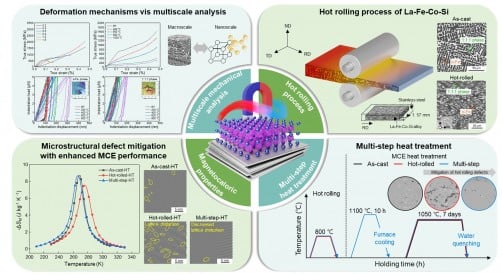
The research team has synthesized various magnetocaloric materials, notably lanthanum (La)-based and manganese (Mn)-based alloys. They successfully fabricated sheet and fine-wire specimens using advanced techniques such as hot rolling, cold drawing, and micro-channel machining. These methods allowed for near-net shaping, enhancing cooling efficiency and reliability. Notably, the team produced large-area La-based thin sheets measuring 0.5 mm thick and Gd-based fine wires with a diameter of 1.0 mm, demonstrating world-class performance.
In their work with non-rare-earth Mn-based materials, the researchers improved cooling performance by managing thermal hysteresis and adjusting magnetic anisotropy. They also created Korea’s first measurement system for directly monitoring adiabatic temperature changes in magnetic cooling materials and components. This innovation enables quantitative verification of property differences based on the manufacturing process, paving the way for optimized materials and components.
As global regulations on refrigerants tighten, such as those outlined in the Kigali Amendment to the Montreal Protocol, which mandates a complete ban on major gas refrigerants after 2030, magnetic cooling technology is becoming increasingly relevant. Several studies in advanced nations, including Germany, have shown that magnetic cooling systems can achieve coefficients of performance (COP) superior to traditional refrigeration methods, highlighting its potential as a next-generation cooling solution.
The KIMS research team is committed to enhancing its technological edge in magnetic cooling through impactful publications and key patents. Dr. Jong-Woo Kim stated, “Once commercialized, this technology will overcome the limitations of conventional gas-based cooling systems and provide an eco-friendly and stable cooling solution.” Senior Researcher Dr. Da-Seul Shin added, “Through this creative convergence research project, we aim to further advance magnetocaloric technology and establish a domestic industrial infrastructure for it, while also expanding into the global market.”
This research was supported by the Basic Research Program of KIMS and the Creative Convergence Research Program of the National Research Council of Science and Technology (NST). The findings were published in May 2025 in the esteemed journal Rare Metals, where Ph.D. candidate Sun-Young Yang served as the first author. The research team has also registered a domestic patent related to the magnetic cooling evaluation system and filed a corresponding application in the United States.
As the world shifts towards sustainable technologies, KIMS is positioning itself at the forefront of magnetic cooling innovation, paving the way for environmentally friendly refrigeration solutions that could transform the market.