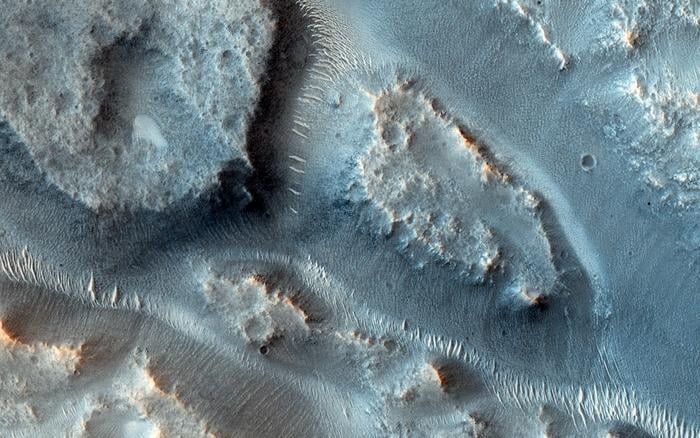
Scientists from the University of Texas at Austin have successfully mapped ancient river basins on Mars, providing new insights into the planet’s watery past. This groundbreaking study, published in the Proceedings of the National Academy of Sciences, details the first-ever mapping of Martian drainage systems, shedding light on how much water existed on the Red Planet long ago.
The researchers utilized images from the Mars Orbiter Laser Altimeter (MOLA) and the Context Camera (CTX) to identify and label various river systems. MOLA operated on NASA’s Mars Global Surveyor from 1997 to 2006, while CTX is currently active aboard the Mars Reconnaissance Orbiter, providing comprehensive coverage of Mars. The team employed ArcGIS Pro, a mapping software well-regarded for its capability to analyze Earth and planetary datasets.
Mapping the Martian Landscape
The study focused on drainage systems larger than 10,000 km², a standard size for significant drainage areas on Earth. In total, the researchers mapped 16 drainage systems, estimating that these formations produced roughly 28,000 km³ of sediment. This amount represents approximately 42 percent of the total sediment volume that flowed across ancient Mars.
The significance of this research extends beyond just mapping; it offers a framework for understanding the planet’s hydrological history. The study found that outlet canyons contributed about 24 percent of the global river sediment on ancient Mars, highlighting how interconnected these features are.
Mars is believed to have formed around 4.5 billion years ago. While scientific opinions differ on the duration of liquid water on its surface, a study in 2022 indicated that Mars may have retained liquid water up to 2 billion years ago. Evidence of past liquid water includes features such as deltas, outflow channels, and valleys, alongside mineralogical indicators like clays and hematite, famously discovered by NASA’s Opportunity rover in 2004.
Understanding Mars’ Water Loss
Researchers propose several reasons for Mars’ loss of liquid water, including the planet’s loss of magnetic field and subsequent climate collapse. Unlike Earth, Mars has a smaller core, leading to a quicker cooling process and a gradual dissipation of its magnetic field. This exposure to solar and cosmic radiation resulted in the stripping away of water from the surface and atmosphere.
While some water may have escaped into space, there is a possibility that a portion has been buried underground, potentially becoming groundwater or stored in polar regions. This study opens the door for future exploration of ancient river basins on Mars, inviting further research into the planet’s hydrological and geological history.
As scientists continue to analyze Mars’ past, the mapping of these ancient watersheds plays a crucial role in unraveling the mysteries of the Red Planet. The insights gained from this research could also inform studies on other celestial bodies, enhancing our understanding of planetary evolution.