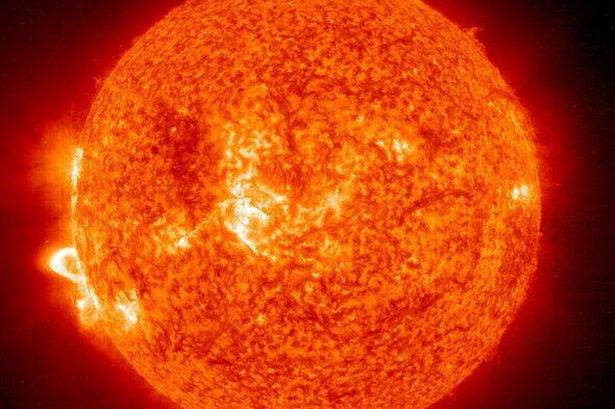
A significant sunspot cluster, designated AR 4294-4296, has emerged on the sun’s Earth-facing side, sparking concerns over potential solar activity. This formation, measuring nearly 90% of the size of the sunspot responsible for the historic Carrington Event of 1859, is now directly aligned with Earth. While scientists are monitoring the situation closely, they emphasize that the likelihood of another Carrington Event occurring is minimal.
The sunspot cluster comprises two magnetically linked groups, AR 4294 and AR 4296, which became visible on November 28, 2023. Remarkably, NASA’s Perseverance Mars rover detected these dark regions about a week earlier while observing the sun’s far side. Sunspots like AR 4294-4296 are known to pose a potential threat due to their ability to produce intense solar flares and coronal mass ejections (CMEs) that could disrupt technology on Earth.
Understanding the Solar Threat
According to reports from Spaceweather.com, the new sunspot group is among the largest seen in the past decade and has the potential to release X-class flares, the most powerful category of solar flares classified by the National Oceanic and Atmospheric Administration (NOAA). If a CME were to be ejected from this cluster, it could lead to significant disruptions, including radio blackouts and interference with electronic devices.
Historical context sheds light on the potential consequences of solar storms. The Carrington Event, which unleashed a record-breaking X45 solar flare, caused extensive disruptions in 1859. Should a similar event occur today, experts estimate damages could exceed $1 trillion, affecting satellites and electrical grids globally. The recent X7 flare in October 2024 serves as a reminder of the scale of these solar phenomena, illustrating that even smaller flares can have substantial impacts.
While the size of a sunspot can influence the magnitude of solar flares, it is not the sole determining factor. The configuration of a sunspot’s magnetic field and its frequency of eruptions are crucial in assessing its explosive potential. Some large sunspots can remain harmless, while others may produce significant solar activity.
Monitoring and Public Response
Scientists are observing the magnetic field of AR 4294-4296 closely for signs of increased activity. Although the complex has already released an X-class flare while on the sun’s far side, experts report no immediate indication of catastrophic events akin to the Carrington Event.
Public response has been encouraged to remain calm, as the chances of a severe solar storm are low. While auroras and minor technological disruptions may occur over the coming week, scientists believe that if AR 4294-4296 passes Earth without major eruptions, it could return for another round of observation in late December.
With the sunspot cluster now prominently aimed at Earth, specialists stress the importance of maintaining a level-headed perspective. Continuous monitoring will help ensure that any potential impacts are managed effectively, safeguarding technology and infrastructure from unforeseen solar activity.