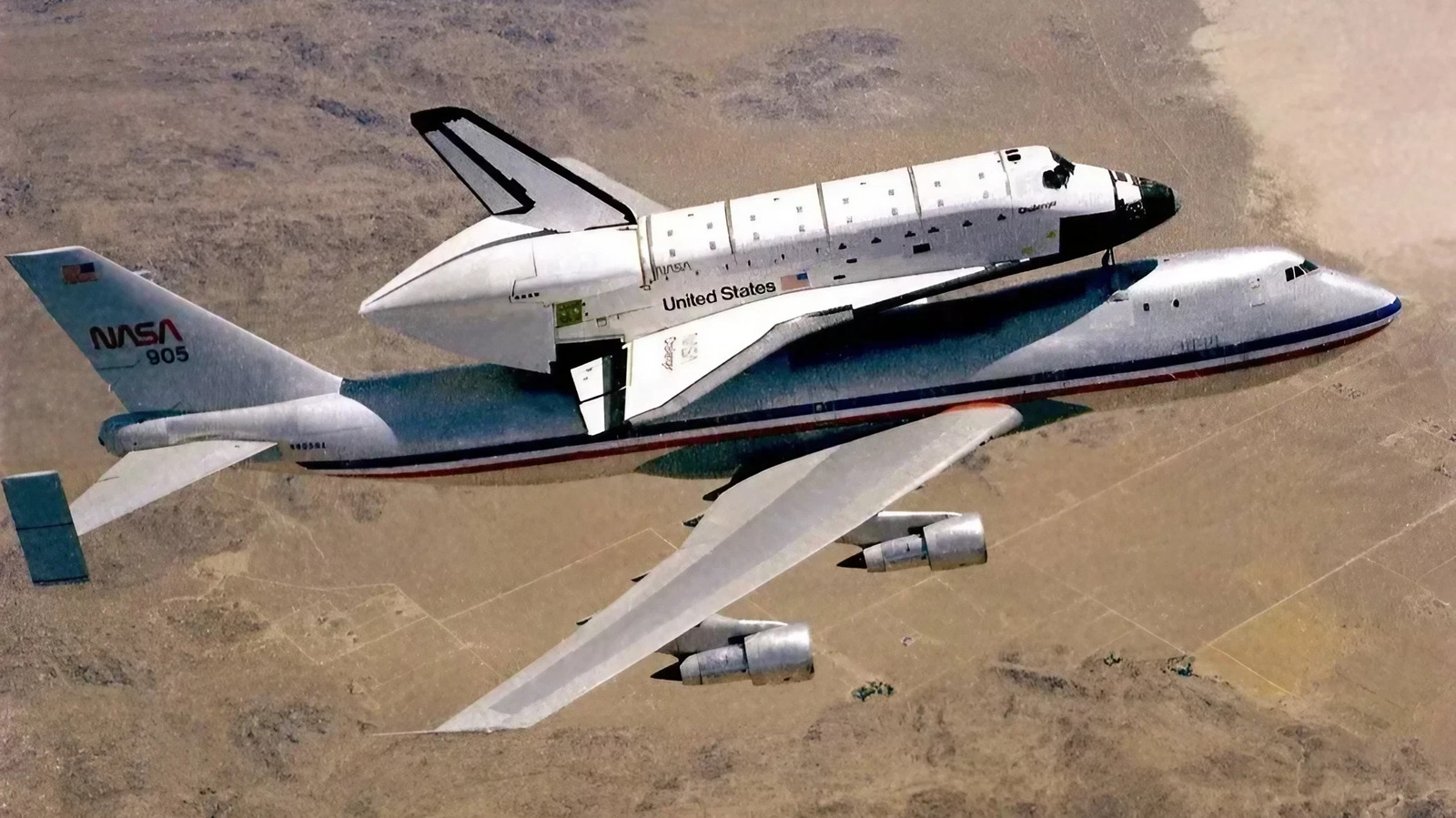
NASA’s decision to use a Boeing 747 to transport its space shuttles was driven by the need for a powerful and reliable aircraft capable of handling the shuttle’s considerable weight of approximately 100 tons. After evaluating options, NASA selected the Boeing 747 over the Lockheed C-5 Galaxy primarily due to its superior airframe design. The 747’s wings are positioned below the main fuselage, which provided a more stable platform for mounting the shuttle. In contrast, the C-5’s high-wing design posed challenges for securely attaching a shuttle on top.
The Boeing 747, a four-engine jumbo jet, had entered commercial service in 1969. At that time, it was the largest commercial aircraft, designed for intercontinental range and heavy lifting. Each of its four Pratt & Whitney engines produces 48,600 pounds of thrust, enabling the aircraft to handle a maximum gross taxi weight of 713,000 pounds. This capability was essential for NASA, as the modified 747s would carry the added weight of the shuttles.
Modifications for Shuttle Transport
NASA acquired two Boeing 747 aircraft for shuttle transport. The first, designated NASA 905, was a 747-123 model purchased from American Airlines in 1974 for $15,601,192. The second aircraft, NASA 911, was a 747-100SR-46 obtained from Japan Air Lines in 1989. Both jets underwent extensive modifications to accommodate the shuttles. Engineers at Boeing added three massive struts to the fuselage to securely hold the orbiter, which required substantial reinforcement of the internal structure.
The addition of a shuttle impacted the aircraft’s aerodynamics, prompting the installation of two extra vertical stabilizers on the tail for enhanced directional stability. Engineers also integrated instrumentation to monitor the orbiter’s electrical loads during flight. For initial testing in 1977, NASA 905 featured an innovative crew escape system equipped with pyrotechnics.
Mounting the shuttle on the 747 was a complex operation requiring specialized equipment known as Mate-Demate Devices. These structures lifted the orbiter high enough to allow the 747 to be driven underneath for attachment.
Operational History and Legacy
For over a decade, NASA 905 was the primary aircraft for shuttle transport missions. In 1990, NASA 911 joined the operations, and both jets shared the responsibility thereafter. Following the retirement of the shuttle fleet, the 747s had one final mission. NASA 905 completed three ferry missions to deliver the orbiters to their respective museum homes. Notably, it delivered the shuttle Discovery to the Smithsonian’s National Air and Space Museum, making a celebratory loop around Washington D.C. at approximately 1,500 feet.
NASA 911 was retired in February 2012 and is currently displayed at the Joe Davies Heritage Airpark. NASA 905 followed suit later that year, becoming part of a significant exhibit at Space Center Houston. The legacy of these modified Boeing 747s endures as a testament to the ingenuity and engineering prowess required to support NASA’s ambitious space exploration missions.