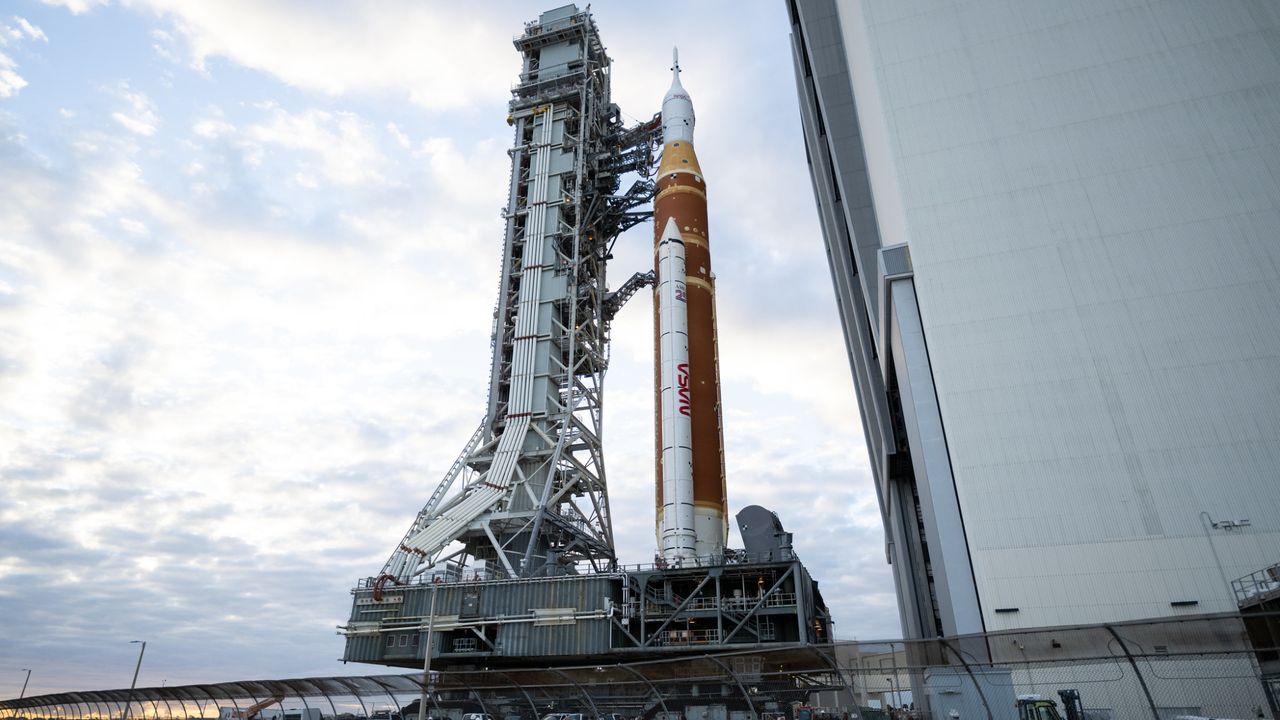
NASA has moved a significant step closer to its next lunar mission with the rollout of the Artemis 2 rocket. The Space Launch System (SLS), designed to carry astronauts to the moon, began its journey from the Vehicle Assembly Building (VAB) at Kennedy Space Center (KSC) in Cape Canaveral, Florida, early this morning, January 17, 2024. This marks a pivotal moment for NASA as it prepares for a potential launch within weeks.
The SLS, which stands at an impressive 322 feet (98 meters) tall and weighs approximately 2,870 tons (2,600 metric tons) when fully fueled, departed the VAB at 07:04 EST (12:04 GMT). The rocket is supported by a Mobile Launch Platform (MLP) featuring massive treads that slowly transported it along a 4-mile (6.4 kilometers) route to Launch Complex-39B (LC-39B). The entire traversal is estimated to take between eight to ten hours, moving at a pace of less than 1 mph (1.6 kph).
Engineers have dedicated the past year and a half to assembling the Artemis 2 SLS, which today made its first appearance as a fully integrated launch vehicle. The rocket is equipped with two solid rocket boosters, each measuring 177 feet (54 meters) tall, and four RS-25 engines originally developed for the Space Shuttle program. Together, these components produce a staggering 8.8 million pounds of thrust at liftoff, propelling the Orion crew capsule and its upper stages into space.
Once positioned at LC-39B, NASA will conduct a thorough series of system integrations and vehicle checkouts in preparation for the mission. A significant milestone in this process will be the wet dress rehearsal, scheduled for February 2, 2024. This crucial test simulates a launch countdown while the rocket is fully fueled. If everything goes smoothly, Artemis 2 is poised for its earliest launch attempt on February 6, 2024.
Artemis 2 will carry NASA astronauts Reid Wiseman, Victor Glover, and Christina Koch, along with Jeremy Hansen from the Canadian Space Agency. The mission is set to last approximately ten days, during which the crew will perform essential tests on the Orion spacecraft as they fly around the moon. Unlike previous missions, Artemis 2 will not enter lunar orbit but will instead follow a “free-return trajectory.” This path ensures that if any issues arise, the capsule will naturally return to Earth without the risk of becoming stranded in lunar orbit.
Artemis 2 serves as a critical step in NASA’s broader Artemis program, aimed at returning humans to the moon’s surface and establishing a sustainable presence. The subsequent mission, Artemis 3, is planned to land astronauts on the lunar surface, contingent upon the success of Artemis 2.
NASA officials remain optimistic about the readiness of the SLS and the outcome of upcoming tests. They hope to avoid the complications that plagued the Artemis 1 mission, which faced numerous delays due to equipment issues and weather conditions. The Artemis 1 mission was successfully launched in November 2022 after extensive preparations and troubleshooting.
As the Artemis 2 crew continues their training at KSC, they are focused on launch-day rehearsals and other preparations. Today’s rollout is not just a technical milestone; it also represents a significant moment for the astronauts, who were present to witness the rocket’s journey to the launch pad for the first time.
In summary, NASA’s Artemis 2 mission is poised to advance human exploration of the moon and beyond. With the SLS now on the launch pad, the eyes of the world will be on NASA as it prepares for this historic journey back to lunar orbit.