Scientists have discovered the amino acid tryptophan on the asteroid Bennu, a finding that could reshape our understanding of the origins of life. This breakthrough comes from NASA’s OSIRIS-REx mission, which successfully collected samples from Bennu in 2020 and returned them to Earth in 2023.
The analysis indicates that Bennu, which orbits Earth approximately every six years, contains 15 out of the 20 amino acids essential for life as we know it. Tryptophan is particularly significant; it is a complex amino acid and has never been detected in any meteorite or extraterrestrial sample before. This discovery was made possible by a meticulous examination of a 50 milligram sample from Bennu, analyzed by a team led by astrochemist José Aponte at NASA’s Goddard Space Flight Center.
Insights into Life’s Origins
The presence of tryptophan supports the hypothesis that the building blocks of life may not have originated solely on Earth. “Finding tryptophan in the Bennu asteroid is a big deal,” Aponte noted. “Seeing it form naturally in space tells us that these ingredients were already being made out in the early Solar System. That would have made it easier for life to get started.”
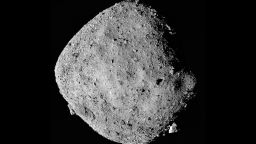
Bennu, named after an ancient Egyptian deity symbolizing creation and rebirth, is approximately one-third of a mile wide. It likely broke off from a larger asteroid between 2 billion and 700 million years ago and has been orbiting near Earth for about 1.75 million years. Current data suggests it could pose a potential impact risk in 2182, with an estimated probability of collision at 1 in 2,700.
The asteroid’s composition reflects the early solar system, dating back approximately 4.5 billion years. The materials that form Bennu originated from supernova explosions that occurred well before the solar system’s formation. These explosive events served as a cosmic forge, creating elements that would later contribute to the asteroid’s structure.
Implications for Astrobiology
The findings extend beyond just the presence of tryptophan. Researchers previously identified 14 amino acids and five biological nucleobases in Bennu samples. The growing body of evidence suggests that asteroids like Bennu may have delivered vital ingredients for life to Earth during its formative years.
Angel Mojarro, a postdoctoral researcher and the first author of the study, emphasized the importance of these discoveries. “What this is telling us is that many of the building blocks of life can be produced naturally within asteroids or comets, and finding tryptophan expands the alphabet of amino acids that are produced in space.”
Although tryptophan has been identified, further tests are necessary to confirm its presence definitively. George Cody, a staff scientist at the Carnegie Institution for Science, expressed optimism about the finding, noting the pristine condition of the Bennu samples, which were collected directly from the asteroid, minimizing contamination risks.
Dante Lauretta, a professor of planetary science at the University of Arizona and co-author of the study, highlighted the significance of these pristine samples. “Because OSIRIS-REx returned these samples intact, we’re finally seeing the fragile salts, minerals, and organics that meteorites lose on entry,” he stated.
The broader implications of this research suggest a connection between the natural chemistry of early solar system bodies and the molecular makeup of life today. According to the late Harold Morowitz, a pioneer in studies of life’s origins, the molecules essential to living organisms might be regarded as molecular “fossils” from the solar system’s beginnings.
Kate Freeman, a professor at Penn State University, remarked on the diversity of compounds that can originate in space. “Asteroids were the early Earth’s grocery delivery service, having provided a wealth of molecules to our prebiotic world,” she commented.
The continued study of Bennu and other celestial bodies underscores the importance of sample return missions in understanding our universe. Sara Russell, a professor of planetary sciences at the Natural History Museum in London, noted the value of uncontaminated material collected from space. “The discovery of tryptophan in particular is surprising, as we don’t see this in meteorites, perhaps because it does not survive the fall through the Earth’s atmosphere,” she explained.
As research on Bennu progresses, scientists are poised to uncover more about the fundamental ingredients of life and the processes that may have led to its emergence on Earth. The findings not only enhance our understanding of astrobiology but also highlight the potential for future explorations into the origins of life itself.