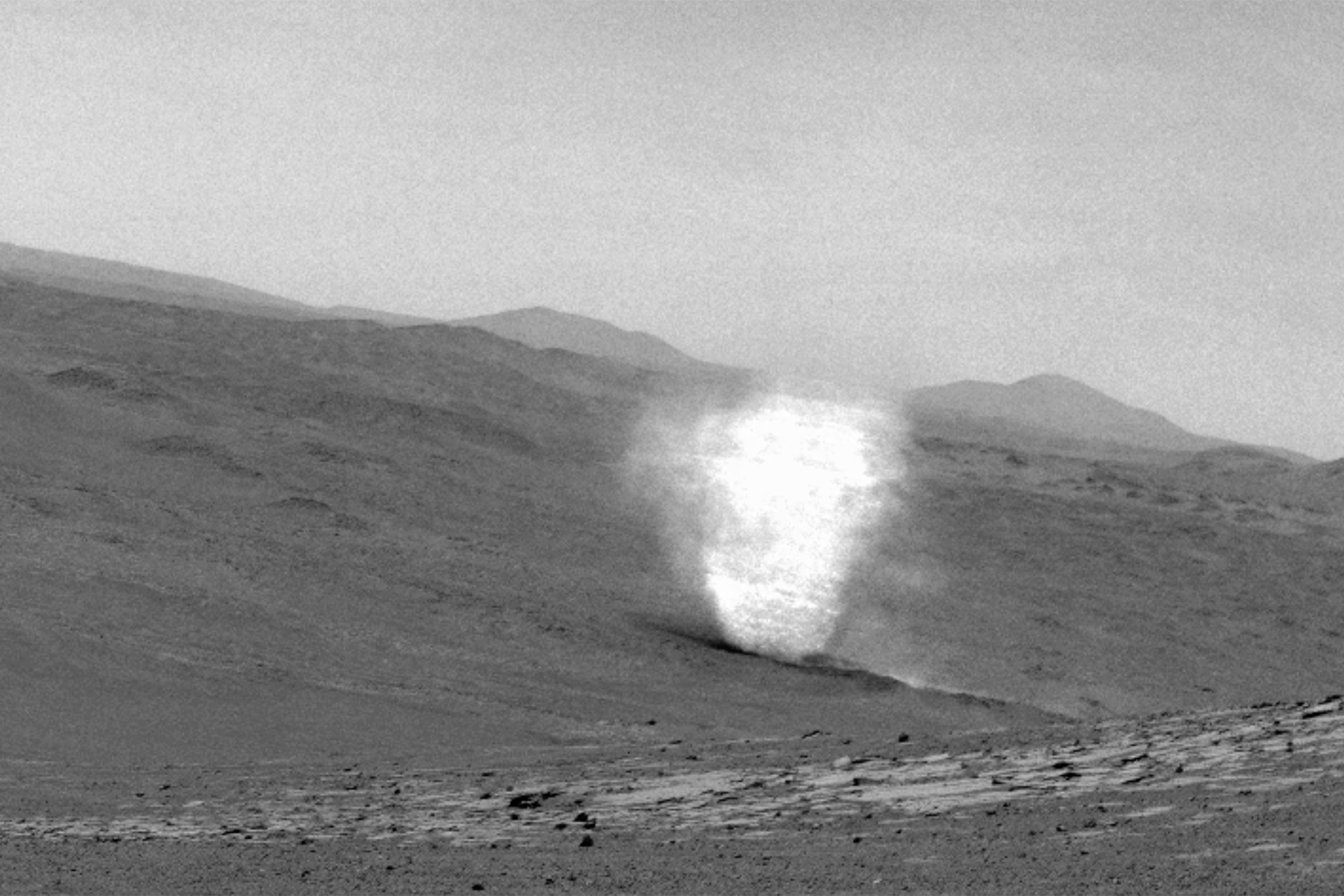
NASA’s Perseverance rover has made a groundbreaking discovery on Mars, capturing evidence of electric discharges occurring within dust devils on the planet’s surface. This phenomenon, previously theorized but never directly observed, confirms that lightning discharges are present in the Martian atmosphere. The findings are detailed in a recent study published in the journal Nature.
Dust devils are common on Mars, generated by rapidly rising columns of warm air that create whirlwinds. Similar to those on Earth, these whirlwinds occur when warm air near the ground rises and interacts with cooler air above. Researchers had hypothesized that the dust particles caught in these whirlwinds could become electrically charged through a process known as the triboelectric effect, which is the same principle that causes static electricity when shuffling across a carpet.
According to lead author Baptiste Chide, a planetary scientist at L’Institut de Recherche en Astrophysique et Planétologie in France, “Triboelectric charging of sand and snow particles is well documented on Earth, particularly in desert regions, but it rarely results in actual electrical discharges.” He added that the thin atmosphere on Mars makes these discharges more likely, as the threshold for generating sparks is significantly lower compared to Earth.
The long-standing question of whether lightning occurs on Mars has puzzled scientists, especially given its detection on other planets, such as Jupiter and Saturn. The breakthrough came unexpectedly—an acoustic microphone on the rover’s SuperCam instrument, which is primarily designed to analyze the sounds produced when the SuperCam laser interacts with Martian rocks, began recording electrical disturbances. Since the mission began in 2021, the rover has logged a total of 55 electrical disturbances, with 16 recorded during the passage of a dust devil directly over the rover.
The researchers noted that the number of discharges did not increase during Mars’ frequent dust storms, leading to the conclusion that these events are specifically linked to dust devils. The rover’s chance encounters with these phenomena provided an unexpected opportunity to validate their hypothesis.
This discovery carries significant implications for our understanding of Mars’ atmospheric chemistry. Lightning can instigate unique chemical reactions and may influence the chemical composition of the planet’s surface. Such changes could enhance the likelihood of forming complex compounds, and potentially even organic molecules, which are essential for life.
As scientists continue to study the data collected by the Perseverance rover, the findings about electric dust devils further enrich our understanding of Mars and its complex environment. This exciting development marks a significant milestone in Martian exploration and opens new avenues for future research into the planet’s atmospheric and chemical processes.