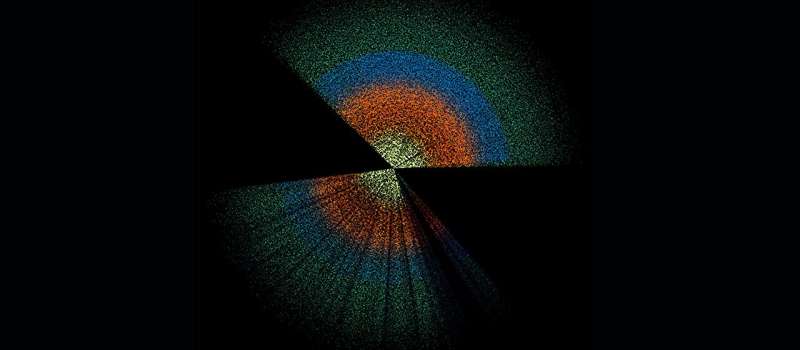
Researchers at the Large Hadron Collider (LHC) have made significant advancements in understanding the behavior of quark-gluon plasma (QGP), a state of matter believed to have existed moments after the Big Bang. Their findings reveal that a distinctive pattern of “flow” observed in particles resulting from heavy ion collisions reflects the collective behavior of these particles, shaped by extreme pressure gradients generated during collisions.
The study, led by Jiangyong Jia, a physicist at Stony Brook University and Brookhaven National Laboratory, highlights how the distribution of particles mimics the conditions of the early universe. The analysis focused on a specific type of flow, termed “radial flow,” which differs geometrically from the previously studied “elliptic flow.” Jia emphasized that this new flow type is sensitive to different aspects of viscosity within the fluid system.
Flow Dynamics and Historical Context
Previous research at the Relativistic Heavy Ion Collider (RHIC) laid the groundwork for understanding these particle interactions. The initial measurements from RHIC, released in 2001, identified directional differences in particle flow patterns during collisions of gold ions. This elliptical flow pattern indicated that particles emerged more prominently along the reaction plane defined by the collision’s direction, rather than transversely.
The elliptical flow is believed to arise from the shape of the overlap region between colliding ions, which can create asymmetric pressure gradients. These gradients push more particles outward along the wider section of the overlap area, akin to a football’s waistline, compared to the pointed ends. Such results were surprising to physicists, as they demonstrated that quarks and gluons continue to interact strongly even after being liberated from their confined states within protons and neutrons.
This collective behavior of particles pointed to the existence of a nearly frictionless liquid with extremely low shear viscosity. As Peter Steinberg, another physicist from Brookhaven Lab and co-author of the ATLAS paper, noted, the new radial flow measurements enrich the narrative that began with the onset of RHIC operations.
Collaborative Efforts and Future Implications
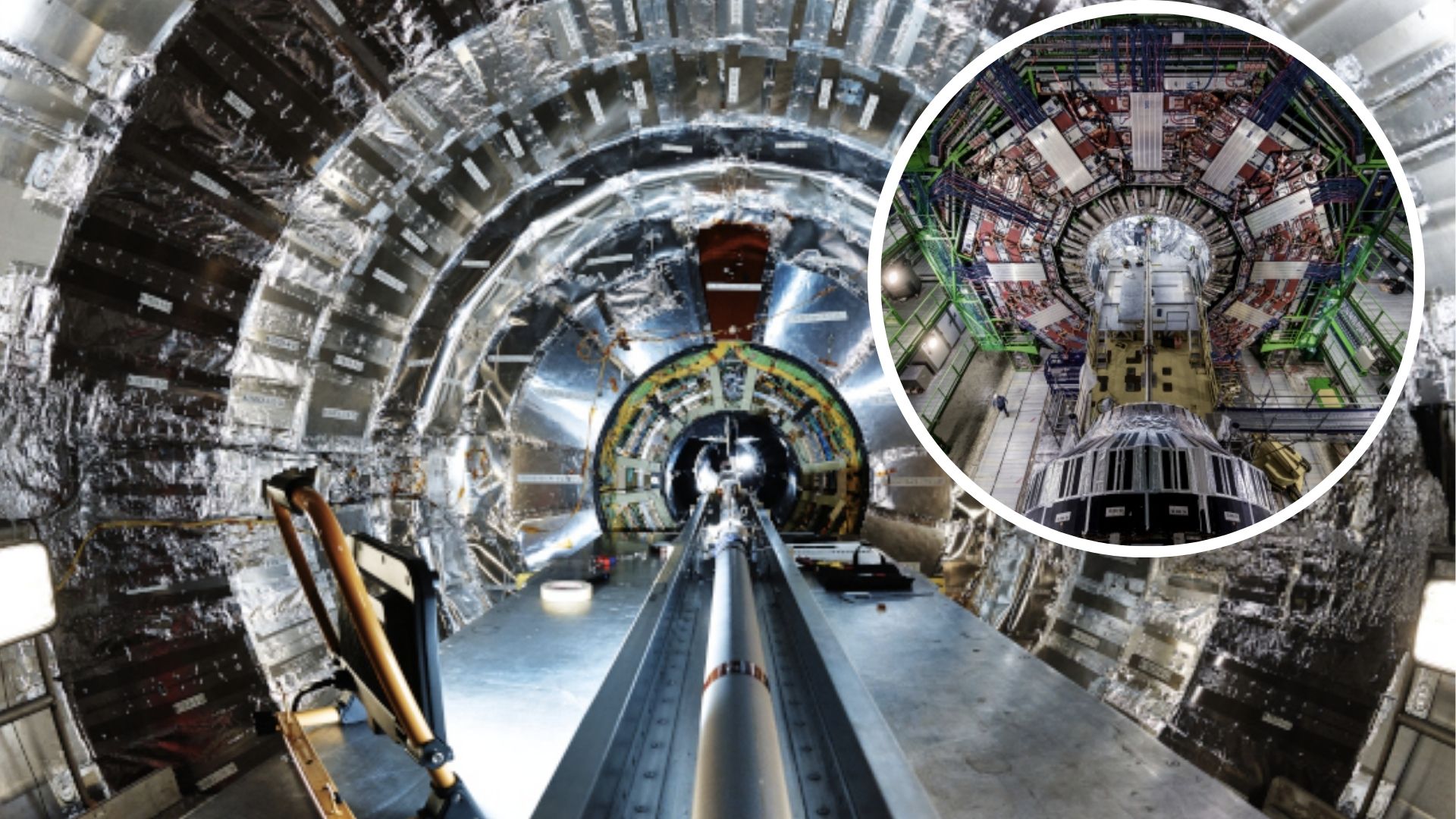
The findings from the ATLAS experiment at the LHC are further validated by complementary measurements from ALICE, another experimental detector at the LHC. Both experiments provide critical insights into the same types of collisions, reinforcing the results published in the same issue of Physical Review Letters.
The collaborative research underscores the importance of understanding the fundamental properties of matter under extreme conditions. Scientists involved in this work from the U.S. Department of Energy’s Brookhaven National Laboratory and Stony Brook University played leading roles in this analysis, which could have profound implications for our understanding of the early universe.
As researchers continue to explore the behavior of quark-gluon plasma, these findings represent a crucial step in unraveling the complexities of particle dynamics that shaped the cosmos shortly after the Big Bang.