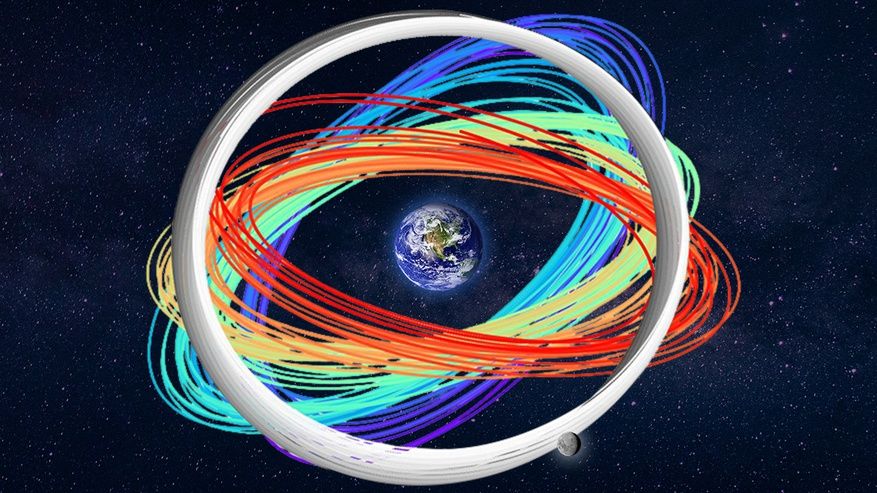
The challenge of preventing satellite collisions in Earth’s increasingly crowded orbit has prompted researchers at the Lawrence Livermore National Laboratory (LLNL) in California to develop a sophisticated model that maps one million potential orbital routes. This innovative approach aims to enhance safety as the number of human-made objects in space continues to rise, with over 45,000 currently orbiting our planet.
As space agencies prepare for a busy launch schedule in 2026, understanding how to navigate the complexities of low Earth orbit is critical. The LLNL researchers focused on cislunar space, the region between Earth and the Moon, to simulate the trajectories of countless satellites and space debris. Utilizing an open-access database and the power of LLNL’s supercomputers, they conducted simulations over six years to analyze the stability of these orbits.
Insights from the Data
According to LLNL scientist Denvir Higgins, the ability to visualize a million orbits enables a comprehensive analysis using machine learning techniques. This method allows researchers to predict the lifetime of orbits, assess their stability, and detect anomalies that could indicate unusual movements. The simulations revealed that approximately half of the modeled orbits remained stable for at least one year, while just under 10% sustained stability throughout the entire six-year period.
Another LLNL scientist, Travis Yeager, emphasized the complexity of accurately predicting satellite positions. He noted, “If you want to know where a satellite is in a week, there’s no equation that can actually tell you where it’s going to be. You have to step forward a little bit at a time.” This underscores the importance of ongoing monitoring and analysis in maintaining safe operations in space.
The Power of Supercomputing
The computational effort required to track one million orbits over six years is substantial. LLNL reported that the simulations utilized 1.6 million CPU hours, a task that would take over 182 years on a single computer. However, by leveraging the capabilities of the lab’s Quartz and Ruby supercomputers, the researchers were able to complete the simulations in just three days.
This groundbreaking work has the potential to inform future satellite traffic management strategies, identifying busy intersections in space where collisions are more likely to occur. As international satellite launches continue without coordinated oversight, tools like this model will be essential for enhancing safety and reducing the risk of catastrophic collisions.
With the number of satellites expected to increase, LLNL’s model could play a crucial role in shaping the future of space operations, ensuring that the benefits of satellite technology can be enjoyed while minimizing risks to both existing satellites and future missions. As space exploration advances, managing the growing clutter in orbit will be vital for maintaining sustainable pathways to the stars.