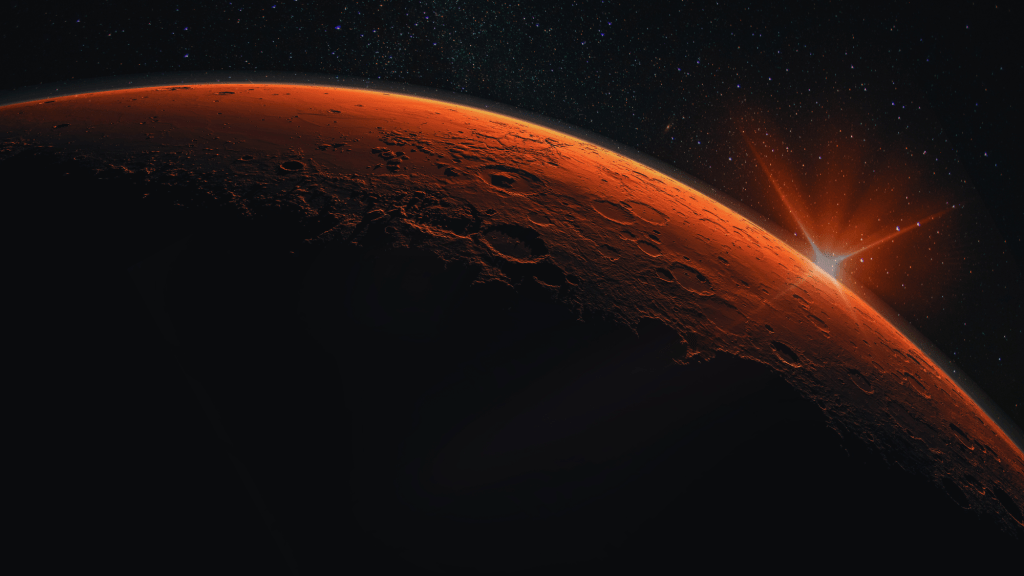
A recent study by the National Institute of Standards and Technology (NIST) has clarified how time flows differently on Mars compared to Earth. Published in The Astronomical Journal, the research indicates that an atomic clock on Mars would operate approximately 477 microseconds faster per day than one on Earth. This finding is particularly significant for future space missions and potential colonization efforts on Mars.
The study highlights an important detail: the time difference is not constant. Depending on Mars’ position in its orbit around the Sun, the variation in time can fluctuate by as much as 226 microseconds daily. While these discrepancies may seem trivial in a vacuum, they pose substantial challenges for scientific applications that require precise timing.
Understanding the mechanics behind this phenomenon reveals Mars’ complex orbit. Unlike Earth, which follows a predictable path, Mars experiences a more erratic trajectory influenced by multiple gravitational forces, including its own, the Sun’s, and even those from Earth and the Moon. This interplay complicates the timing and navigation systems that future Mars missions will rely upon.
According to NIST physicist Bijunath Patla, the situation exemplifies a classic “three-body problem.” In this context, however, the dynamics become even more intricate due to additional gravitational influences. Patla remarked, “A three-body problem is extremely complicated. Now we’re dealing with four,” underscoring the mathematical complexities involved in calculating time discrepancies.
The implications of this research extend beyond theoretical physics. As scientists prepare for potential human habitation on Mars, synchronized clocks will be essential to establish a reliable navigation system akin to the Global Positioning System (GPS) used on Earth. Understanding how time behaves differently on Mars is a critical step toward establishing effective communication and coordination between Earth and a Martian colony.
Interestingly, this research also suggests that individuals living on Mars would experience a slight acceleration in aging compared to their Earth counterparts. Specifically, spending fifty years on Mars could result in a person being nearly nine seconds older than if they had remained on Earth. While this difference is minimal, it raises intriguing questions about the experience of time in varying gravitational environments.
As space agencies contemplate long-term missions to Mars, the findings from NIST provide a foundation for understanding the challenges of timekeeping on another planet. The research not only enhances our understanding of Martian physics but also sets the stage for future exploration and potential colonization efforts. By accounting for these time variations, scientists and engineers can better prepare for the realities of life on Mars.