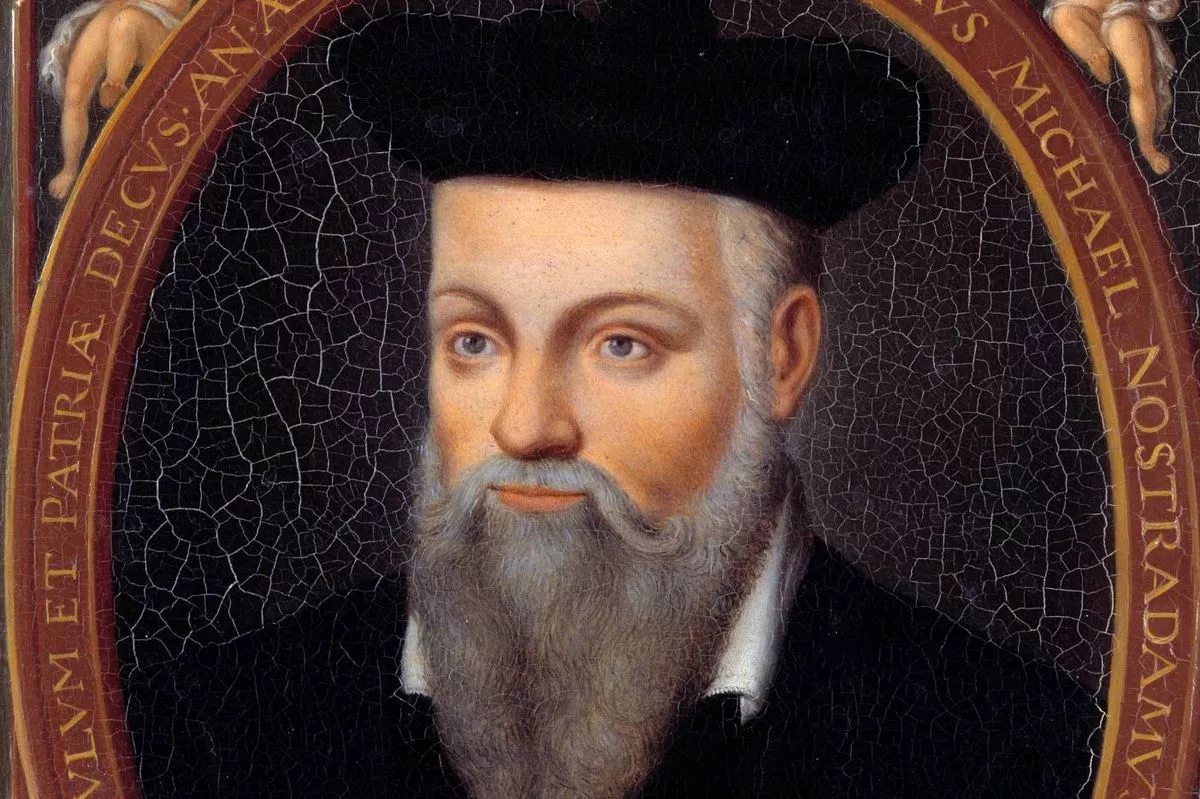
The 16th-century French astrologer Nostradamus has once again captured public attention with predictions for the year 2026. Known for his cryptic quatrains, Nostradamus foresaw a series of significant and often ominous events that some believe could unfold in the near future. His prophetic insights, compiled in his 1555 publication titled ‘The Prophecies’, contain a total of 942 quatrains, each open to interpretation.
Among his predictions is a verse that appears to reference warfare: “Seven months great war, people dead through evil/ Rouen, Evreux the King will not fail.” Some interpret this as a commentary on the ongoing conflict between Russia and Ukraine, suggesting a continuation or escalation of hostilities that have marked recent years. Another quatrain hints at catastrophic events previously linked to warfare, with phrases that some argue foreshadowed the nuclear bombings of Hiroshima and Nagasaki during World War Two.
Unusual Predictions for 2026
One of Nostradamus’ more whimsical predictions states: “The great swarm of bees will arise by the night ambush.” This line, associated with the number 26, has sparked speculation about an event occurring next year. While the imagery evokes curiosity, the actual meaning of the bees remains unclear, leading some to question how a swarm could cause significant harm.
Another prediction suggests that a “great man” will be struck down by a thunderbolt, as noted in the 26th verse of Century I. This phrase could refer to any prominent figure, be it a royal, a world leader, or a celebrity. The dramatic imagery raises questions about a potential lightning strike during a high-profile event, possibly leading to a surprising incident on a red carpet in 2026.
Perhaps the most disturbing forecast relates to the picturesque region of Ticino in Switzerland. Nostradamus ominously writes, “Because of the favour that the city will show… the Ticino will overflow with blood…” This prediction could imply a mass casualty event, a devastating plague, or a natural disaster impacting the region.
Understanding Nostradamus’ Legacy
Skeptics of Nostradamus’ work often point to the ambiguity of his language, written in Middle French and often accompanied by intentionally vague Latin phrasing. The existence of multiple manuscripts, spelling discrepancies, and various interpretations throughout the centuries complicate the understanding of his true intentions.
As 2026 approaches, the allure of Nostradamus’ predictions continues to spark debate among historians, astrologers, and the general public. While some view them as mere curiosities, others consider them as serious warnings. The interpretations of his quatrains will likely continue to evolve as people seek to decipher their meanings in the context of contemporary events.