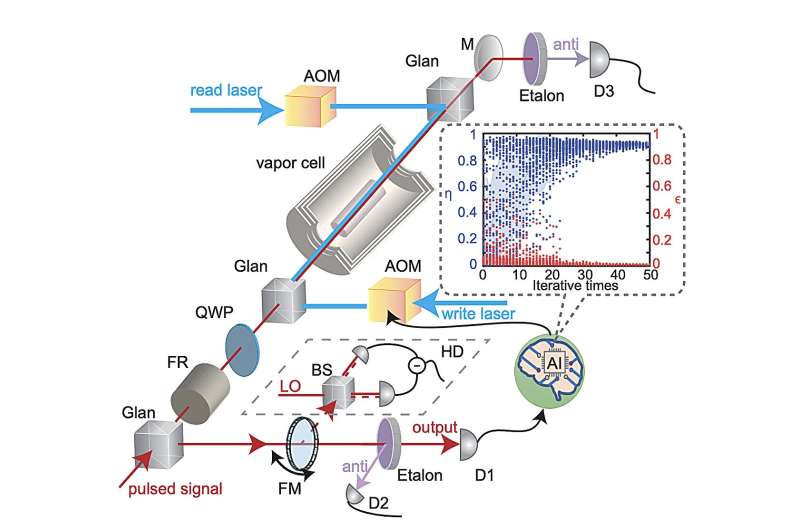
On November 15, 2025, a team of researchers led by Professor Weiping Zhang from Shanghai Jiao Tong University and Professor Liqing Chen from East China Normal University unveiled a groundbreaking advancement in quantum memory technology. Their work demonstrates a Raman quantum memory that achieves an impressive efficiency of 94.6% and a fidelity of 98.91%, marking a significant step forward in the storage and retrieval of quantum information.
This development is critical as quantum memories are essential for the effective processing of quantum information. To be viable for practical applications, these devices must not only store quantum data with high efficiency but also maintain the integrity of the information upon retrieval. Previous attempts to create efficient quantum memories often resulted in random fluctuations, or noise, which adversely affected the quality of the stored information.
Innovative Techniques in Quantum Information Storage
The researchers utilized a novel method of controlling atom-light interactions during the storage of quantum information. This approach is detailed in their paper published in Physical Review Letters. By employing a far-off resonant Raman scheme, the team was able to not only enhance the speed of optical signal storage but also minimize noise, allowing for the near-perfect performance of their quantum memory.
“Quantum memory with near-unity efficiency and fidelity is indispensable for quantum information processing,” Zhang stated. “Achieving such performance has long been a central challenge in the field, motivating extensive research efforts.” The researchers focused on elucidating the underlying physics of these interactions, which ultimately led to the development of a method for achieving optimal quantum memory performance.
Breaking Through Previous Limitations
Utilizing rubidium-87 vapor, the team successfully applied their mathematical approach to overcome the longstanding “efficiency–fidelity trade-off” that has hindered the realization of perfect quantum memories. This breakthrough paves the way for the future development of various quantum technologies, including long-distance quantum communication and advanced quantum computing systems.
The implications of this research extend far beyond theoretical advancements. “Our plans for future research include studying new physics-driven principles and integrating the memory into quantum repeaters for fault-tolerant quantum computing architectures and quantum networks,” Zhang added.
This work indicates a promising future for quantum technologies, as enhanced quantum memories can significantly improve the performance and reliability of systems that rely on quantum information processing.
This article has been fact-checked and reviewed to ensure the accuracy of the information presented, highlighting the rigorous editorial process that underscores the significance of this research.