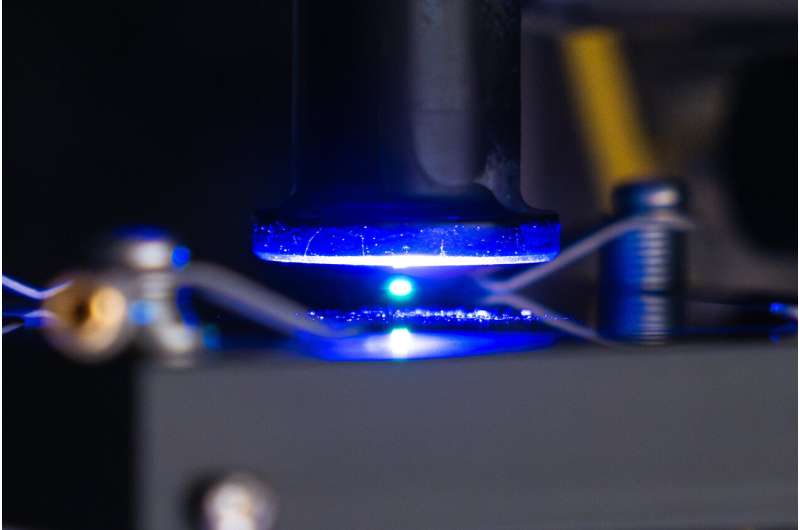
Physicists at the Institute of Science and Technology Austria (ISTA) have made a groundbreaking advancement in acoustic levitation. Their research, published in the Proceedings of the National Academy of Sciences on December 2, 2025, demonstrates a method to prevent the phenomenon known as ‘acoustic collapse,’ allowing multiple particles to remain separated in mid-air using electric charge.
Acoustic levitation utilizes sound waves to lift objects, but it has a significant limitation. When multiple particles are levitated simultaneously, they tend to clump together, akin to magnets attracting each other. This occurs due to attractive forces generated by sound scattering off the particles. The team, led by Scott Waitukaitis, an assistant professor at ISTA, aimed to overcome this challenge by incorporating electrostatic repulsion.
Sue Shi, a Ph.D. student and first author of the study, explained that their original goal was to facilitate the formation of crystals from levitated particles. However, they soon realized that resolving the collapse issue was vital. By applying electric charge to the particles, they successfully countered the attractive forces, allowing for various configurations — from fully separated to completely collapsed systems.
In collaboration with Carl Goodrich, also an assistant professor at ISTA, and Ph.D. student Maximilian Hübl, the team created simulations to analyze the balance between sound and electrostatic forces. These simulations clarified the dynamics of the different arrangements they observed, including intriguing behaviors that suggested the presence of “non-reciprocal” interactions, which challenge conventional physics.
Some particles displayed unexpected behaviors, such as spontaneous rotation or pursuing one another. While Newton’s third law of motion states that for every action there is an equal and opposite reaction, the researchers noted that the extra momentum gained by the particles is compensated by the sound waves. Prior theoretical predictions had suggested these effects were possible but had not been observed due to the collapsing nature of previously levitated particles.
By introducing electrostatic forces, Waitukaitis remarked, “We can now maintain stable, well-separated structures. This finally gives us a controllable platform to investigate these subtle non-reciprocal effects.”
The implications of this research extend beyond mere curiosity. The ability to manipulate matter in mid-air could have significant applications in fields such as materials science, micro-robotics, and dynamic structure formation from small components. Shi, reflecting on her journey, noted that while the initial hybrids and erratic rotations were frustrating, they ultimately led to fascinating discoveries.
“That’s the funny thing about experiments,” she said. “The most interesting discoveries often come from the things that don’t go as planned.”
This innovative approach allows scientists to explore and manipulate materials in ways that were previously unachievable, pushing the boundaries of what is possible with acoustic levitation. The team at ISTA is already using this technique to delve deeper into the non-reciprocal effects they have uncovered, marking a significant step forward in the field of physics and engineering.