For the first time, researchers have directly observed metal pollutants released during the reentry of a space object, specifically a Falcon 9 rocket from SpaceX. This groundbreaking finding, published on February 19, 2025, in the journal Communications Earth and Environment, highlights potential environmental hazards posed by space debris.
The study emphasizes the growing concern over metal pollution as the frequency of satellite launches accelerates. Since the beginning of space exploration nearly 70 years ago, the number of objects sent into orbit has surged, particularly in the last decade. SpaceX alone plans to expand its Starlink network to over 40,000 satellites in low-Earth orbit, with nearly 10,000 currently operational. These satellites have a projected lifespan of about five years before they disintegrate in the atmosphere, releasing metals such as lithium, aluminum, and copper.
These metal pollutants can potentially catalyze chemical reactions that harm the ozone layer. A 2023 study indicated that approximately 10 percent of particles in the stratosphere are derived from burnt-up satellites and rocket stages. This alarming statistic prompted a team of researchers to investigate further and trace these contaminants directly to a piece of reentering debris.
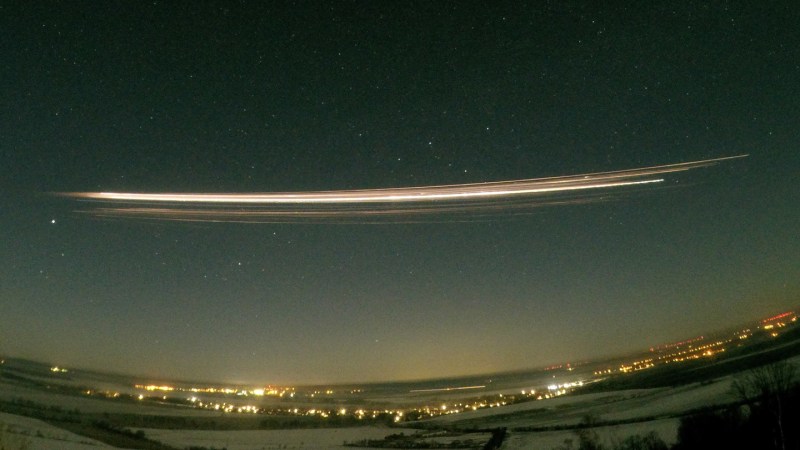
On February 19, 2025, the research team observed a lithium plume approximately 100 kilometers above Germany, originating from the disintegrating upper stage of a Falcon 9 rocket over Ireland and the United Kingdom. Meteorologist Claudia Stolle, from the Leibniz Institute of Atmospheric Physics in Germany, remarked, “A few hours after the reentry of this rocket, we could see 10 times more lithium than we would have observed otherwise.”
The researchers utilized lidar technology, which emits laser pulses tuned to specific wavelengths to detect materials like lithium. They also conducted advanced atmospheric simulations, revealing that prevailing winds transported the lithium plume from the reentry site in the North Atlantic to the lidar location near Kühlungsborn, Germany.
While there is a natural influx of metals into the atmosphere from meteorites, the cumulative effect of increasing space debris could potentially raise metal pollution levels by around 40 percent, according to Stolle and her colleagues. As more entities pursue satellite launches, tracking these contaminants and understanding their impacts on the environment will become increasingly vital.
Stolle concluded, “All of them will burn up sooner or later,” underscoring the necessity for robust monitoring systems as the space industry continues to expand. The implications of this research stretch beyond immediate environmental concerns, emphasizing the need for sustainable practices in the rapidly evolving field of space exploration.