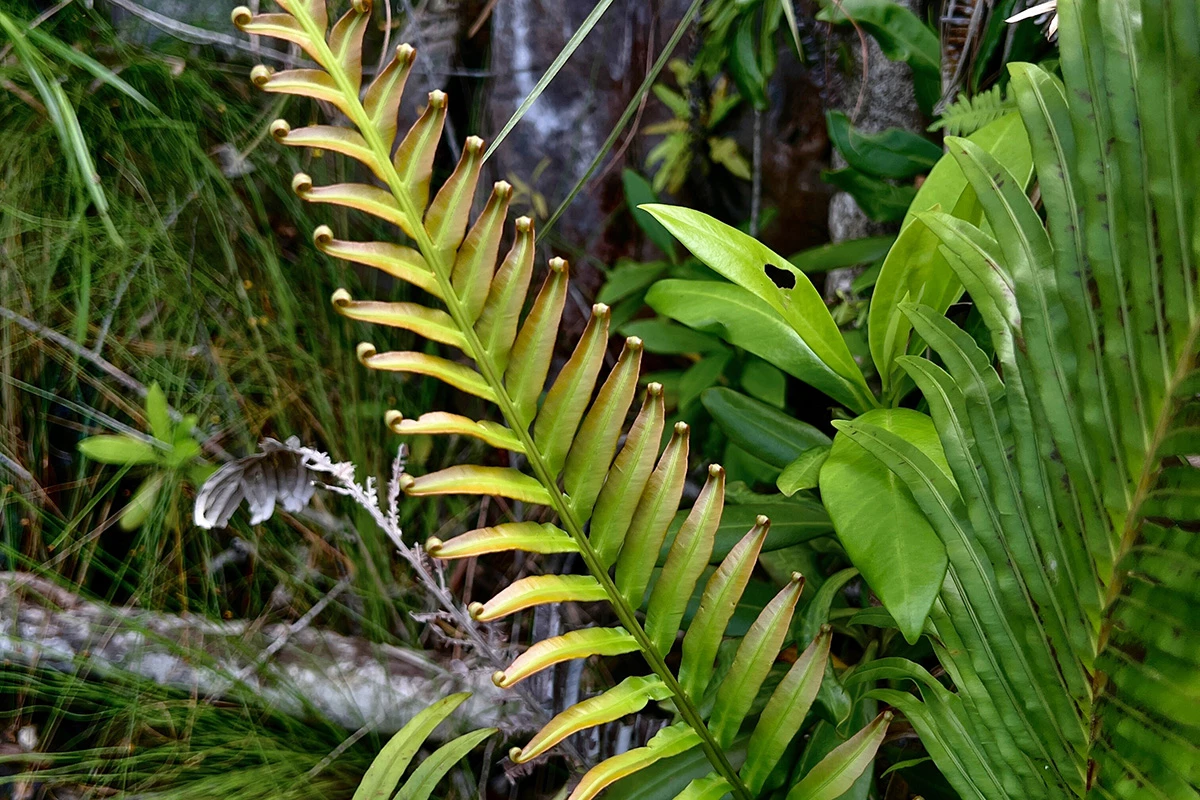
A team of scientists from the **Chinese Academy of Sciences** has made a significant discovery: the common fern species **Blechnum orientale** can naturally crystallize rare earth elements (REEs) within its tissues. This finding offers a potential alternative to the destructive mining practices typically associated with extracting these vital materials, which are essential for producing various technologies, including electric vehicles and smartphones.
The research, led by geochemist **Liuqing He**, was published in the journal **Environmental Science & Technology** earlier this month. Traditionally, REEs are found in small quantities within specific types of igneous rocks, formed as magma cools. In contrast, the study revealed that **B. orientale** can facilitate the mineralization of REEs under ordinary conditions, producing minerals like **monazite**, which were previously only known to form under extreme geological pressures and temperatures.
This breakthrough could significantly reduce the need for conventional mining, which often leads to soil degradation and environmental pollution. REEs, despite their name, are not rare; they are widely distributed but often exist in low concentrations, making extraction challenging. **China** currently dominates the global REE supply chain, controlling approximately **70%** of the mining and a substantial share of processing capacity.
**B. orientale** is classified as a hyperaccumulator plant, capable of thriving in soils with high levels of heavy metals that would be toxic to most other plant species. According to Liuqing He, the fern’s ability to generate **nano-sized monazite particles**—an industrially significant REE source—under normal surface conditions opens new avenues for the extraction of these valuable elements.
Researchers employed advanced microscopic imaging and chemical analysis techniques to examine the ferns growing in **South China**. The findings suggest a potential application of **phytomining**, a process where plants are used to extract metals from the soil, thus offering a sustainable means to source REEs.
In the context of electric vehicles, essential REEs like **neodymium**, **dysprosium**, and **praseodymium** are critical for manufacturing powerful permanent magnets used in motors. These elements also play crucial roles in smartphones and other electronic devices, from displays to camera lenses.
While the study indicates that **B. orientale** does not currently produce REEs in vast quantities, it underscores the need for further exploration into the capabilities of phytomining. Future research aims to determine whether this fern is unique in its ability to accumulate REEs or if other plant species share this characteristic.
Moreover, the researchers hope to develop efficient methods to extract monazite from the fern and break it down into its component REEs, minimizing resource loss during the process. He emphasized the significance of this discovery, stating, “This discovery reveals an alternative pathway for monazite mineralization under remarkably mild conditions and highlights the unique role of plants in initiating such processes.”
The implications of this research could be profound, offering a more environmentally friendly approach to securing the vital resources necessary for modern technology.