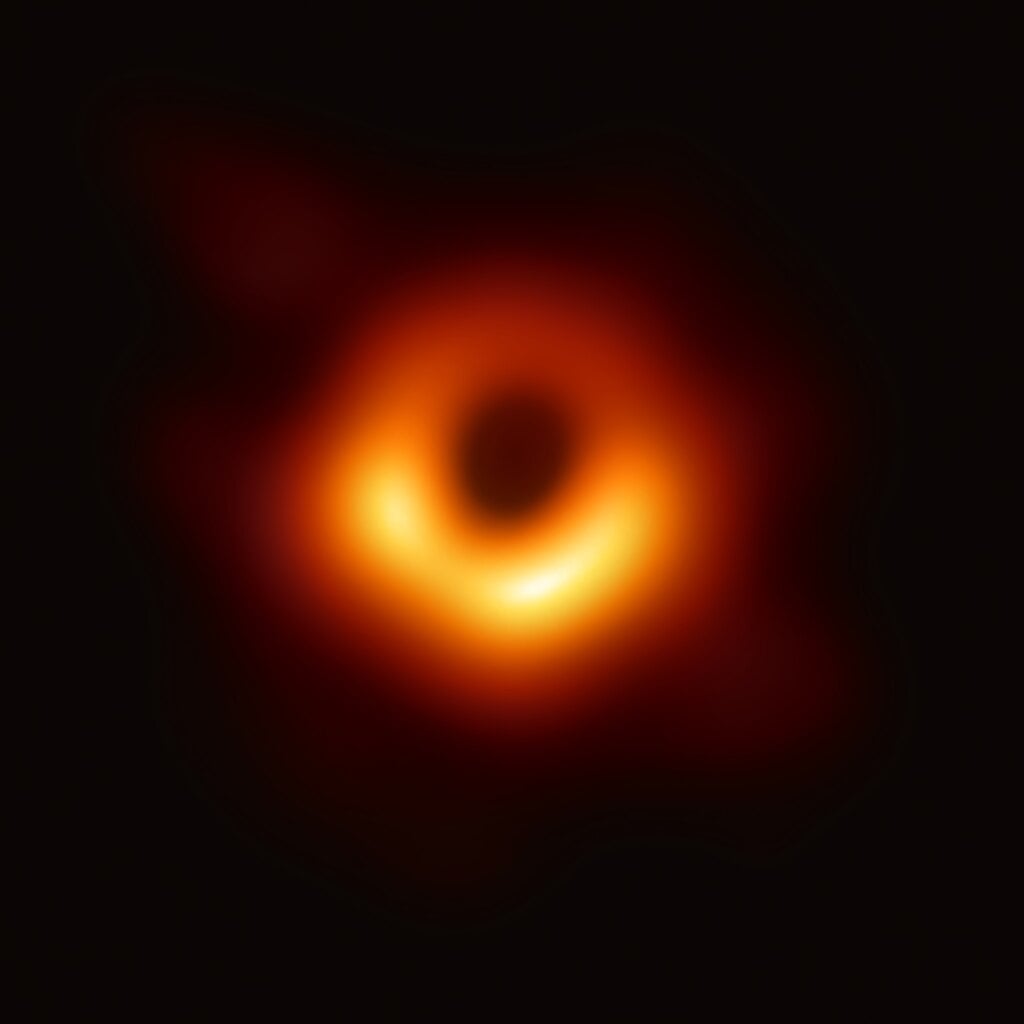
The scientific community is embarking on an ambitious project to create three-dimensional visualizations of black holes, a significant advancement following the groundbreaking images captured by the Event Horizon Telescope. This new initiative, known as the TomoGrav project, is backed by a budget of £4 million and aims to reveal the complex dynamics surrounding these enigmatic cosmic entities.
Revolutionizing Black Hole Imaging
The first photograph of a black hole, released in April 2019, showcased the supermassive black hole M87*, located approximately 55 million light years from Earth. This image marked a pivotal moment in astronomy, providing the first direct visual proof of black holes, which exert such strong gravitational forces that not even light can escape them. A subsequent image of Sagittarius A*, the black hole at the center of our Milky Way Galaxy, was revealed in 2022, captivating audiences worldwide.
Despite these monumental achievements, both images offered only a two-dimensional glimpse of the phenomena at play. They illustrated superheated plasma swirling around the black holes, yet failed to capture the intricate processes of how this material flows, how magnetic fields direct energy into vast jets, or how spacetime is influenced by such intense gravitational forces.
The TomoGrav project aims to overcome these limitations. Dr. Kazunori Akiyama, who co-led the team responsible for the first black hole images, is collaborating with Professor Yves Wiaux from Heriot-Watt University. Together, they intend to develop what they describe as “dynamic gravitational tomography,” which will produce three-dimensional movies that depict the flow and evolution of plasma around black holes over time.
Innovative Techniques for Enhanced Understanding
The Event Horizon Telescope operates by linking radio telescopes around the globe, effectively forming a virtual telescope the size of Earth. This setup achieves unprecedented resolution, but the process of translating the incomplete data into coherent images necessitates advanced computational algorithms. Dr. Akiyama was instrumental in developing one of these algorithms for the original images. Meanwhile, Professor Wiaux has pioneered artificial intelligence techniques that reconstruct images from fragmented data, methods that are now being applied across various scientific disciplines.
The TomoGrav project is expected to uncover dynamics that have remained elusive until now. Black holes are known to rotate, a factor that plays a crucial role in determining the energy that can be extracted from infalling matter. This energy powers colossal jets that can stretch across thousands of light years and significantly influence galactic formation and evolution. While scientists can observe these jets, the mechanisms of their formation have not yet been visualized.
By producing time-resolved three-dimensional maps of magnetic fields and plasma around black holes, the researchers aim to illustrate how matter spiraling inward generates the magnetic fields that channel energy outward. This groundbreaking research will also contribute to the most rigorous tests of Albert Einstein’s theory of general relativity under extreme conditions.
The team plans to collaborate with the proposed Black Hole Explorer space mission, which aims to precisely map photon rings—light that has orbited a black hole multiple times before escaping. These measurements will provide insights into gravity where spacetime is most severely distorted.
The TomoGrav project promises to push the boundaries of our understanding of black holes and the fundamental laws of physics, illuminating a field that has fascinated scientists and the public alike for generations.