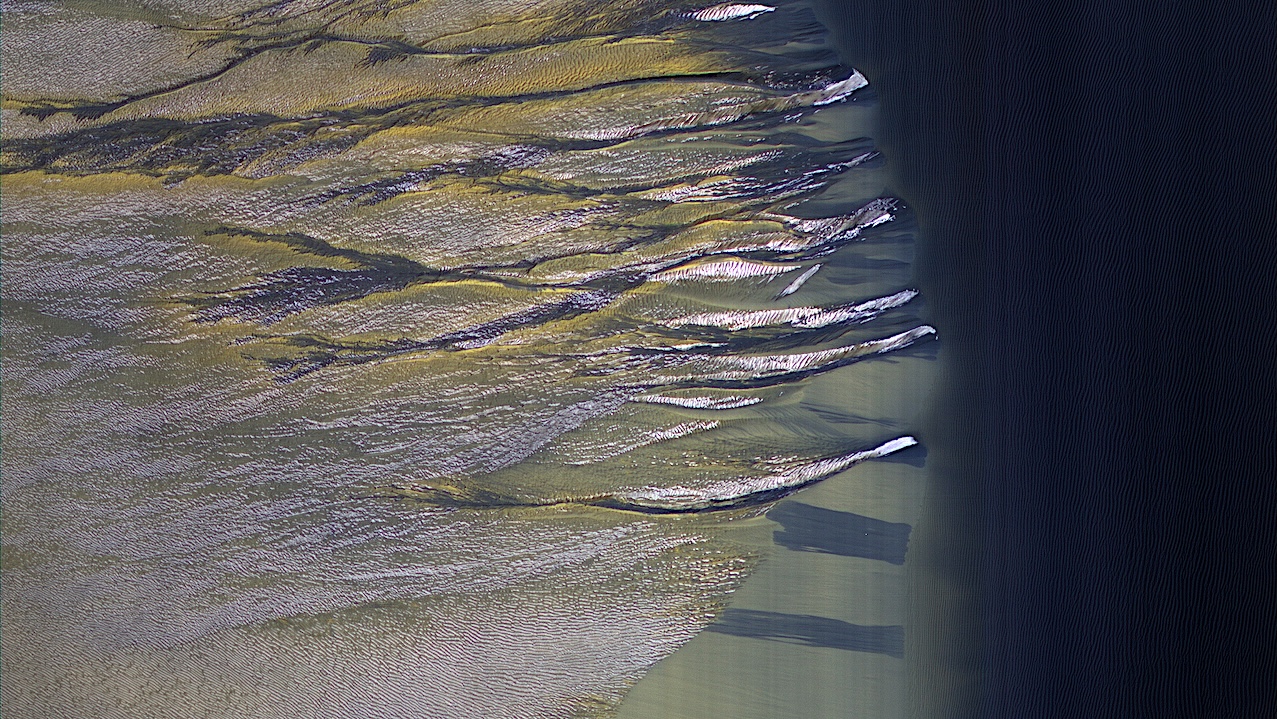
Recent observations of the dark sand dunes in the Kaiser Crater on Mars reveal a notable seasonal transformation. During the winter months, these dunes are blanketed in a layer of white seasonal ice. However, as Martian spring progresses, the western slope of the dune is partially defrosted, showcasing a fascinating interplay between ice and sand.
The latest images, enhanced for clarity, highlight bright patches of frost—composed of both water and carbon dioxide ices—spread across the dune. These patches are an indication of the seasonal changes occurring on the planet’s surface. As the sun’s rays begin to warm the dune in spring, the frost undergoes a rapid transformation from solid ice to gas, leading to the observable dark streaks of sand that flow down the dune’s slope.
Understanding the Dynamics of Martian Frost
The flows of sand that emerge from this melting frost are not random; they are intricately influenced by the ripples on the dune’s surface. The interaction between the flowing sand and the frost creates a dynamic landscape that scientists are keen to study further. The width of the observed area is approximately 520 meters, providing researchers with a substantial view of these geological processes.
These findings contribute to our understanding of the Martian environment, particularly in relation to astrobiology and the potential for life. The transition from ice to gas not only alters the physical landscape but also holds implications for the planet’s climate and the presence of water in various forms.
The ongoing research into these phenomena is critical for future explorations and missions to Mars. As scientists continue to monitor the changes in the Kaiser Crater, they gather vital data that could inform our understanding of the planet’s history and its capacity to support life in the past or present.
In summary, the defrosting of the dunes in Kaiser Crater provides a captivating glimpse into the seasonal changes on Mars, revealing intricate interactions between ice and sand that are essential for understanding the planet’s environment. As more data is collected, the story of Mars continues to unfold, offering exciting possibilities for future exploration.