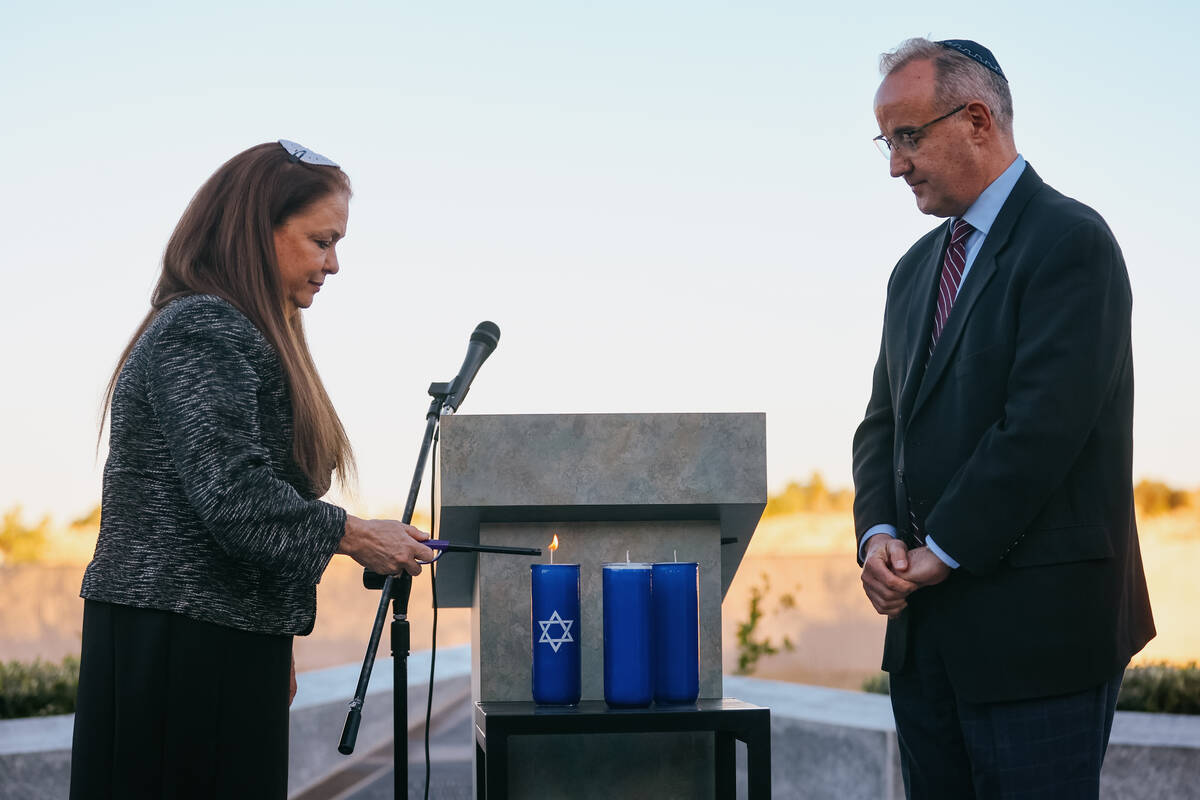
A new research center dedicated to Holocaust and genocide studies will be established at the University of Nevada, Las Vegas (UNLV), following funding approved in a spending package signed by former President Donald Trump. The announcement was made by Elliot Malin, chair of the Governor’s Advisory Council on Education Relating to the Holocaust, during a solemn remembrance event held at the King David Memorial Chapel & Cemetery in Las Vegas.
The funding allocation of $700,000 aims to create a permanent center that will focus on Holocaust research and education. During his address, Malin highlighted the importance of this initiative, stating, “By getting this funded and built and established, we’re going to be able to reach more people. We’ll be able to honor the memory of our local survivors and bring that history to UNLV.” A representative from UNLV confirmed the funding and expressed optimism about the center’s potential to document and showcase the memory of the Holocaust for the community.
The announcement coincided with January 27, designated as International Holocaust Remembrance Day, which marked a gathering of approximately 75 attendees. The ceremony also paid tribute to the victims of six concentration camps in Poland, including Auschwitz, where it is estimated that around 1.1 million people were killed. Overall, over six million individuals lost their lives during the Holocaust, including about 1.5 million children.
Las Vegas Mayor Shelley Berkley spoke at the event, reflecting on her visits to concentration camps and the tragic loss of children during the Holocaust. “What strikes me the most is the millions of children that did not survive their childhood because of the Holocaust,” she stated. Berkley expressed her concern about the resurgence of antisemitism globally and emphasized the importance of ensuring that such atrocities are never repeated.
Among the attendees was Thomas Jacobson, a resident of Los Angeles who, as a child, was aboard the MS St. Louis, a ship carrying nearly 1,000 German-Jewish refugees seeking refuge from Nazi persecution in 1939. The ship was famously denied entry to the United States, Cuba, and Canada before returning to Europe. Jacobson, now 87, shared his experiences, emphasizing the need to keep the history alive. “We were turned away everywhere we went; nobody wanted the Jews in those days,” he recalled.
He underscored the importance of education, noting, “I wanted some Nevadans to be able to hear from a survivor because there’s not many of us left.” Jacobson, who became a civil rights attorney, pointed out the alarming parallels between historical events leading up to World War II and contemporary issues. “I know you really have to fight for democracy,” he said. “For me, getting out and interacting with people, it gives me energy.”
The planned research center at UNLV is expected to serve as a significant educational resource, allowing students to engage with local schools to promote understanding of the Holocaust. Malin described the center’s potential role, stating, “We will establish a museum where UNLV students will bring CCSD school children in to learn about the Holocaust.” This initiative aims to foster a deeper awareness of the historical events and their implications for society today.
As discussions about the Holocaust and its lessons continue, the establishment of this research center stands as a testament to the commitment to education and remembrance. The collaboration between UNLV and the advisory council highlights a proactive approach to preserving history and ensuring that the stories of survivors and victims are not forgotten.