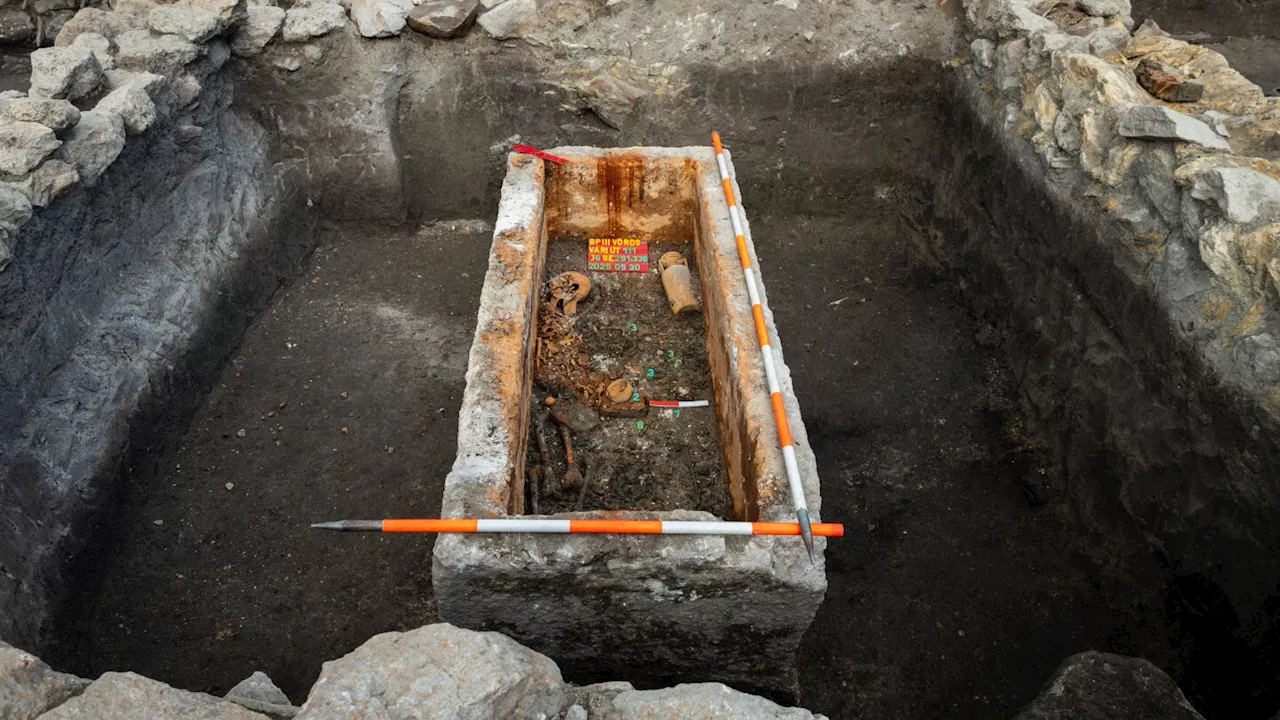
URGENT UPDATE: A stunning 1,700-year-old Roman sarcophagus has just been unearthed in the Óbuda district of Budapest, offering a remarkable glimpse into the life of a young woman from ancient times. Discovered during a significant excavation by archaeologists from the Budapest History Museum, this limestone coffin was found perfectly sealed with metal clamps and molten lead, making it a rare find that has remained untouched for centuries.
The excavation team, led by archaeologists Gabriella Fényes and Gergely Kostyál, revealed the sarcophagus on September 30, 2025, as part of ongoing archaeological work in a region once known as Aquincum, a bustling Roman settlement located on the banks of the Danube River. The coffin was remarkably well-preserved and contained a complete skeleton alongside an array of artifacts, including 140 coins, bronze figures, and exquisite glass vessels.
Fényes emphasized the significance of the find, stating, “The peculiarity of the finding is that it was a hermetically sealed sarcophagus. It was not disturbed previously, so it was intact.” This discovery provides not just archaeological insight but a poignant testament to the care and affection of those who buried the young woman. “The deceased was buried very carefully by her relatives. They must have really loved who they buried here,” Fényes added.
The sarcophagus was located among the remnants of abandoned houses, in an area that had been repurposed as a burial ground in the 3rd century. Nearby, excavators uncovered additional Roman structures, including an aqueduct and simpler graves, but none of comparable wealth or preservation.
The careful burial practices reflected in the sarcophagus, including the presence of a bone hairpin and traces of gold-threaded fabric, suggest the young woman likely held a higher social status. Kostyál remarked, “It is truly rare to find a sarcophagus like this, untouched and never used before, because in the fourth century it was common to reuse earlier sarcophagi.”
Archaeologists are now set to conduct further examinations of the remains, which could reveal more about her age, health, and origins. Fényes expressed hope that additional treasures may still be uncovered, as they sift through the 4 centimeters of mud found inside the coffin.
This extraordinary find is not just about artifacts; it offers a deep emotional connection to the past. “I was very touched by the care and expression of love that we were able to get a glimpse of,” Fényes noted. “Even now, I shudder to think how painful it must have been for the people at that time to bury this young lady.”
As news of this remarkable discovery spreads, experts and history enthusiasts alike are eager to learn more about the secrets that this ancient sarcophagus may still hold. Stay tuned for updates on this developing story as archaeologists continue their vital work in Budapest.