NASA’s Chandra X-ray Observatory has expanded its catalog of cosmic observations to include over 1.3 million individual X-ray detections. This significant milestone, announced on January 25, 2026, enhances the existing Chandra Source Catalog (CSC), which now holds data on more than 400,000 unique sources detected until the end of 2020. As the leading X-ray telescope, Chandra continues to play a crucial role in advancing our understanding of the universe.
The latest version of the catalog, referred to as CSC 2.1, encompasses extensive X-ray data that enables scientists to analyze a variety of celestial phenomena. This includes detailed positional information and energy data for each source, allowing researchers to correlate X-ray observations with other wavelengths collected by ground-based and space telescopes, such as NASA’s James Webb and Hubble Space Telescopes.
Unveiling the Galactic Center
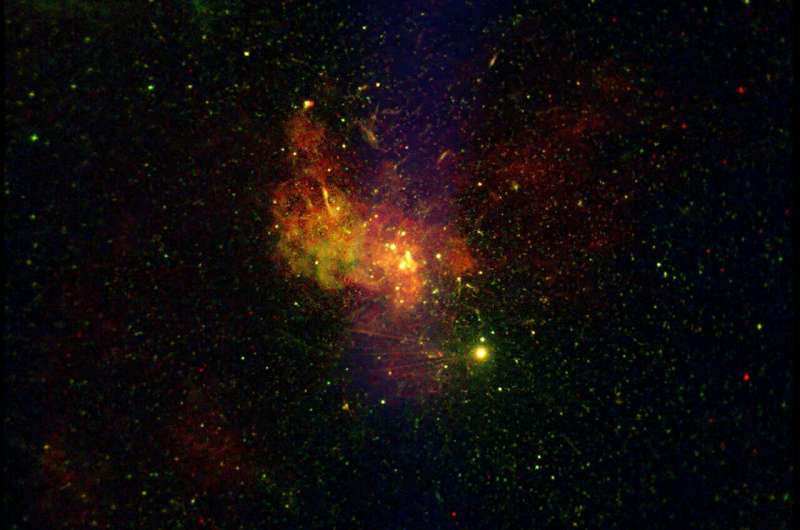
The breadth of information available in the Chandra Source Catalog is exemplified in a newly released image of the Galactic Center. This region, located around the supermassive black hole known as Sagittarius A*, reveals over 3,300 individual X-ray sources within a small area measuring just 60 light-years. The image is a composite of 86 observations, totaling more than three million seconds of observing time by Chandra.
Additionally, a recent sonification of the Chandra data offers a unique auditory experience by translating the astronomical findings into sound. This representation spans 22 years of observations, from the launch of Chandra through 2021. The sonification highlights the repeat sightings of various X-ray sources over time, with different notes representing multiple detections at specific locations.
Visualizing the Universe
In this innovative visual presentation, the core of the Milky Way is centrally located, with the Galactic plane depicted horizontally. Each detection is represented by a circle, with the size of the circle indicating the number of detections at that location. A year counter at the top of the frame updates to show the progression of observations, ending with the phrase “… and beyond” as Chandra remains fully operational.
The final frames of the sonification video showcase a collage of images captured by Chandra throughout its mission, further illustrating the extensive data collected over the years.
For those interested in exploring the latest findings, the most recent version of the Chandra Source Catalog is available online at [Chandra X-ray Center](https://cxc.cfa.harvard.edu/csc/). This invaluable resource continues to support research across various fields of astronomy, offering insights into the complex and dynamic universe we inhabit.