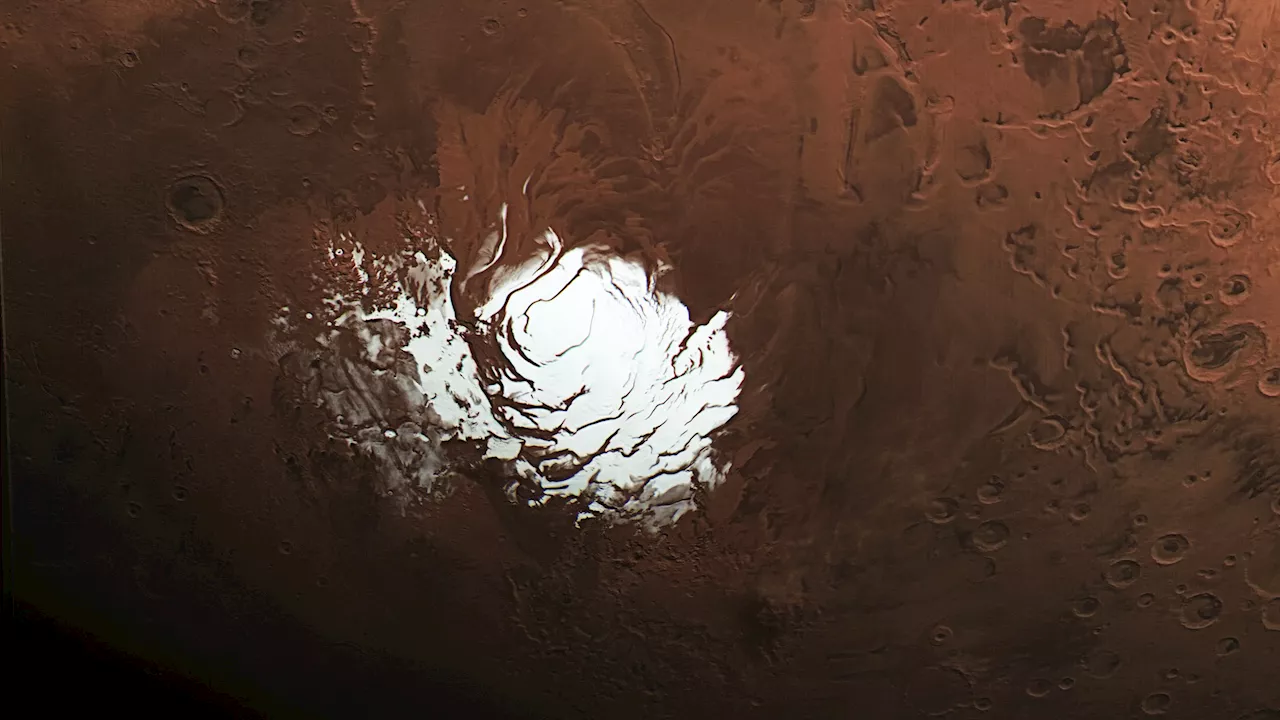
BREAKING: NASA’s Mars Reconnaissance Orbiter (MRO) has just revealed stunning new findings that challenge the existence of a suspected underground lake on Mars. Utilizing an innovative radar technique, scientists have determined that the area previously thought to be a lake is likely a layer of rock and dust. This development, announced on May 26, 2023, could shift our understanding of water on the Red Planet.
This urgent update follows the 2018 discovery by the European Space Agency’s Mars Express, which detected signals interpreted as an underground lake beneath Mars’ south polar ice cap. Now, researchers from NASA have revisited this enigmatic region, raising critical questions about the potential for life on Mars and the planet’s geological history.
The radar technique employed by the MRO, known as SHARAD, was enhanced through a unique maneuver that rolled the spacecraft 120 degrees. This adjustment allowed for deeper penetration of radar signals, revealing that the previously detected features do not match the bright signals typically associated with liquid water. Instead, the data suggests a more complex subsurface composition.
Gareth Morgan and Than Putzig, scientists from the Planetary Science Institute, led the study, indicating that while the lake hypothesis sparked significant scientific inquiry, the latest evidence makes it challenging to support the idea of liquid water existing beneath the ice.
The implications are profound. Water is essential for life, and understanding its presence on Mars is crucial for future exploration missions. “The lake hypothesis generated lots of creative work, which is exactly what exciting scientific discoveries are supposed to do,” said Morgan. “And while this new data won’t settle the debate, it makes it very hard to support the idea of a liquid water lake.”
NASA’s findings not only reshape our understanding of this Martian feature but also open the door for further exploration. The successful roll maneuver could be applied to other scientifically interesting regions on Mars, including the Medusae Fossae, where the presence of ice could indicate valuable water resources for human missions.
As scientists continue to analyze the data, the global scientific community watches closely. The MRO has been a pivotal player in Mars exploration since its launch in 2006, providing critical insights into the planet’s climate and geology. With this latest revelation, the quest to understand Mars and its potential to harbor life takes another significant turn.
Stay tuned for more updates as researchers delve deeper into the mysteries of the Red Planet, using advanced technology to unlock the secrets hidden beneath its icy surface.