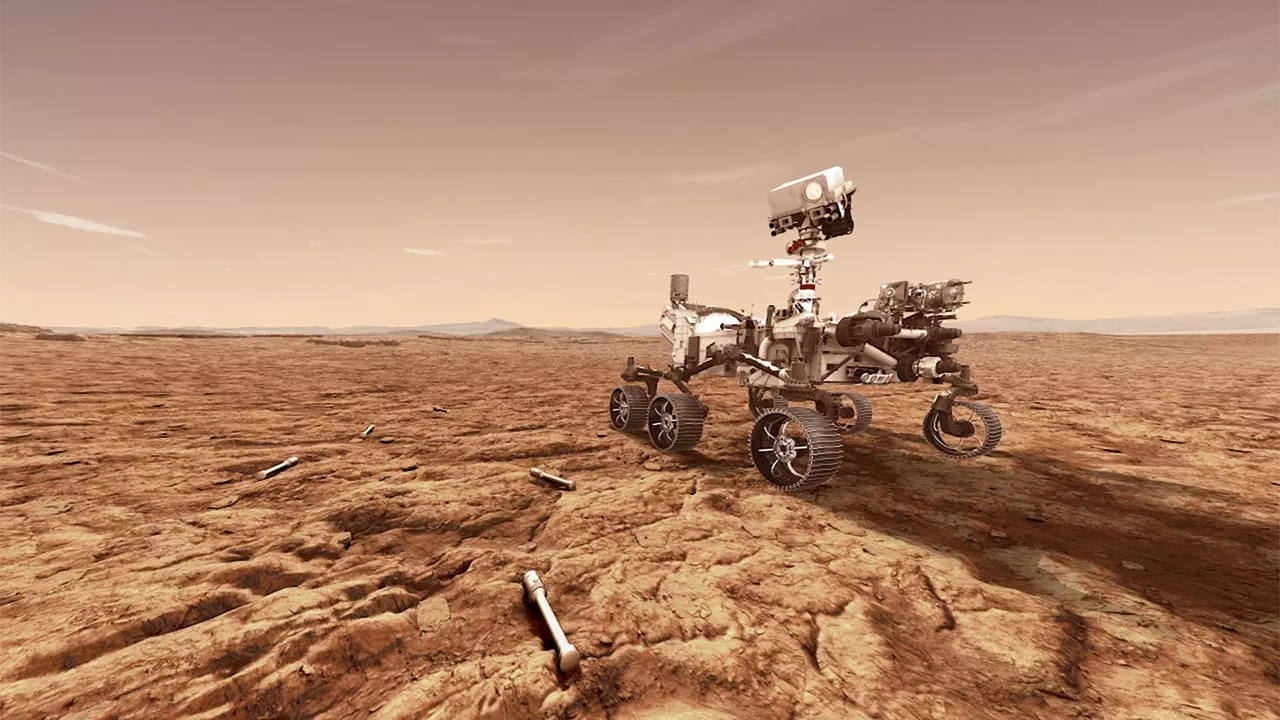
BREAKING: NASA’s Perseverance rover has potentially unearthed a meteorite on Mars, a major development in the quest to understand the planet’s history of cosmic visitors. Discovered just outside Jezero Crater, the shiny rock, nicknamed ‘Phippsaksla’, exhibits high levels of iron and nickel, sparking excitement among scientists.
This discovery comes as NASA confirms the rover’s first encounter with a metallic rock, a significant milestone after nearly four years of exploration. The shiny object caught the attention of the Perseverance team, prompting them to conduct immediate tests revealing a composition akin to meteorites found on both Mars and Earth.
According to a recent update on the rover’s mission page, the discovery of Phippsaksla could place Perseverance among other rovers like Curiosity, Opportunity, and Spirit, which have previously documented similar findings. NASA has emphasized that iron and nickel are elements typically associated with meteorites formed deep within ancient asteroids, not native Martian materials.
The rover’s SuperCam instrument, which utilizes a laser to analyze rock compositions, was directed at Phippsaksla to gather data. This technology allowed scientists to vaporize small samples of the rock and identify its chemical makeup from several meters away.
NASA notes that if Phippsaksla is confirmed as a meteorite, it will enhance our understanding of how such cosmic materials interact with the Martian surface over time. The rock’s location atop impact-formed bedrock outside Jezero crater could provide pivotal insights into its origin and how it arrived on Mars.
In a statement, NASA officials remarked, “This finding underscores the ongoing surprises Mars has in store, even at 140 million miles away.” The agency is actively pursuing further analyses to validate the meteorite hypothesis.
Perseverance, which launched on July 30, 2020, and landed on Mars on February 18, 2021, is equipped with state-of-the-art technology designed to search for signs of ancient microbial life. Built at NASA’s Jet Propulsion Laboratory in Pasadena, California, the rover has traveled over 293 million miles and carries a hefty price tag of $2.7 billion.
As the mission progresses, NASA is preparing for future human exploration of Mars in the 2030s, making the exploration of rocks like Phippsaksla crucial for understanding the planet’s past.
Stay tuned for more updates as NASA continues to analyze this exciting find, which could be a game-changer in our understanding of Mars and its history with meteorites.