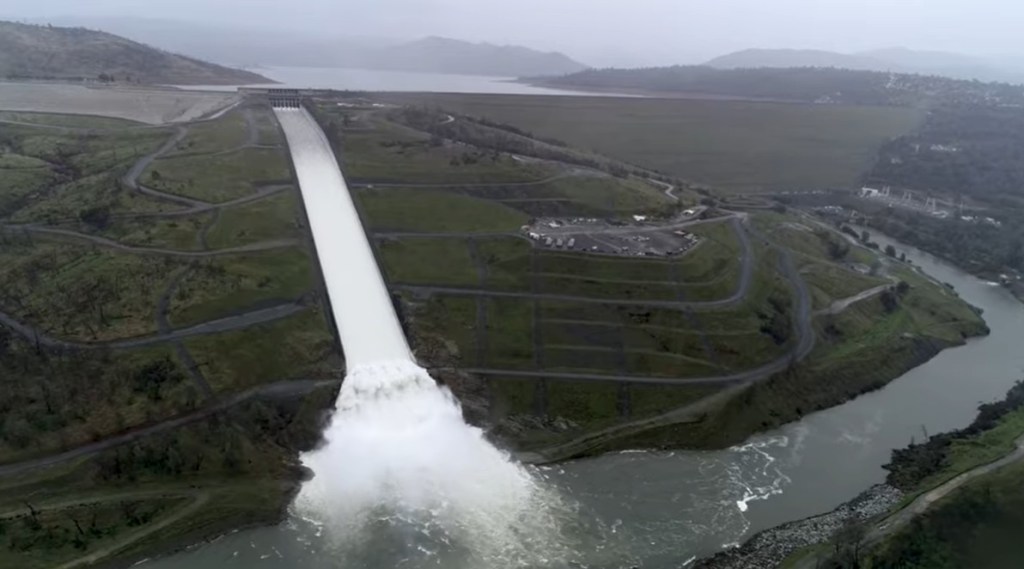
UPDATE: Oroville Dam, the tallest dam in the United States, has begun releasing water after a series of intense storms have rapidly filled California’s second-largest reservoir. Operators announced the opening of the spillway gates early Monday, releasing billions of gallons into the Feather River below to prevent potential flooding.
This urgent action follows 12 inches of rain in the Oroville watershed over the past three weeks, causing the reservoir’s level to spike dramatically. From 51% full to 75% full, Oroville now holds an astounding 2,578,222 acre feet of water, an increase of 837,554 acre feet—equivalent to 273 billion gallons, enough to fill 400,000 Olympic swimming pools.
Due to the rapid rise, engineers at the California Department of Water Resources opened the spillway gates at 6 a.m. on Monday, drastically increasing water releases from 1,856 cubic feet per second on Christmas Day to 16,135 cfs on Monday. However, the reservoir continues to rise approximately 3 feet per day as inflows remain twice the outflows.
“To maintain this storage space, DWR must increase releases from Lake Oroville,” the department stated, referencing U.S. Army Corps of Engineers regulations.
The urgency of this situation cannot be overstated. With a forecast of at least 10 days of sunny weather, the Department of Water Resources has already reduced outflows to 12,842 cfs as they aim to manage the reservoir levels effectively.
Notably, Oroville has been a critical indicator of California’s water supply, reflecting both drought and deluge conditions. Historically, it has filled to capacity during wet years but reached its lowest level ever in August 2022 at just 22% full, leading to the shutdown of its power plant due to insufficient water.
Oroville Reservoir serves as a vital water source for cities and farms across California, from San Jose to San Diego. This year’s early storms have brought a much-needed boost to the water supply, but experts emphasize the continuing need for more precipitation in the coming months to bolster reservoir levels and the Sierra Nevada snowpack, which constitutes 30% of the state’s water supply.
In past winters, such as 2017, Oroville made headlines when its spillway partially collapsed, prompting the evacuation of 188,000 residents. This winter, however, the outlook is far more positive, with water experts hopeful for additional storms in February and March.
The current situation at Oroville Dam highlights the delicate balance of managing California’s water resources—an ongoing challenge that impacts millions of residents. As authorities continue to monitor water levels, the focus remains on preventing flooding and ensuring a sustainable water supply for the state.
This situation is developing, and local authorities encourage residents to stay informed about potential updates and any necessary precautions as weather patterns evolve.