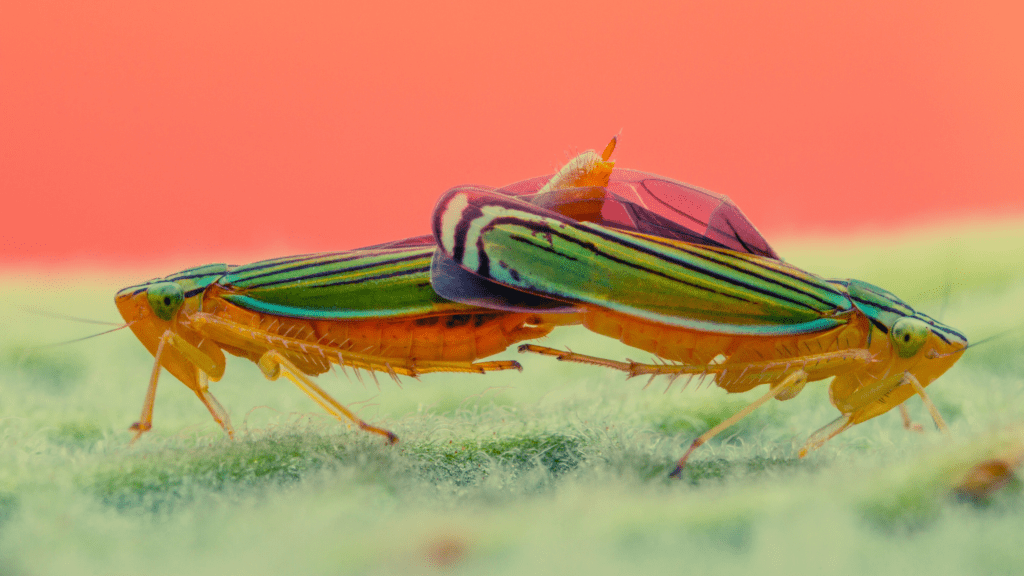
URGENT UPDATE: Scientists at Penn State University have successfully replicated the remarkable ‘invisibility’ technique of leafhoppers, common insects known for their ability to blend into leaves. This breakthrough, detailed in a study published in ACS Nano on October 15, 2023, could have wide-ranging applications across multiple industries.
Leafhoppers utilize microscopic particles called brochosomes to scatter light and reduce their visibility to predators. The Penn State team has mimicked this natural phenomenon in the lab, demonstrating a stunning 80 to 96 percent reduction in reflected glare across visible and ultraviolet light. This significant reduction in glare could revolutionize fields such as energy device performance and optical materials.
The research team developed a novel microfluidic system that creates droplets of dissolved polymers. As the solvent evaporates, it forms hollow spheres with intricate patterns resembling those found in nature. By adjusting the polymer chemistry, they successfully recreated five distinct brochosome designs, with sizes ranging from a few hundred nanometers to about two micrometers. Impressively, this method can produce over 100,000 particles per second, vastly outpacing traditional nanoscale manufacturing techniques.
The implications of this discovery are profound. Potential uses include enhanced military camouflage and advanced drug delivery systems, leveraging the unique shape and surface properties of these particles. While the practical applications will require further testing, the researchers are excited about the possibilities.
What makes this study particularly compelling is its origin from a seemingly ordinary backyard insect. The leafhopper’s evolutionary adaptation to manage light has now inspired innovative scientific methods that could be extended beyond laboratory settings.
As scientists continue to explore and validate these findings, the excitement builds. This research not only showcases the wonders of nature but also opens doors for technological advancements that can profoundly impact various sectors. Keep an eye on future developments from Penn State as they push the boundaries of science and technology.
Stay tuned for updates on this fascinating intersection of biology and engineering, as the potential for real-world applications continues to unfold.