BREAKING: Scientists have made a groundbreaking discovery along California’s north coast, revealing previously concealed fault lines that could trigger devastating earthquakes up to magnitude 8.0. This urgent finding highlights the potential underestimation of seismic risks in the region, as reported in the latest study published in the journal Science.
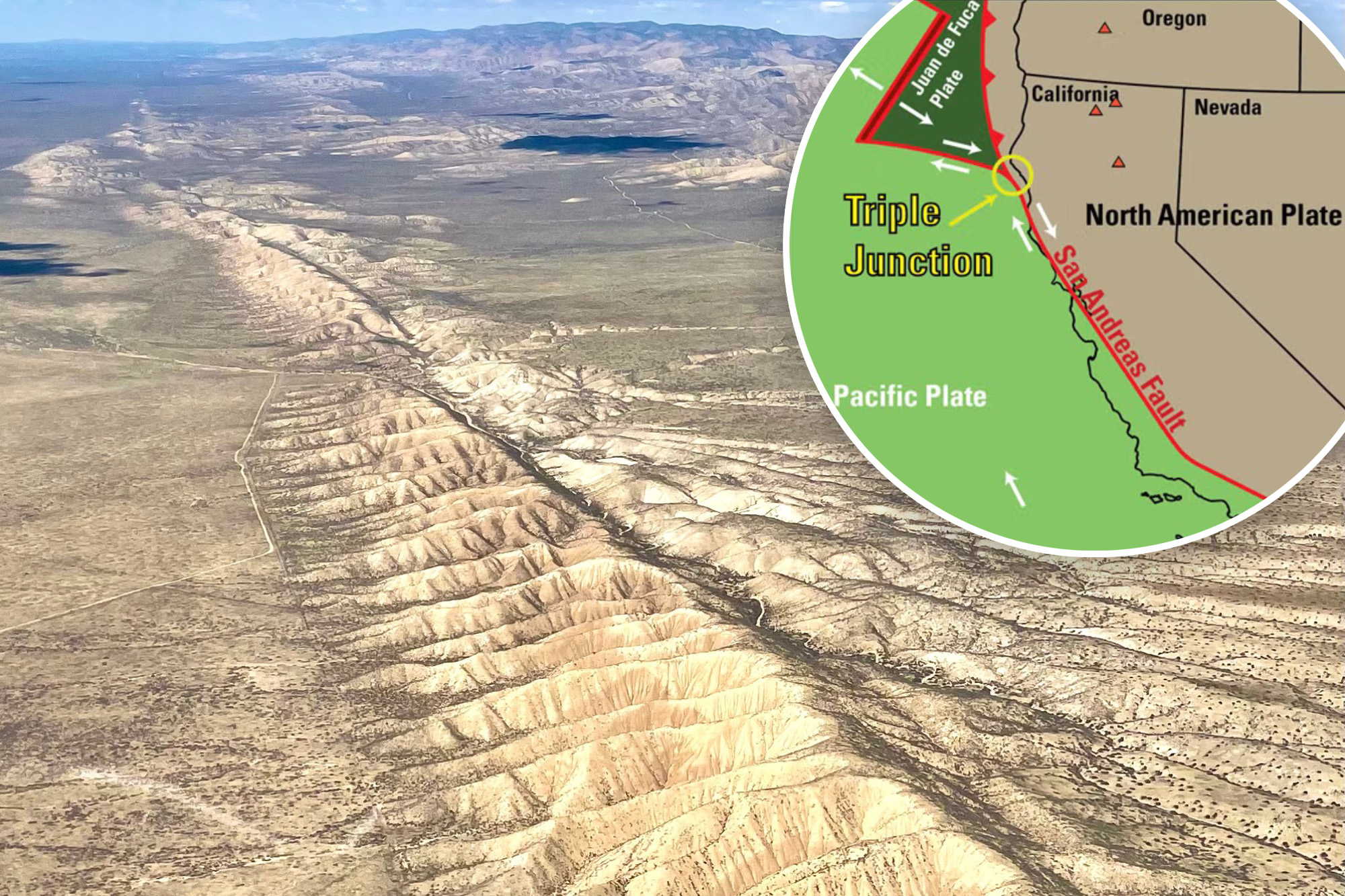
The research focuses on the Mendocino Triple Junction, a seismic hotspot where three tectonic plates converge: the San Andreas Fault, the Cascadia Subduction Zone, and the Mendocino Fault. However, new findings indicate that this area is actually comprised of five moving plates, two of which are hidden beneath the surface. This discovery raises alarms for the millions living in the affected regions.
Lead author David Shelly of the USGS Geologic Hazards Center in Colorado likened the situation to “only seeing the tip of the iceberg.” In a statement, he emphasized the need to understand the underlying tectonic processes to accurately predict seismic hazards.
Researchers utilized a network of seismometers in the Pacific Northwest to track “low-frequency” earthquakes that occur deep underground, where tectonic plates grind against each other. These tremors, too small to detect at the surface, were confirmed through tidal-sensitivity models, revealing the presence of previously theorized tectonic threats.
One significant finding is a fragment of the North American plate that has broken off and is being pulled down with the Gorda plate at the southern end of the Cascadia subduction zone. Additionally, the existence of the Pioneer fragment, a remnant of the ancient Farrallon plate, has been validated. This fragment is being dragged under the North American plate, a process known as subduction.
The implications are alarming, as the subducting surface is not as deep as previously believed. This could explain the shallow origin of the 1992 Humboldt County earthquake, which reached a magnitude of 7.2. Tectonic geodesist Kathryn Materna from the University of Colorado Boulder noted, “It had been assumed that faults follow the leading edge of the subducting slab, but this example deviates from that.”
The stakes have never been higher for residents of California and the surrounding areas. With seismic activity potentially escalating, authorities urge communities to prepare for possible future earthquakes. Scientists are now calling for increased monitoring and research in the Mendocino Triple Junction to better understand the seismic hazards that lie beneath.
As this story develops, experts are emphasizing the necessity for public awareness and readiness. The ramifications of this discovery could reshape how we approach earthquake preparedness in one of the most seismically active regions in the United States.
Stay tuned for further updates on this critical issue, as researchers continue to delve into the complexities of our planet’s tectonic behavior. This urgent situation is one that everyone should be aware of and prepared for, as the ground beneath California may be more unstable than we ever imagined.