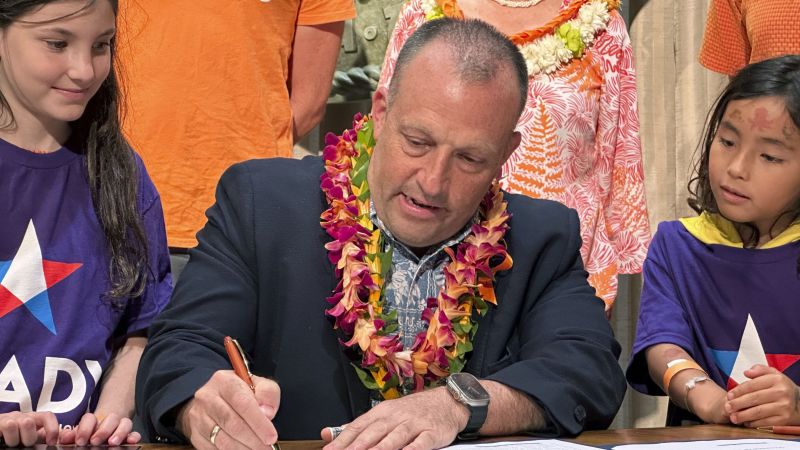
UPDATE: The Supreme Court is set to hear critical arguments today, October 3, 2023, on a controversial Hawaii law that restricts individuals from carrying firearms onto private property without explicit consent from the property owner. This law is designed to limit firearms in public spaces, including retail stores, and is a pivotal moment in the ongoing gun rights debate in the United States.
This case, known as Wolford v. Lopez, is the latest challenge to gun regulations following the high court’s 2022 decision that broadened Second Amendment rights, confirming the constitutional right to bear arms outside the home. Hawaii’s law, enacted in response to this landmark ruling, requires concealed carry license holders to obtain direct approval from property owners before bringing firearms onto their premises.
Gun control advocates argue that this law is rooted in property rights rather than a direct limitation of Second Amendment guarantees. They assert that property owners have the long-standing authority to dictate what can be brought onto their land. Douglas Letter, chief legal officer at the gun control group Brady, emphasized, “Since our founding as a nation, private property rights have been foundational to American identity.”
Four other states—California, New York, New Jersey, and Maryland—have implemented similar regulations, but challengers claim that Hawaii’s law is the most extreme. It currently remains on hold pending the Supreme Court’s decision, which follows a split ruling from the 9th Circuit Court of Appeals that favored Hawaii’s law despite vigorous dissent.
Opponents of the Hawaii law, including concealed carry permit holders, argue that it violates the Second Amendment by making it the default assumption that firearms are prohibited in most public spaces. They contend that the requirement for consent effectively criminalizes carrying firearms in areas that should otherwise be open to them. “The right to prohibit firearms belongs to the property owner, not the State,” their court filings state.
Hawaii’s Attorney General Anne Lopez counters that the law does not infringe upon activities protected by the Second Amendment, asserting that it aligns with the requirements established in the Bruen ruling. Lopez’s defense highlights historical precedents from both the Founding Era and Reconstruction, citing numerous state laws that prohibited armed entry onto private property without explicit consent.
“Requiring evidence of a more extensive and widespread historical tradition would turn the Second Amendment into a ‘regulatory straightjacket,’” Hawaii officials argue.
As the Supreme Court prepares to deliberate, the case has drawn national attention due to its implications for gun rights and property laws. The outcome could set a significant precedent, impacting similar regulations across the country and shaping the future landscape of the Second Amendment.
With the stakes high, all eyes will be on the Supreme Court’s ruling in the coming weeks. The implications of this case may redefine the balance between individual rights and property owner autonomy in the United States.