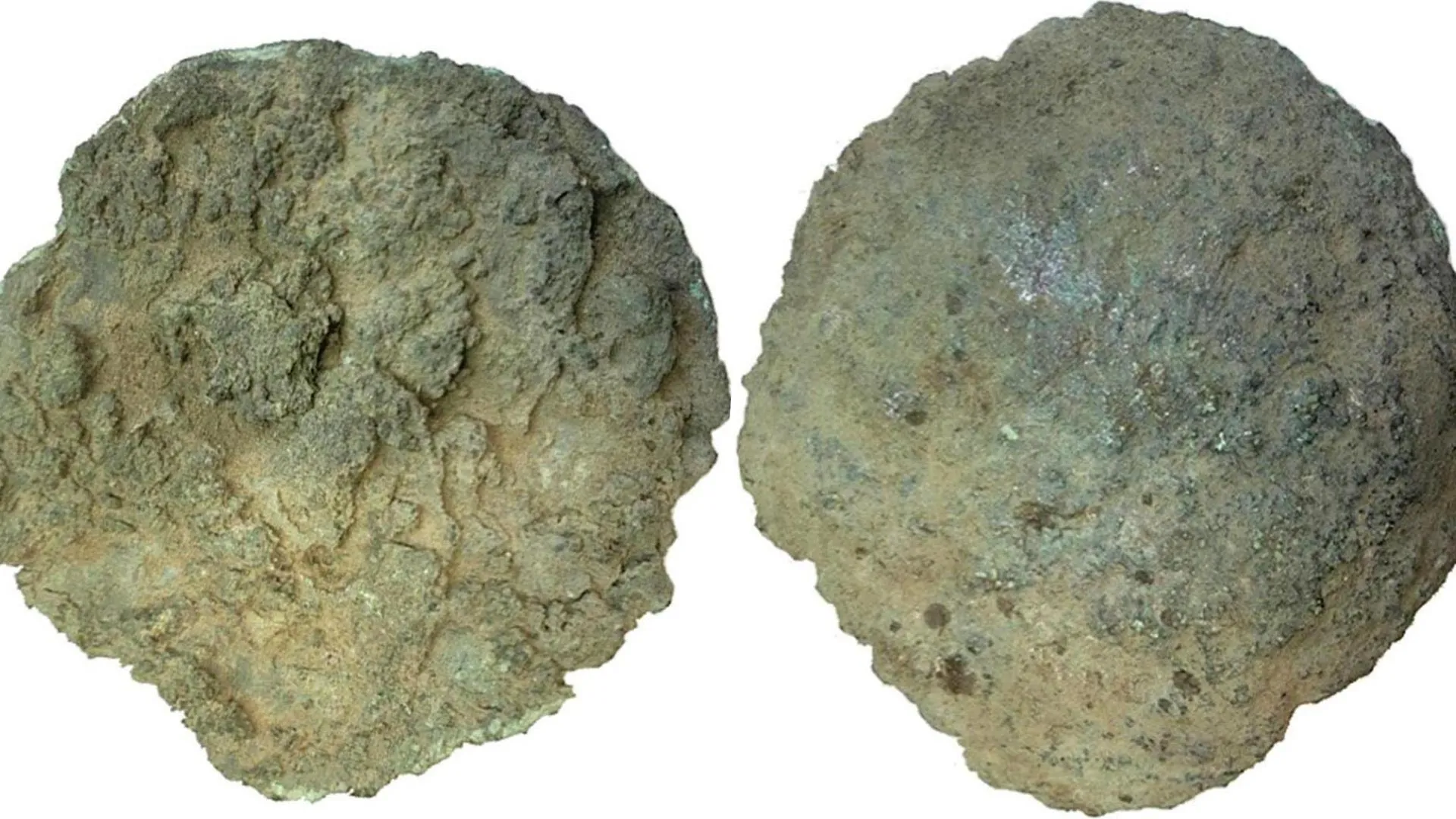
UPDATE: A groundbreaking discovery in Sweden is shaking up our understanding of Iron Age history. Researchers from the University of Gothenburg have confirmed that a previously identified Bronze Age plano-convex ingot actually belongs to the Iron Age, thanks to advanced chemical and isotopic testing.
The ingot, recovered from the Särdal Find, was initially misclassified due to its shape and size. However, tests revealed its composition—a copper-zinc-tin-lead alloy—typical of the Iron Age, aligning closely with findings from Poland. This revelation opens new avenues for understanding ancient trade networks across the Baltic region.
Researchers were surprised by the findings, as lead researcher Serena Sabatini explains, “Due, in particular, to its shape and size, it seemed to us a Bronze Age artifact, but the ingot turned out to be made of a copper-zinc-tin-lead alloy, typical of the Iron Age and later periods.”
This discovery is significant because it highlights the importance of collaboration in archaeology. The research team worked with Polish scholars who had discovered Iron Age artifacts with similar compositions. Sabatini emphasized, “Without the successful collaboration with our Polish colleagues, we would have never achieved such remarkable results!”
The Särdal ingot marks the first complete plano-convex ingot found in Sweden, illustrating how isolated artifacts can contribute to a broader historical understanding. The study, published in the Journal of Archaeological Science, showcases how scientific analysis can recontextualize our past.
This finding also underscores how ancient societies were more interconnected than previously thought. The results bolster existing hypotheses about trade and networking in the Baltic area during the Nordic pre-Roman Iron Age. Sabatini stated, “Networking and international collaboration are also important to unveil patterns and data that would remain unknown when one looks exclusively at the local context.”
The research team employed well-established archaeometallurgical techniques, including lead isotope and trace element analyses. These methods have been instrumental in revealing the geological sources of metal artifacts since the 1980s. However, this study goes further by integrating the analytical data with historical and archaeological information, providing a richer context for the ingot’s origins.
As this story develops, the implications of the Särdal Find will continue to resonate in the world of archaeology. Scholars and enthusiasts alike are eager to see how this discovery will reshape our understanding of ancient trade routes and cultural exchanges.
Stay tuned for more updates on this exciting development in Iron Age research.