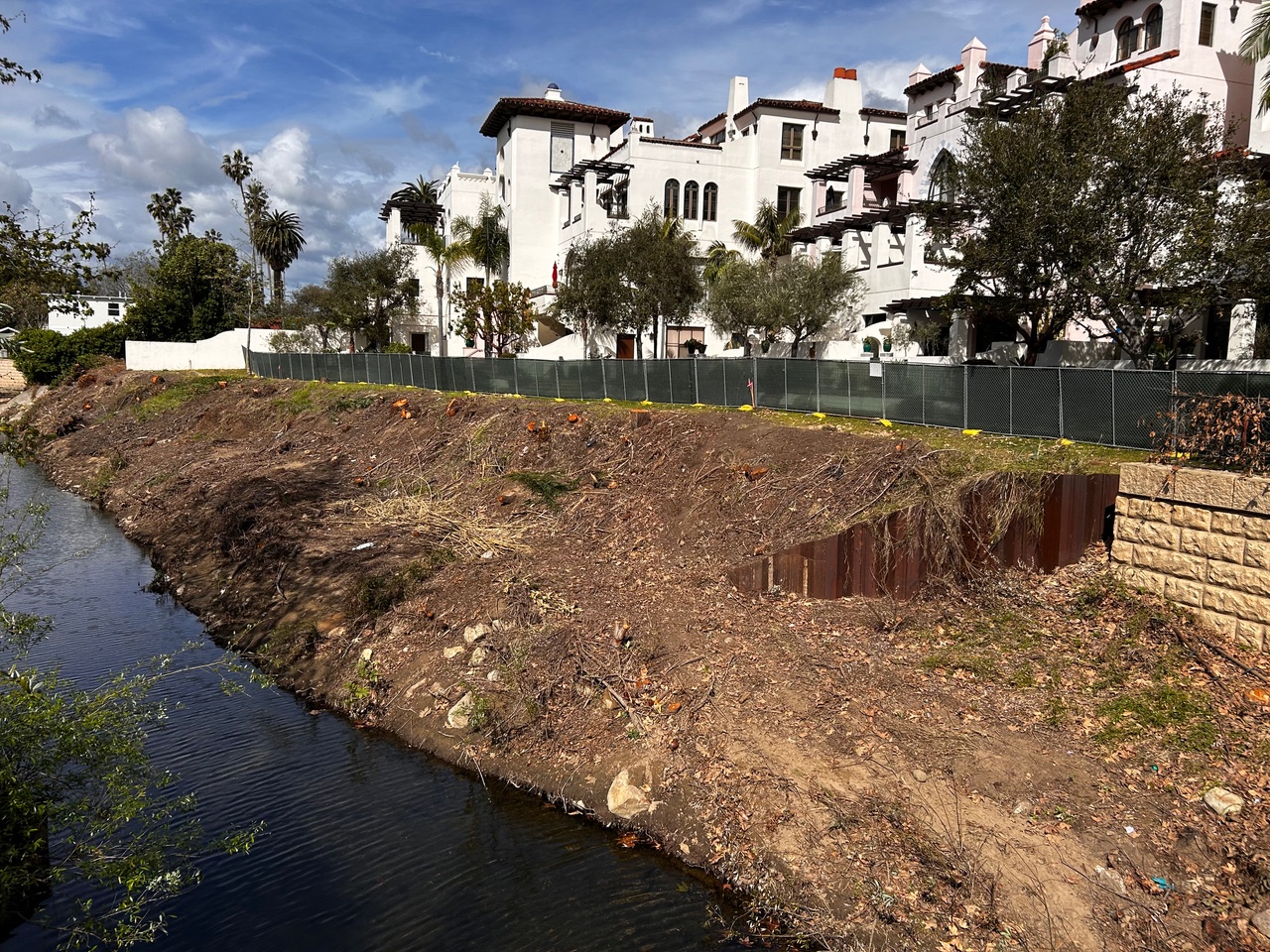
URGENT UPDATE: The removal of 30-foot sycamores has just taken place behind the Sevilla condos at 401 Chapala Street, marking the beginning of a critical $13 million widening project for Mission Creek in Santa Barbara. These beloved trees, which offered shade and privacy to residents, were sacrificed to mitigate flooding risks in downtown.
The Santa Barbara County Flood Control and Water Conservation District confirmed the removal as part of a larger initiative to widen Mission Creek from the Gutierrez Bridge to Haley Street, a project expected to last one year. The creek has a history of flooding, with significant events recorded in 1995, 1998, 2005, and 2010-11, making this development urgent for local safety.
Paul Portney, president of the Sevilla Homeowners Association, expressed deep concern, stating, “Those trees provided screening, not only for us but also for the units on De La Vina on the other side of the creek.” The loss of the trees has left residents with a stark view of the creek’s concrete banks and tree stumps, prompting feelings of grief among the condo community.
County officials explain that extensive studies led to the decision to cut down the sycamores, with some trees saved that did not interfere with construction needs. “Nobody likes cutting down trees,” said Andrew Raaf, environmental manager for the Flood Control District. “We’ll need to excavate the soil under them, with massive heavy equipment working in the area.”
The project aims to widen the creek bed by up to 20 feet in some areas, allowing for 3,400 cubic feet per second of water flow—adequate for a 20- to 25-year flood. This enhancement is designed to prevent future flooding and includes the construction of sloped banks and decorative retaining walls.
Construction is set to commence in mid-March and is expected to wrap up before the winter rains. “I think we would have seen damage at the Amtrak station,” noted Matt Griffin, engineering manager for county flood control, referencing the success of previous phases of the project in mitigating flood risks during heavy rains.
Planners aim to make the finished project visually appealing and safer for the community. They plan to replant the area with native species, including sycamores and willows, ensuring a return to some of the natural beauty lost in this process. However, Portney warns residents to prepare for a year of disruption, particularly those living on the lower floors of the condos.
The urgency of this project cannot be overstated, as flooding poses a substantial threat to the neighborhood. The U.S. Army Corps of Engineers has been studying improvements to Mission Creek since the 1960s, highlighting the longstanding need for this infrastructure work.
As residents grapple with the loss of their trees, they also acknowledge the necessity of these changes for the greater good. Portney summarized the sentiment, stating, “I’d prefer that this could be done overnight with a magic wand, but we understand it’s a big project, and there’s going to be disruption.”
Stay tuned for updates as construction progresses and community members adapt to the changes along Mission Creek.