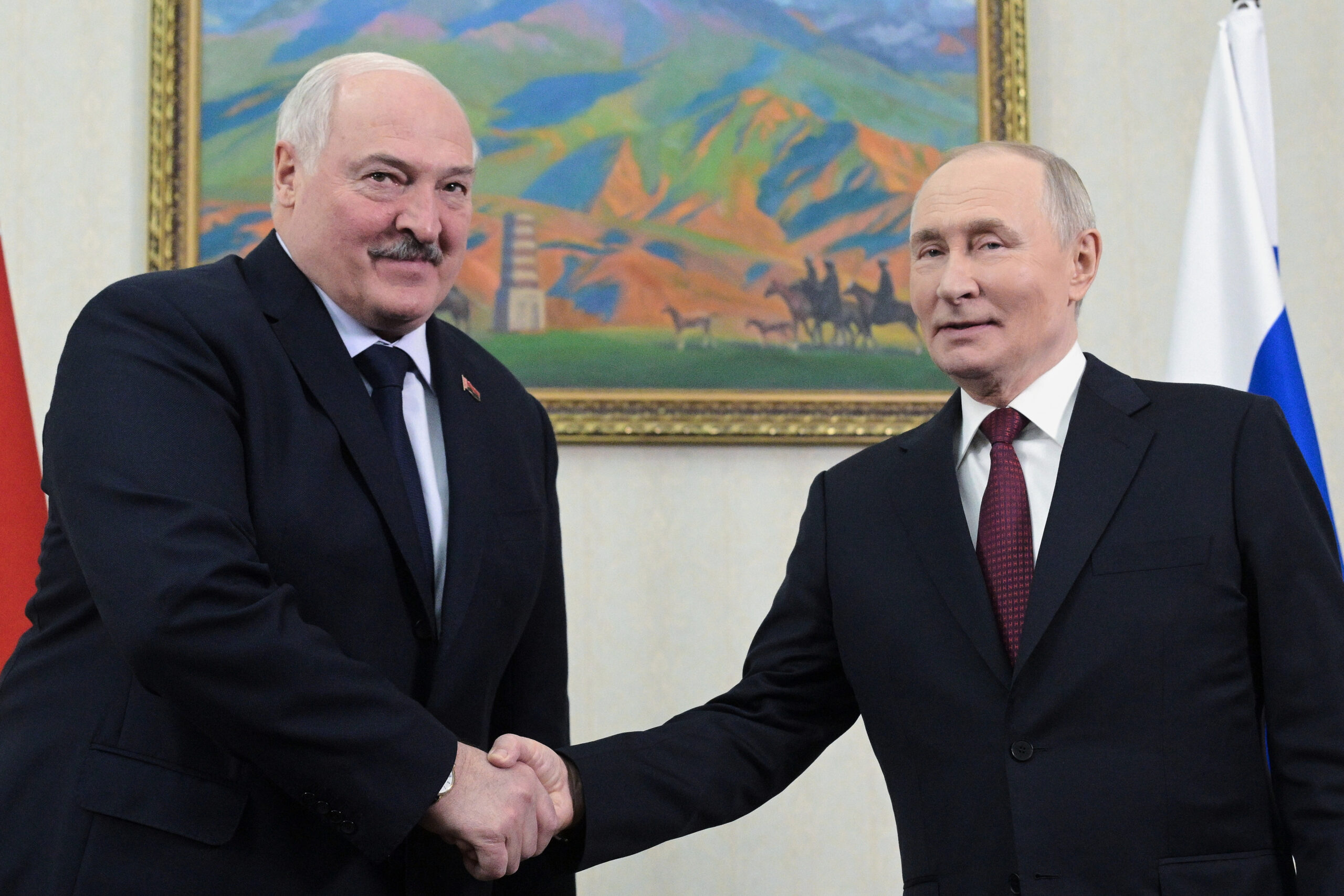
Belarus has officially received the Russian nuclear-capable Oreshnik missile system, according to President Alexander Lukashenko. This announcement came on Thursday, just as peace talks regarding the ongoing conflict in Ukraine reach a pivotal moment. Lukashenko stated that the missile system arrived in Belarus on Wednesday and is now entering combat duty, although he did not disclose the number of missiles deployed or provide further details.
During a meeting with senior military officials, Russian President Vladimir Putin confirmed that the Oreshnik would be operational within the month. He emphasized that Moscow would continue to pursue its objectives in Ukraine if Kyiv and its Western allies remain unyielding in the negotiations. This deployment marks a significant escalation in military capabilities for Belarus, which has previously hosted Russian tactical nuclear weapons.
The Oreshnik, an intermediate-range ballistic missile, is designed to strike targets at distances between 500 and 5,500 kilometers (approximately 310 to 3,400 miles). Its deployment follows a history of military cooperation between Russia and Belarus, particularly in light of the ongoing conflict that began with Russia’s full-scale invasion of Ukraine in February 2022. Lukashenko has previously stated that Belarus hosts several dozen Russian tactical nuclear weapons.
Military Capabilities and Strategic Implications
Putin has touted the Oreshnik’s advanced features, claiming that its multiple warheads can penetrate defenses at speeds reaching Mach 10. He has warned that the missile could be used against countries allied with Ukraine that permit strikes on Russian territory. Russian state media reported that the missile could reach an air base in Poland in just 11 minutes and NATO headquarters in Brussels within 17 minutes. The ambiguity surrounding whether it carries a nuclear or conventional warhead before impact adds to the system’s strategic significance.
In December 2024, during the signing of a security pact with Lukashenko, Putin indicated that while Russia maintains control over the Oreshniks, Belarus would have the authority to select targets. This arrangement raises concerns about the potential for Belarusian involvement in future military actions, particularly against neighboring countries.
The Kremlin’s revised nuclear doctrine, released in 2024, has further implications for regional security. It asserts that any conventional attack on Russia supported by a nuclear power will be regarded as a joint assault on Russia itself. This stance appears to lower the threshold for the possible use of Russian nuclear weapons and extends the Russian nuclear umbrella to Belarus.
Domestic and International Reactions
Lukashenko’s regime, which has faced international criticism and sanctions for its human rights record and cooperation with Russia, has maintained a delicate balance in its foreign relations. Although he has strengthened ties with Moscow, Lukashenko has also sought a rapprochement with the United States. Recent developments included the release of 123 political prisoners, including Nobel Peace Prize laureate Ales Bialiatski, following a deal to lift U.S. sanctions on Belarusian potash exports.
Opposition leader Sviatlana Tsikhanouskaya has condemned the missile deployment, stating that it exacerbates Belarus’s military and political dependence on Russia. She remarked, “The deployment of Oreshnik turns Belarus into a target and militarizes the country, and we stand categorically against it.” Tsikhanouskaya characterized Lukashenko as a tool for Kremlin ambitions, underscoring the ongoing internal and external pressures facing the Belarusian government.
As the situation unfolds, the implications of the Oreshnik missile deployment will likely reverberate throughout the region, influencing diplomatic negotiations and military strategies in a conflict that has already reshaped the geopolitical landscape of Eastern Europe.