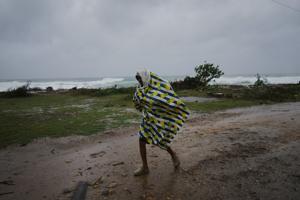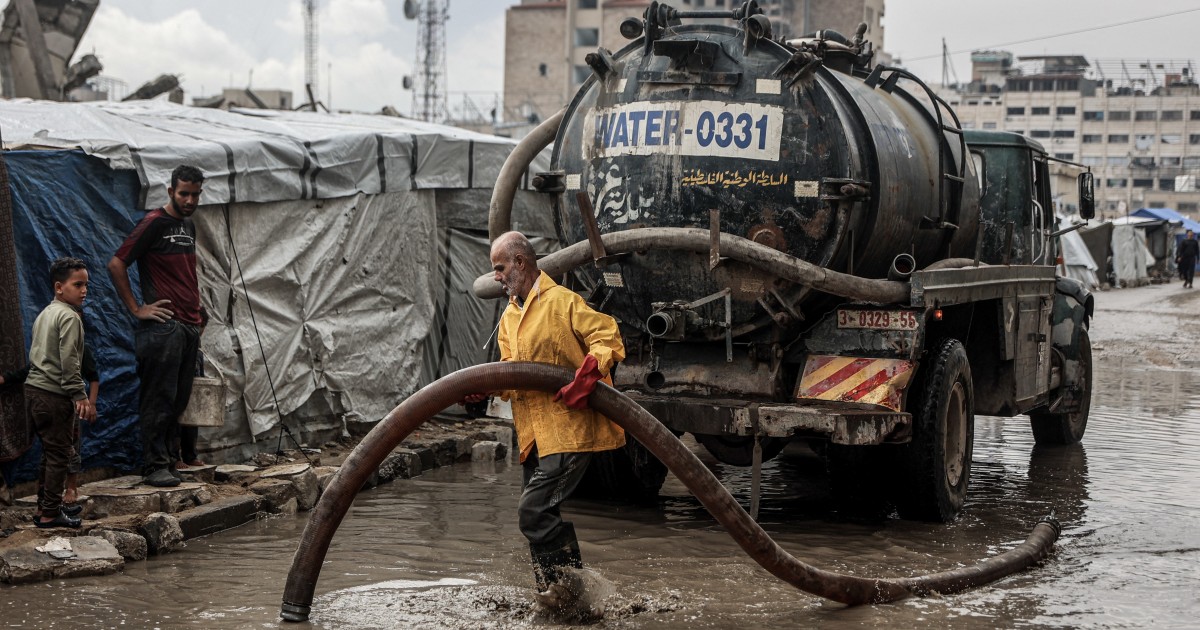
Heavy rainfall inundated camps throughout Gaza on March 2, 2024, exacerbating already dire conditions for the region’s displaced population. Roads transformed into rivers, while families huddled inside tents, struggling to keep floodwaters at bay. With the onset of colder weather, the urgency of humanitarian concerns for Gaza’s two million residents has intensified.
In Gaza City, **Sana Abu Harad**, a 38-year-old mother, expressed her desperation as she pointed to her shivering child and the drenched bedding in their tent. “Everything is underwater,” she told NBC News. “Why must this little child sleep in floodwater? I struggled so much just to get this tent, and now nothing protects us. Where will I live with my children now?”
The flooding crisis has been worsened by the collapse of essential water and sewage systems. Following two years of Israeli strikes that devastated key infrastructure, many residents find themselves in overcrowded areas lacking basic sanitation. According to the **International Organization for Migration (IOM)**, over 1.5 million individuals in Gaza urgently need emergency shelter assistance.
**Mahmoud Basal**, spokesman for Gaza’s Civil Defense agency, described the situation as a “true catastrophe.” He noted that the mixing of rainwater with sewage poses serious health risks, stating, “There is no sewage system, no rainwater drainage system, and no water reservoirs; all of them have been destroyed by Israel, along with all the infrastructure.”
Humanitarian efforts continue to face significant obstacles. The **United Nations** reported last week that Israel has denied over 100 requests for the entry of essential relief materials, including blankets, winter clothes, and supplies for water, sanitation, and hygiene services. **Deputy U.N. Spokesperson Farhan Haq** highlighted how these restrictions impede assistance for those in need.
In contrast, **COGAT**, the Israeli body responsible for coordinating humanitarian aid, asserted that hundreds of trucks carrying food, water, fuel, and medical supplies enter Gaza daily. Despite this claim, many residents remain without adequate shelter or resources to protect themselves from the elements.
As international diplomacy continues, the **U.N. Security Council** is set to vote on a U.S. proposal for a U.N. mandate for an international stabilization force in Gaza. This proposal has drawn criticism from Russia, China, and several Arab nations, reflecting the complex geopolitical tensions surrounding the region.
Tensions have also escalated within Israel’s government. A recent joint statement in support of the U.S. resolution, which emphasized Palestinian self-determination, has incited backlash from far-right members of Prime Minister **Benjamin Netanyahu**’s Cabinet. **Itamar Ben-Gvir**, Israel’s National Security Minister, and **Bezalel Smotrich**, Finance Minister, have publicly urged Netanyahu to firmly reject any notion of a Palestinian state.
Netanyahu, reliant on ultranationalist support to maintain his majority, reiterated his opposition to a Palestinian state during a government meeting, asserting that Israel’s position has not changed. “I don’t need reinforcements and tweets and lectures from anyone,” he declared.
The ongoing humanitarian crisis in Gaza, compounded by the harsh weather and damaged infrastructure, leaves those affected in a precarious situation. **Ma’in Albuhteiti**, a resident in Gaza City, described the harsh realities faced by his family of eight. “We were completely flooded; we couldn’t move. The situation is extremely tragic,” he lamented.
With urgent needs unmet and the threat of further storms looming, the people of Gaza can only hope for improved conditions in the future.