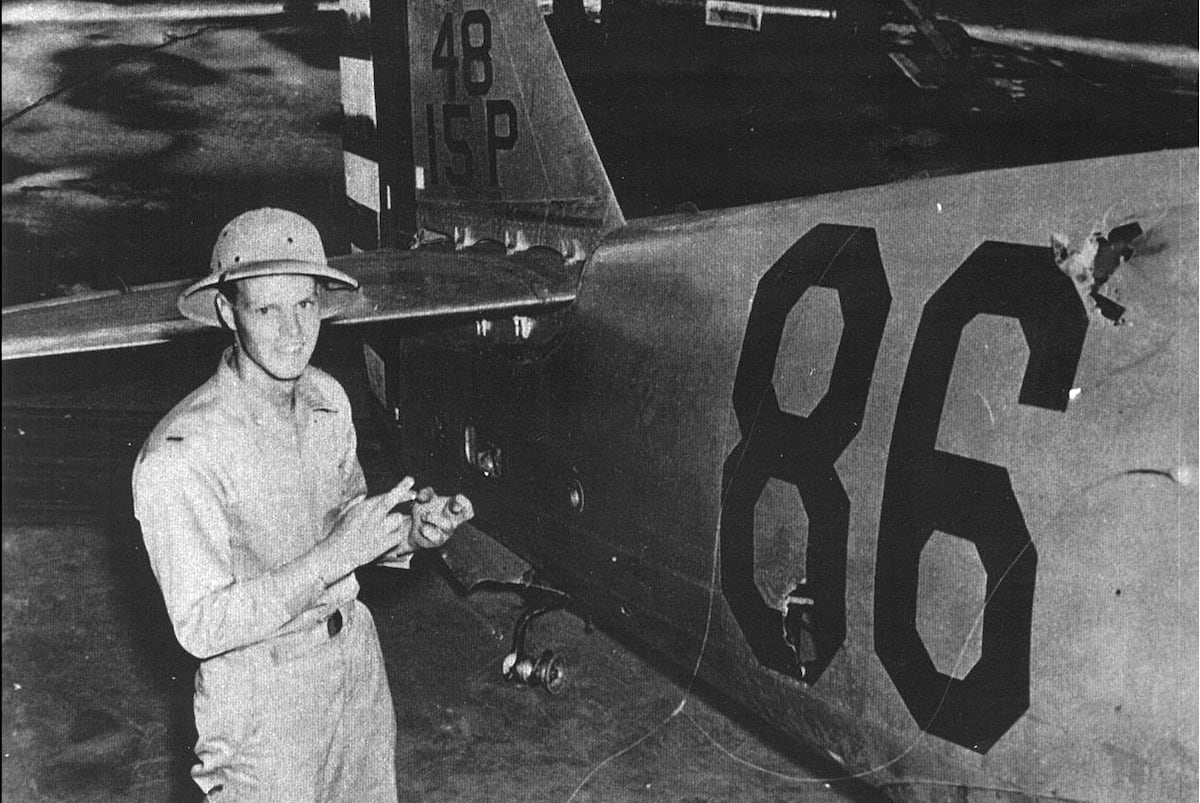
On the morning of December 7, 1941, as Japanese planes launched a surprise attack on Pearl Harbor, Lieutenant Philip M. Rasmussen of the U.S. Army Air Corps sprang into action. Assigned to the 46th Pursuit Squadron at Wheeler Field on Oahu, he became one of the few American pilots to take to the skies during the assault. His courageous response would earn him a Silver Star for valor that day, marking a significant moment in the unfolding narrative of World War II.
Rasmussen’s journey to this pivotal moment began in September 1940, when he entered flight training. By April 1941, he had completed his training and was assigned to Wheeler Field. Despite the absence of direct communication regarding an impending conflict, there was a palpable sense among the pilots of the potential for war with Japan. In his diary, Rasmussen recorded a letter from his father on December 2, expressing concerns about escalating tensions. Just days later, he noted in his diary that diplomatic efforts had faltered, signalling an ominous turn in relations.
As the fateful morning unfolded, Rasmussen was in the barracks when he witnessed a Japanese aircraft dive towards the hangar. “I saw this huge orange explosion of smoke and orange flames,” he recalled. Realizing the gravity of the situation, he ran to arm himself and head toward the flight line, donning a webbed belt and a .45-caliber pistol. The chaos around him escalated as enemy planes strafed the area, and he noted the immediate destruction of aircraft lined up wingtip to wingtip.
Rasmussen managed to reach a Curtiss P-36, starting the engine with urgency. An armorer assisted him by supplying ammunition, and Rasmussen taxied towards earthen revetments for cover. “Each airplane was exploding and igniting the one next to it because they were so close together,” he described, highlighting the perilous environment. Once loaded, he and his fellow pilots took off in formation, determined to defend their base.
Upon reaching altitude, they were directed towards Kaneohe Bay, where they spotted enemy aircraft preparing for another attack. “We dove down and were going to jump these aircraft,” he recounted. During the engagement, Rasmussen successfully hit one of the enemy planes, but the encounter quickly turned dangerous when another Japanese aircraft attempted to ram him, resulting in damage to his own plane.
Rasmussen’s aircraft was severely compromised, losing its canopy and rudder control. He maneuvered into the clouds, relying on his training to maintain control despite the chaos. “Our actions were preceding our thoughts,” he said, illustrating the instinctual responses required in such high-pressure situations.
After a harrowing flight back to Wheeler Field, he was escorted by fellow pilot Lew Sanders. As they approached their base, friendly forces mistakenly opened fire, but fortunately, they recognized Rasmussen’s aircraft as friendly. Upon landing, he faced additional challenges; his hydraulic systems had failed, and he had to pump manually to lower the landing gear. The aircraft came to a halt on the wet grass, and he emerged dazed but unharmed.
In the aftermath, Rasmussen changed into a flight suit and returned to assist with the ongoing emergency. The destruction he witnessed was overwhelming, with many planes destroyed or damaged beyond repair. His experiences that day would remain etched in his memory, a testament to the chaos and heroism displayed in one of the most significant events in American military history.
Philip M. Rasmussen continued to serve throughout the war, participating in various combat missions, including a bombing run over Japan, for which he was awarded the Distinguished Flying Cross. He eventually retired as a lieutenant colonel in 1965 and passed away in 2005 at the age of 86. Today, he rests at Arlington National Cemetery, a reminder of the bravery displayed on that fateful day in December.