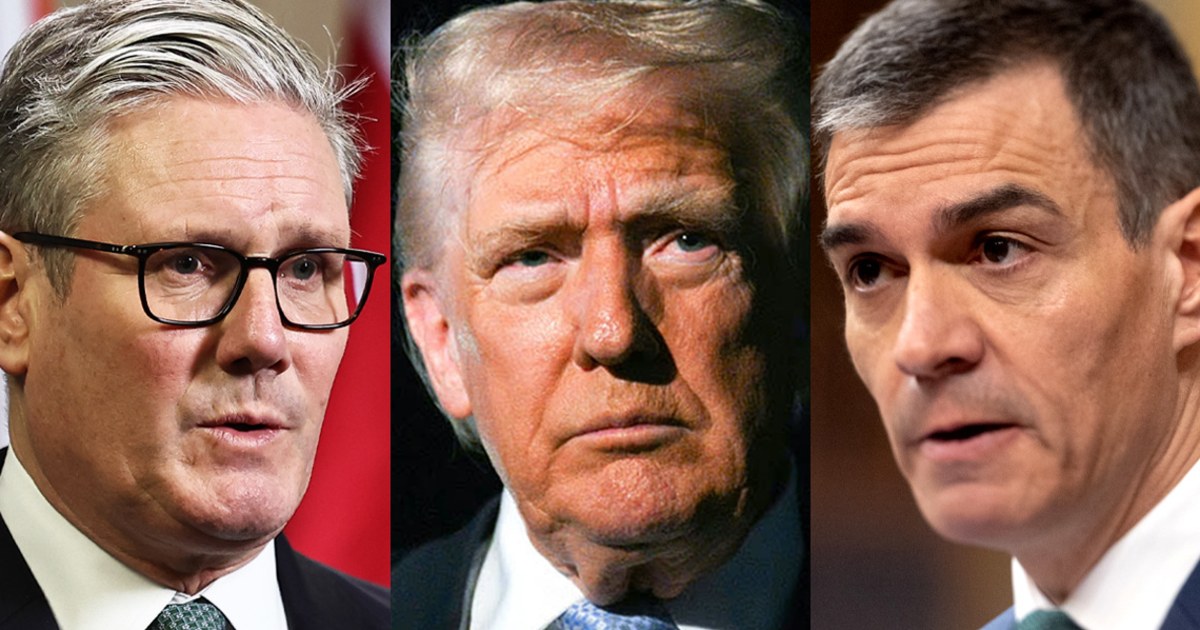
Tensions are escalating between the United States and its European allies as President Donald Trump voices frustration over their limited support in the ongoing conflict with Iran. Following a series of diplomatic clashes, including threats of trade sanctions, Trump’s dissatisfaction has reached new heights, particularly after the U.K. and Spain restricted U.S. military operations.
On March 15, 2024, Trump expressed his discontent when U.K. Prime Minister Keir Starmer initially denied access to British bases for U.S. airstrikes against Iran. Although the U.K. later permitted the use of its bases for defensive operations, the delay prompted Trump to assert, “This is not Winston Churchill that we’re dealing with.” His frustrations were compounded when Spain barred U.S. military planes from using joint bases in Andalusia, leading Trump to threaten to “cut off all trade with Spain,” a member of the European Union’s single market.
European leaders have reacted cautiously to the U.S. military actions. French President Emmanuel Macron stated that the strikes on Iran fall “outside the framework of international law,” further aggravating Trump. In contrast, some European leaders have maintained favorable relations with the U.S. German Chancellor Friedrich Merz, for instance, has allowed the U.S. to utilize the Ramstein Air Base during the conflict, prompting Trump to commend Germany’s cooperation.
Italy’s dealings have also garnered Trump’s praise. According to the Italian newspaper Corriere della Sera, Trump referred to Italian Prime Minister Giorgia Meloni as a “great leader” for her support of existing military agreements. The White House has echoed this sentiment, with press secretary Karoline Leavitt noting that Trump expects all European allies to cooperate in what he describes as a critical mission against Iran.
Despite these tensions, many European nations are still unified in their approach to Iranian threats. Spain, Italy, France, and the Netherlands have deployed naval and air assets to Cyprus following an Iranian drone strike on a British base. Spain has positioned its most advanced warship in the eastern Mediterranean, highlighting its commitment to European defense cooperation.
European Union foreign policy chief Kaja Kallas remarked that the U.S. foreign policy shift has “rocked the trans-Atlantic relationship to its foundation.” She accused Iran of being “an exporter of war” and indicated that the EU aligns with the U.S. perspective on Iranian actions. However, experts caution against overinterpreting the varying responses from Europe.
Fawaz Gerges, a professor of international relations at the London School of Economics, emphasized that European governments likely still support the U.S. in principle. “We should not really focus on the rhetoric of European leaders,” he said, urging observers to consider their actions, including the deployment of military resources to support the U.S. and Israel.
Trump’s calls for European support underscore a desire for a mutually beneficial relationship, despite the evident strains. Michael Bociurkiw, a nonresident senior fellow at the Atlantic Council’s Eurasia Center, noted that Trump has actively sought support from European governments, recognizing their importance. He suggested that European leaders are beginning to realize the need for greater independence in their foreign policy.
The dynamics of international alliances are further complicated by the ongoing conflict in Ukraine. While Trump previously criticized Ukrainian President Volodymyr Zelenskyy and reduced support for Ukraine against Russia, recent developments indicate a shift. Zelenskyy announced that the U.S. has requested assistance in countering Iranian drone technology, showcasing Ukraine’s relevant experience in this area.
As the situation continues to unfold, the potential for a diplomatic divide between the U.S. and Europe looms. Nonetheless, European nations remain focused on collective security and the need to address Iranian threats, even as they navigate their complex relationships with the United States.