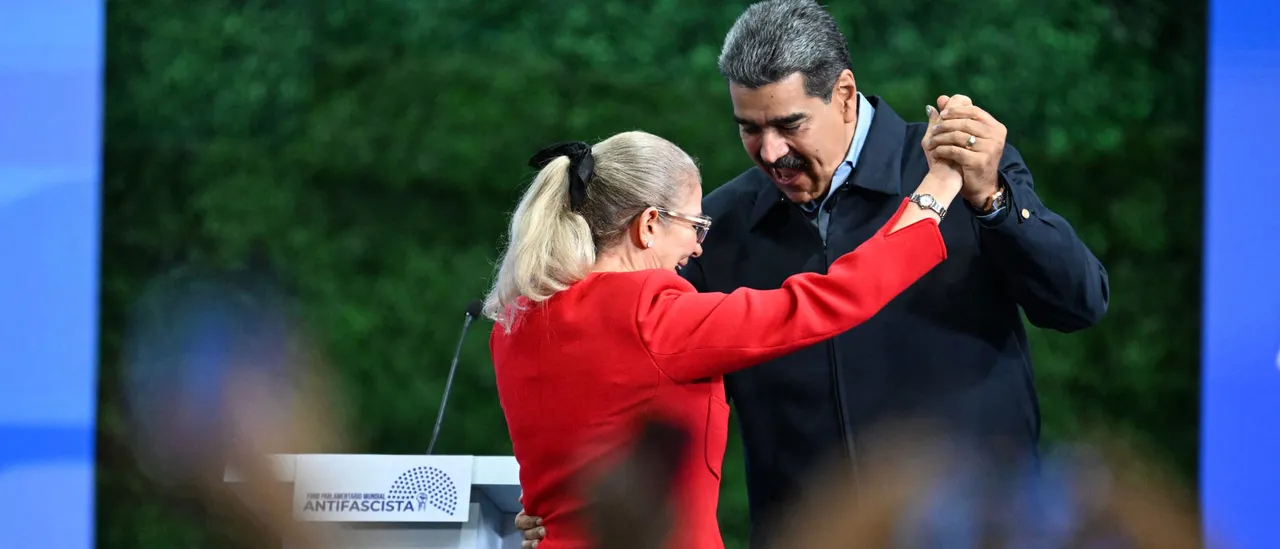
A federal indictment has been unsealed, charging deposed Venezuelan leader Nicolás Maduro, his wife Cilia Flores, and their son Nicolás Maduro Guerra with orchestrating a widespread drug-fueled culture of corruption. The indictment, released on Saturday, reveals that this corruption extends throughout Latin America, impacting regions as close as Central America and Mexico.
The indictment was confirmed by Attorney General Pam Bondi in the Southern District of New York shortly after former President Donald Trump announced Maduro’s capture. The charges include narco-terrorism conspiracy among four counts, marking a significant escalation in U.S. efforts to hold the Maduro regime accountable.
A grand jury found that Maduro and corrupt officials within his administration facilitated a network that allowed drug trafficking to thrive, thereby empowering notorious crime syndicates such as Tren de Aragua. The indictment accuses Maduro of perpetuating a culture in which powerful Venezuelan elites profit from drug trafficking while corrupting military and intelligence officials, who form the so-called Cartel de Los Soles, named for the sun insignia worn by senior military figures.
Details of the Indictment
The 25-page indictment identifies six defendants, including Maduro and his inner circle. This includes Diosdado Cabello Rondón and Ramón Rodríguez Chacín, high-ranking members of Maduro’s United Socialist Party, as well as Niño Guerrero, leader of Tren de Aragua. The document asserts that Maduro, like former President Hugo Chávez, actively participates in a system that enriches elite individuals through the drug trade while enabling widespread corruption.
According to the indictment, Venezuela’s strategic geographic location has made it a haven for drug traffickers since Chávez came to power in 1999. Estimates from the U.S. State Department indicate that between 200 and 250 tons of cocaine are trafficked annually out of Venezuela.
The indictment further alleges that Maduro and his associates collaborated with narco-terrorist groups to ship cocaine to the United States via transshipment points in Central America and the Caribbean, specifically mentioning countries like Honduras, Guatemala, and Mexico.
Corruption and Drug Trafficking Networks
The document details how Maduro’s regime enabled a culture of corruption, where narcotics traffickers in neighboring countries paid off politicians for protection. This created a system where political power was maintained through drug money, facilitating a cycle of corruption that spanned the region.
The indictment highlights that Maduro Guerra, who has served as a Deputy in the Venezuelan National Assembly since 2021, was directly involved in drug trafficking operations. He reportedly arranged shipments of cocaine intended for U.S. cities, including Miami and New York.
The U.S. government has taken additional steps against the Cartel de Los Soles, designating it as a Foreign Terrorist Organization (FTO) in November 2025. Secretary of State Marco Rubio described the cartel as being led by Maduro and other high-ranking members of his regime, emphasizing their roles in corrupting Venezuela’s military, intelligence, and judiciary bodies.
This indictment represents a significant moment in U.S.-Venezuelan relations, as authorities aim to dismantle the networks of corruption that have plagued the region. The legal proceedings against Maduro and his associates are poised to draw international attention, further complicating the already tense political landscape in Venezuela.