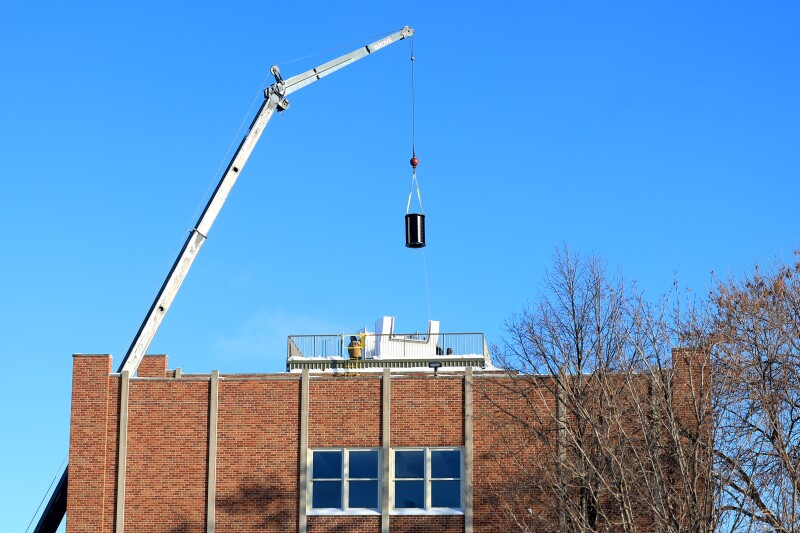
A new laser lab at the University of North Dakota (UND) aims to improve satellite communication capabilities for both local businesses and university students. The project, spearheaded by assistant professor of physics and astrophysics Markus Allgaier, recently saw the installation of key equipment on top of Witmer Hall. This enhancement is part of a broader research infrastructure initiative supported by local contractors and the university’s facilities team.
The Free-Space Optical Communication Lab occupies two levels of Witmer Hall. The rooftop will feature an observatory and telescope equipped with optics necessary for directing lasers at satellites and collecting data transmitted back to Earth. According to Allgaier, this aspect of the project represents a significant technical challenge, as it involves capturing laser light data from the satellites.
Originally scheduled for installation on December 9, 2023, inclement weather conditions delayed the observatory’s setup until December 10. Strong winds and snow flurries pushed the installation to 1 p.m., creating a mix of excitement and tension for Allgaier, who noted, “I’ve not had a project ever in my career where you’re planning for two and a half years and then it comes down to one day.”
In the basement of Witmer Hall, a standard laser lab is being developed, designed to connect with the observatory through optical fibers. This lab features temperature stability and laser tables to minimize experimental vibrations. The dual-purpose facility will not only facilitate laser communication using commercial standards but also support significant research initiatives in the field.
Local needs are also being addressed. The Space Development Agency plans to operate satellites partially from the Grand Forks Air Force Base, and contractors involved in daily satellite operations are actively recruiting talent from UND. Allgaier emphasized the potential for the lab to train local students for jobs that require specialized skills in satellite communication technologies.
The project received funding of $5 million from the state, which has been reinvested into the local economy through the hiring of contractors such as Sand Steel from Emerado and AE2S. Students have already begun utilizing the basement lab for experiments, with three PhD candidates, one Master’s student, and several undergraduates engaged in senior projects.
Allgaier is considering the introduction of upper-level elective courses in optics and laser technology, aiming to expand the lab’s accessibility to all students at UND. “Anyone at UND can use the facility,” he said, highlighting the collaborative potential of the new lab.
Allgaier’s commitment to this project began before he officially joined UND in January 2024, having signed his contract in March 2023. He spent the summer and fall prior to his move discussing technical possibilities with contractors to align with the project budget. Previously, he has built three optics labs, but this is the first where he could make a comprehensive “wish list” for equipment.
He described the challenge of developing laser communication technology as a “chicken and egg” problem. Currently, the new lab will be one of the first ground stations of its type, following the SDA’s initial ground station. Allgaier recalled a conversation with a NASA representative, who noted that the current lack of missions utilizing laser communication often hinders the development of ground stations. “You need to overcome by putting a little bit of faith in that, that this will be a technology that will be used,” he stated.
By the end of spring 2026, all hardware will be in place at the lab, though assembling the equipment will take additional time. The establishment of this facility not only marks a significant milestone for UND but also enhances the university’s role in advancing local and regional satellite communication capabilities.