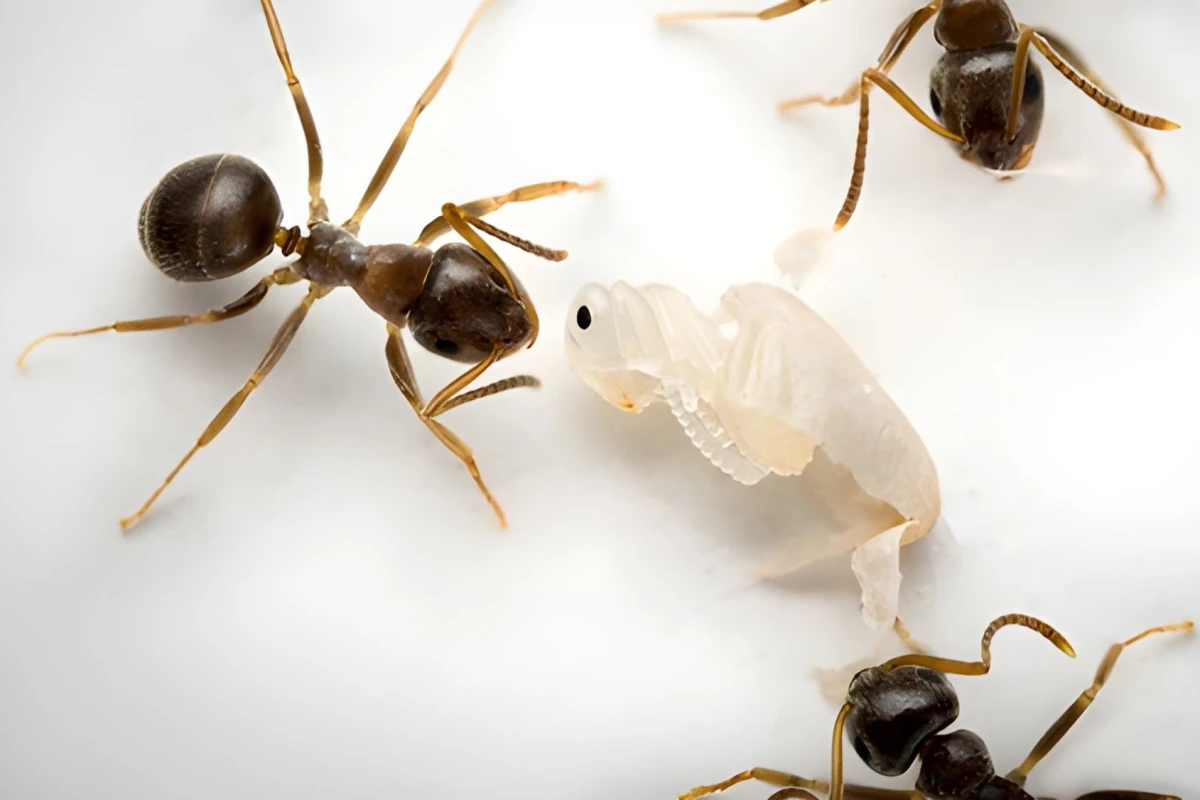
Ant pupae have developed a remarkable survival strategy that involves self-sacrifice to protect their colonies from disease. Researchers from the Institute of Science and Technology Austria (ISTA) discovered that infected pupae emit a unique scent detectable outside their cocoons. This scent prompts worker ants to dismantle the cocoon and use formic acid, an antimicrobial compound, to disinfect the pupae, which ultimately leads to its death.
The research, published on March 15, 2024, in the journal Nature Communications, highlights a fascinating aspect of ant behavior. When a pupae is afflicted with an incurable infection, it signals its condition to the colony. According to Erika Dawson, the first author of the study, this mechanism is a form of altruism that benefits the entire colony. “What appears to be self-sacrifice at first glance is, in fact, also beneficial to the signaler,” she explained. “It safeguards its nestmates, with whom it shares many genes.”
The study emphasizes the concept of an ant colony functioning as a superorganism. Worker ants behave like immune cells in a body, responding to chemical signals emitted by sick individuals. This biological phenomenon is akin to the “find-me-and-eat-me signal,” a term used in immunology to describe how diseased cells communicate their condition.
Research Findings and Implications
To validate their findings, researchers, including Thomas Schmitt from the University of Würzburg, conducted experiments transferring scent molecules from diseased pupae to healthy ones. The results confirmed that worker ants targeted and destroyed the pupae that carried the disease scent. Notably, only worker ant pupae emitted this signal; queen pupae did not, suggesting they possess stronger immune systems and can better withstand infections.
This discovery aligns with earlier research indicating that infected ants exhibit social distancing behaviors, even going so far as to construct separate nest entrances and tunnels. It has long been understood that ants nearing the end of their lives will remove themselves from the nest, a behavior known as “terminal altruism.” These findings underscore a complex social structure within ant colonies, where individual sacrifices can enhance overall colony health.
The implications of this research extend beyond ant behavior. It provides insights into the evolutionary strategies that social animals employ to combat disease threats. Understanding these mechanisms may inform broader discussions on disease management in social species, including humans.
In summary, the findings from ISTA reveal a sophisticated level of social cooperation among ants, showcasing how self-sacrifice can serve the greater good of the community. As research continues, the lessons learned from these tiny but remarkable creatures may offer valuable perspectives on health and survival in the natural world.