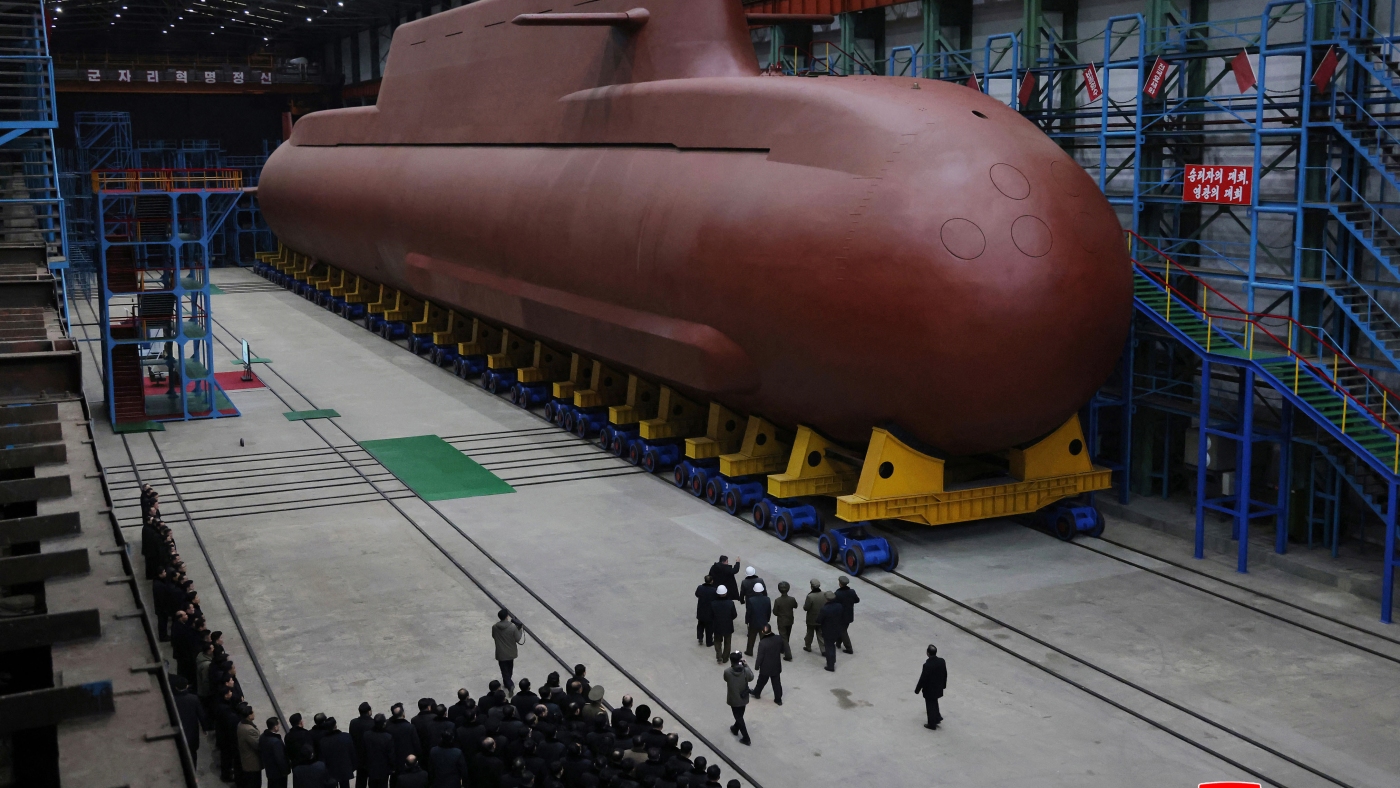
Tensions over nuclear capabilities are intensifying as both North and South Korea accelerate their nuclear submarine programs. This development coincides with shifts in the United States’ security strategy in the Asia-Pacific region. On October 5, 2023, North Korea’s state media unveiled an image of what it described as an “8,700-ton nuclear-powered strategic guided missile submarine.” This announcement marks the first time the country has disclosed details on the size and apparent completion of its submarine since committing to this pursuit in 2021.
North Korea’s leader, Kim Jong Un, stated that the new submarine would bolster national defense in light of “the negative security situation that has come as present reality.” He criticized South Korea’s plans to develop its own nuclear submarines, labeling them as “an offensive act … that must be countered.” This rhetoric underscores the growing military rivalry between the two nations.
In response, South Korea has rapidly advanced its submarine ambitions since receiving approval from then-President Donald Trump in October 2023. A new pan-government task force was launched last week in Seoul, led by national security adviser Wi Sung-lac, who confirmed that South Korea is negotiating a pact with the U.S. for the supply of military-grade nuclear fuel. The push for nuclear submarines is part of a broader strategy to counter North Korea’s expanding nuclear capabilities, which have recently extended to maritime threats.
Strategic Implications and Regional Concerns
The South Korean government has long sought nuclear submarines to enhance its defense against North Korea. Ahn Gyu-back, South Korea’s defense minister, emphasized in October 2023 that conventional, diesel-powered submarines cannot match the endurance and speed of nuclear vessels. In light of this, the United States anticipates that South Korean nuclear submarines will also play a role in addressing regional threats, including those posed by China.
During a visit to Seoul in November 2023, Admiral Daryl Caudle, chief of naval operations for the U.S. Navy, noted that it is a “natural expectation” for these submarines to contribute to shared security goals, particularly regarding what the U.S. identifies as its pacing threat, China. Acknowledging this, South Korean President Lee Jae Myung mentioned during a summit that the limited underwater range of conventional submarines hampers the ability to track vessels both from North Korea and China.
Despite these strategic considerations, South Korea remains cautious about military confrontation with China, given its status as the country’s largest trading partner. Following Lee’s comments, his office clarified that references to submarines in relation to China pertained to general operations near Korean waters rather than specific nations.
Public Sentiment and Future Strategies
Public sentiment in South Korea reflects a desire for a balanced approach to security. A recent survey revealed that a majority of South Koreans believe the country should remain neutral in the event of a serious conflict between the U.S. and China. This public opinion is mirrored in the government’s careful stance regarding its military developments.
Both South Korea and Japan, which has expressed interest in developing nuclear-powered submarines, share concerns about China’s increasing influence. According to political scientist Kim Heungkyu, the U.S. shift in defense focus towards home has fostered distrust among its allies regarding America’s security commitments in Asia. A poll conducted by the Asan Institute in March indicated that less than half of South Koreans believe the U.S. would respond with nuclear force if North Korea were to launch an attack.
In light of these dynamics, there is growing support in South Korea for nuclear armament, even at the risk of facing international sanctions or the withdrawal of U.S. troops. Kim argues that in a potential new international order without U.S. presence in the Western Pacific, South Korea must devise a survival strategy based on nuclear capabilities. Nuclear-powered submarines, he asserts, could serve as an “entry point toward a much bigger goal” of nuclear armament.
While the South Korean government has denied ambitions for nuclear weapons, it continues to pursue access to uranium enrichment and spent fuel reprocessing in discussions with the U.S. Observers, including Kim, suggest that the current U.S. administration is inadvertently steering South Korea and Japan towards a nuclear armament path, regardless of its explicit intentions.