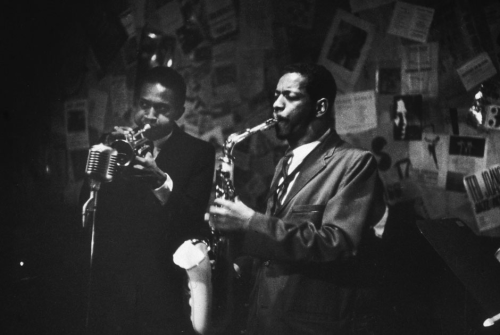
On November 17, 1959, the jazz world witnessed a transformative moment as Ornette Coleman and his quartet debuted at the Five Spot in New York City. This performance marked the beginning of a groundbreaking era in jazz, showcasing the innovative sounds of Coleman, a saxophonist from Fort Worth, Texas. Joined by Don Cherry on trumpet, Charlie Haden on bass, and Billy Higgins on drums, the quartet performed in support of their pioneering album, “The Shape of Jazz to Come,” released by Atlantic Records.
The Five Spot, located at Cooper Square near the Bowery, had already established itself as a hub for cutting-edge jazz, having previously hosted prominent artists such as Cecil Taylor. Coleman’s arrival, however, generated unprecedented excitement. Lines of eager fans, critics, and curious onlookers wrapped around the block, eager to experience what was being termed “free jazz.”
Coleman’s approach to music was informed by elements of bebop, rhythm and blues, and his own unique philosophy known as harmolodics. In the liner notes for his 1960 release “Change of the Century,” he described his vision, stating, “The members of my group and I are now attempting a break-through to a new, freer conception of jazz, one that departs from all that is ‘standard’ and cliché.”
The initial engagement at the Five Spot was scheduled for two weeks, but the immense response extended Coleman’s run well into 1960. The venue became a gathering place for influential figures in the arts, including notable personalities like James Baldwin and Robert Rauschenberg. This extraordinary period not only showcased Coleman’s revolutionary style but also solidified the Five Spot’s status as a critical venue for jazz innovation.
The impact of Coleman’s performances at the Five Spot reached far beyond New York City, marking a significant shift in the musical landscape. His work inspired countless musicians and reshaped the understanding of jazz both in Texas and around the world. The legacy of this pivotal moment continues to resonate today, reminding audiences of the power of creativity and the ongoing evolution of music.
Sources for this historical account include Maria Golia’s “Ornette Coleman: The Territory and the Adventure” and David Oliphant’s “Texan Jazz,” both of which provide valuable insights into the context and significance of Coleman’s contributions to jazz.